[]
Your ongoing selection
Asset(s) Assets
Your quote 0

Your selection

Clear selection
Item added to cart
View cart and checkout
{"event":"pageview","page_type1":"undetected","page_type2":"_assets_search_override","language":"en","user_logged":"false","user_type":"ecommerce","nl_subscriber":"false"}
{"event":"ecommerce_event","event_name":"view_item","event_category":"browse_catalog","ecommerce":{"items":[{"item_id":"PIX4630579","item_category":"photo","item_category2":"no_copyright","item_category3":"standard","item_category5":"not_balown","item_list_name":"search_results","item_name":"meteor_crater_arizona_usa_impact_crater_meteor_crater_arizona_usa","item_variant":"undefined"},{"item_id":"PIX4615020","item_category":"photo","item_category2":"no_copyright","item_category3":"standard","item_category4":"steven_hobbs","item_category5":"not_balown","item_list_name":"search_results","item_name":"mars_surface_seen_by_the_probe_mariner_6_mariner_6_closeup_view_of_martian_craters_martian_crateres_","item_variant":"undefined"},{"item_id":"PIX4615030","item_category":"photo","item_category2":"no_copyright","item_category3":"standard","item_category4":"steven_hobbs","item_category5":"not_balown","item_list_name":"search_results","item_name":"mars_surface_seen_by_the_probe_mariner_7_mariner_7_view_of_martian_craters_martian_crateres_near_the","item_variant":"undefined"},{"item_id":"PIX4630560","item_category":"photo","item_category2":"no_copyright","item_category3":"standard","item_category5":"not_balown","item_list_name":"search_results","item_name":"meteor_crater_arizona_usa_impact_crater_meteor_crater_arizona_usa","item_variant":"undefined"},{"item_id":"PIX4614511","item_category":"photo","item_category2":"no_copyright","item_category3":"standard","item_category4":"sebastian_voltmer","item_category5":"not_balown","item_list_name":"search_results","item_name":"towards_the_southern_pole_of_the_moon_moon_southwest_part_mosaic_showing_the_southwest_part_of_the_v","item_variant":"undefined"},{"item_id":"ELS9138644","item_category":"object","item_category2":"out_of_copyright","item_category3":"standard","item_category4":"euphronios_fl_c_520_500_bc","item_category5":"not_balown","item_list_name":"search_results","item_name":"red_figured_attic_crater_called_crater_of_antaios","item_variant":"undefined"},{"item_id":"PIX4596426","item_category":"photo","item_category2":"no_copyright","item_category3":"standard","item_category4":"steven_hobbs","item_category5":"not_balown","item_list_name":"search_results","item_name":"apollo_missions_artist_view_apollo_program_artist_view_lem_separates_from_the_control_module_to_land","item_variant":"undefined"},{"item_id":"PIX4576935","item_category":"photo","item_category2":"no_copyright","item_category3":"standard","item_category5":"not_balown","item_list_name":"search_results","item_name":"moon_aristarchus_crater_moon_aristarchus_crater_apollo_15_the_aristarchus_crater_and_the_schroeter_v","item_variant":"undefined"},{"item_id":"UIG866325","item_category2":"no_copyright","item_category3":"standard","item_category5":"not_balown","item_list_name":"search_results","item_name":"small_crater_within_aitken_crater","item_variant":"undefined"},{"item_id":"PIX4617015","item_category":"photo","item_category2":"no_copyright","item_category3":"standard","item_category4":"steven_hobbs","item_category5":"not_balown","item_list_name":"search_results","item_name":"march_craters_in_hellas_basin_illustration_mars_craters_near_hellas_illustration_morning_mist_invade","item_variant":"undefined"},{"item_id":"PIX4616373","item_category":"photo","item_category2":"no_copyright","item_category3":"standard","item_category5":"not_balown","item_list_name":"search_results","item_name":"crater_bacolor_on_mars_bacolor_crater_on_planet_mars_view_of_the_impact_crater_bacolor_obtained_by_t","item_variant":"undefined"},{"item_id":"PIX4616151","item_category":"photo","item_category2":"no_copyright","item_category3":"standard","item_category5":"not_balown","item_list_name":"search_results","item_name":"mars_craters_and_channels_in_hephaestus_fossae_mars_craters_and_channels_in_hephaestus_fossae_impact","item_variant":"undefined"},{"item_id":"PIX4574821","item_category":"photo","item_category2":"no_copyright","item_category3":"standard","item_category5":"not_balown","item_list_name":"search_results","item_name":"europe_jupiter_satellite_view_of_the_surface_of_the_europe_satellite_obtained_from_images_made_by_th","item_variant":"undefined"},{"item_id":"PIX4616156","item_category":"photo","item_category2":"no_copyright","item_category3":"standard","item_category5":"not_balown","item_list_name":"search_results","item_name":"mars_craters_and_channels_in_hephaestus_fossae_mars_craters_and_channels_in_hephaestus_fossae_impact","item_variant":"undefined"},{"item_id":"PIX4616171","item_category":"photo","item_category2":"no_copyright","item_category3":"standard","item_category5":"not_balown","item_list_name":"search_results","item_name":"march_chaotic_terrain_between_kasei_valles_and_sacra_fossae_mars_chaotic_terrain_between_kasei_valle","item_variant":"undefined"},{"item_id":"PIX4616176","item_category":"photo","item_category2":"no_copyright","item_category3":"standard","item_category5":"not_balown","item_list_name":"search_results","item_name":"march_chaotic_terrain_between_kasei_valles_and_sacra_fossae_mars_chaotic_terrain_between_kasei_valle","item_variant":"undefined"},{"item_id":"PIX4616168","item_category":"photo","item_category2":"no_copyright","item_category3":"standard","item_category5":"not_balown","item_list_name":"search_results","item_name":"mars_craters_and_channels_in_hephaestus_fossae_mars_craters_and_channels_in_hephaestus_fossae_impact","item_variant":"undefined"},{"item_id":"XLF3792860","item_category2":"undetermined_copyright","item_category3":"standard","item_category5":"balown","item_list_name":"search_results","item_name":"haleakala_crater_hawaii","item_variant":"undefined"},{"item_id":"PIX4615022","item_category":"photo","item_category2":"no_copyright","item_category3":"standard","item_category4":"steven_hobbs","item_category5":"not_balown","item_list_name":"search_results","item_name":"mars_polar_cap_seen_by_the_mariner_7_probe_the_martian_polar_cap_as_seen_by_the_mariner_7_spacecraft","item_variant":"undefined"},{"item_id":"PIX4625625","item_category":"photo","item_category2":"no_copyright","item_category3":"standard","item_category5":"not_balown","item_list_name":"search_results","item_name":"tethys_saturn_satellite_seen_by_the_cassini_probe_saturn_s_moon_tethys_seen_by_cassini_spacecraft_th","item_variant":"undefined"},{"item_id":"PIX4616817","item_category":"photo","item_category2":"no_copyright","item_category3":"standard","item_category4":"steven_hobbs","item_category5":"not_balown","item_list_name":"search_results","item_name":"mars_artist_s_view_mars_artwork_a_view_from_north_of_mars_equato","item_variant":"undefined"},{"item_id":"PIX4616154","item_category":"photo","item_category2":"no_copyright","item_category3":"standard","item_category5":"not_balown","item_list_name":"search_results","item_name":"march_chaotic_terrain_between_kasei_valles_and_sacra_fossae_mars_chaotic_terrain_between_kasei_valle","item_variant":"undefined"},{"item_id":"PIX4576885","item_category":"photo","item_category2":"no_copyright","item_category3":"standard","item_category5":"not_balown","item_list_name":"search_results","item_name":"moon_aristarchus_crater_moon_aristarchus_crater_apollo_15_the_aristarchus_crater_and_the_schroeter_v","item_variant":"undefined"},{"item_id":"PIX4576932","item_category":"photo","item_category2":"no_copyright","item_category3":"standard","item_category5":"not_balown","item_list_name":"search_results","item_name":"moon_tsiolkovsky_crater_on_the_hidden_face_moon_crater_tsiolkovsky_on_lunar_farside_image_obtained_d","item_variant":"undefined"},{"item_id":"PIX4625616","item_category":"photo","item_category2":"no_copyright","item_category3":"standard","item_category5":"not_balown","item_list_name":"search_results","item_name":"tethys_saturn_satellite_seen_by_the_cassini_probe_saturn_s_moon_tethys_seen_by_cassini_spacecraft_th","item_variant":"undefined"},{"item_id":"PIX4576824","item_category":"photo","item_category2":"no_copyright","item_category3":"standard","item_category5":"not_balown","item_list_name":"search_results","item_name":"moon_cratere_eratosthene_moon_eratosthenes_crater_cratere_eratosthene_seen_from_the_control_module_o","item_variant":"undefined"},{"item_id":"PIX4630542","item_category":"photo","item_category2":"no_copyright","item_category3":"standard","item_category5":"not_balown","item_list_name":"search_results","item_name":"meteor_crater_arizona_usa_impact_crater_meteor_crater_arizona_usa","item_variant":"undefined"},{"item_id":"PIX4576886","item_category":"photo","item_category2":"no_copyright","item_category3":"standard","item_category5":"not_balown","item_list_name":"search_results","item_name":"moon_aristarchus_crater_moon_aristarchus_crater_apollo_15_the_aristarchus_crater_on_the_left_the_her","item_variant":"undefined"},{"item_id":"PIX4576807","item_category":"photo","item_category2":"no_copyright","item_category3":"standard","item_category5":"not_balown","item_list_name":"search_results","item_name":"moon_theophile_crater_moon_theophilus_crater_view_of_the_large_impact_crater_theophile_with_the_madl","item_variant":"undefined"},{"item_id":"UIG866266","item_category":"photo","item_category2":"no_copyright","item_category3":"standard","item_category5":"not_balown","item_list_name":"search_results","item_name":"a_crater_on_the_southwest_rim_of_metius_b_crater","item_variant":"undefined"},{"item_id":"PIX4577170","item_category":"photo","item_category2":"no_copyright","item_category3":"standard","item_category5":"not_balown","item_list_name":"search_results","item_name":"cratere_erlanger_sur_la_lune_erlanger_crater_near_moon_north_pole_erlanger_cratere_is_located_90_km_","item_variant":"undefined"},{"item_id":"PIX4616155","item_category":"photo","item_category2":"no_copyright","item_category3":"standard","item_category5":"not_balown","item_list_name":"search_results","item_name":"mars_crateres_and_canals_in_hephaestus_fossae_impact_crateres_and_channel_system_in_hephaestus_fossa","item_variant":"undefined"},{"item_id":"PIX4584135","item_category":"photo","item_category2":"no_copyright","item_category3":"standard","item_category4":"walter_b_myers","item_category5":"not_balown","item_list_name":"search_results","item_name":"surface_of_ceres_ceres_surface_surface_of_the_dwarf_planet_ceres_artist_s_view_what_is_known_about_c","item_variant":"undefined"},{"item_id":"PIX4576950","item_category":"photo","item_category2":"no_copyright","item_category3":"standard","item_category5":"not_balown","item_list_name":"search_results","item_name":"moon_king_crater_moon_king_crater_the_king_impact_crater_on_the_hidden_face_of_the_moon_this_crater_","item_variant":"undefined"},{"item_id":"PIX4576771","item_category":"photo","item_category2":"no_copyright","item_category3":"standard","item_category5":"not_balown","item_list_name":"search_results","item_name":"apollo_8_lunar_craters_moon_craters_seen_from_apollo_8_view_of_goclenius_crateres_foreground_colombo","item_variant":"undefined"},{"item_id":"PIX4577258","item_category":"photo","item_category2":"no_copyright","item_category3":"standard","item_category5":"not_balown","item_list_name":"search_results","item_name":"sunrise_on_the_crater_tycho_tycho_crater_sunrise_sunrise_on_the_central_peak_of_the_crater_tycho_on_","item_variant":"undefined"},{"item_id":"PIX4576872","item_category":"photo","item_category2":"no_copyright","item_category3":"standard","item_category5":"not_balown","item_list_name":"search_results","item_name":"moon_moscow_sea_and_crateres_moon_mare_moscoviense_and_craters_part_of_the_hidden_face_of_the_moon_w","item_variant":"undefined"},{"item_id":"PIX4576879","item_category":"photo","item_category2":"no_copyright","item_category3":"standard","item_category5":"not_balown","item_list_name":"search_results","item_name":"moon_copernicus_crater_moon_copernicus_crater_copernic_crateres_in_the_centre_near_the_limbo_and_rei","item_variant":"undefined"},{"item_id":"PIX4625574","item_category":"photo","item_category2":"no_copyright","item_category3":"standard","item_category5":"not_balown","item_list_name":"search_results","item_name":"tethys_saturn_satellite_seen_by_the_cassini_probe_saturn_s_moon_tethys_seen_by_cassini_spacecraft_th","item_variant":"undefined"},{"item_id":"PIX4625563","item_category":"photo","item_category2":"no_copyright","item_category3":"standard","item_category5":"not_balown","item_list_name":"search_results","item_name":"mimas_satellite_of_saturn_seen_by_the_cassini_probe_on_13_02_2010_saturn_s_moon_mimas_seen_by_cassin","item_variant":"undefined"},{"item_id":"PIX4625578","item_category":"photo","item_category2":"no_copyright","item_category3":"standard","item_category5":"not_balown","item_list_name":"search_results","item_name":"mimas_satellite_of_saturn_seen_by_the_cassini_probe_on_13_02_2010_saturn_s_moon_mimas_seen_by_cassin","item_variant":"undefined"},{"item_id":"PIX5973683","item_category":"photo","item_category2":"no_copyright","item_category3":"standard","item_category5":"not_balown","item_list_name":"search_results","item_name":"tenoumer_impact_crater_mauritania_photo","item_variant":"undefined"},{"item_id":"PIX4576479","item_category":"photo","item_category2":"no_copyright","item_category3":"standard","item_category4":"p_lazzarotti","item_category5":"not_balown","item_list_name":"search_results","item_name":"moon_copernicus_crater_and_sea_of_the_islands_moon_copernicus_crater_and_mare_insularum_the_copernic","item_variant":"undefined"},{"item_id":"PIX4577000","item_category":"photo","item_category2":"no_copyright","item_category3":"standard","item_category5":"not_balown","item_list_name":"search_results","item_name":"cratere_copernic_copernicus_crater_crateres_copernic_and_gay_lussac_in_the_foreground_image_obtained","item_variant":"undefined"},{"item_id":"PIX4614521","item_category":"photo","item_category2":"no_copyright","item_category3":"standard","item_category4":"sebastian_voltmer","item_category5":"not_balown","item_list_name":"search_results","item_name":"moon_cratere_clavius_moon_clavius_crater_image_obtained_on_august_24_2016_a_day_before_the_last_quar","item_variant":"undefined"},{"item_id":"PIX4630651","item_category":"photo","item_category2":"no_copyright","item_category3":"standard","item_category5":"not_balown","item_list_name":"search_results","item_name":"impact_crater_oasis_libya_oasis_impact_crater_libya_the_oasis_crater_in_libya_is_said_to_have_been_f","item_variant":"undefined"},{"item_id":"PIX4615396","item_category":"photo","item_category2":"no_copyright","item_category3":"standard","item_category5":"not_balown","item_list_name":"search_results","item_name":"mars_gale_crater_region_gale_crater_area_on_planet_mars_view_of_the_region_of_the_impact_crater_gale","item_variant":"undefined"},{"item_id":"PIX4625545","item_category":"photo","item_category2":"no_copyright","item_category3":"standard","item_category5":"not_balown","item_list_name":"search_results","item_name":"mimas_satellite_of_saturn_seen_by_the_cassini_probe_on_13_02_2010_saturn_s_moon_mimas_seen_by_cassin","item_variant":"undefined"},{"item_id":"PIX4576831","item_category":"photo","item_category2":"no_copyright","item_category3":"standard","item_category5":"not_balown","item_list_name":"search_results","item_name":"moon_copernicus_crater_moon_copernicus_crater_copernic_crateres_in_the_centre_near_the_limbo_and_rei","item_variant":"undefined"},{"item_id":"PIX4616192","item_category":"photo","item_category2":"no_copyright","item_category3":"standard","item_category5":"not_balown","item_list_name":"search_results","item_name":"mars_volcanoes_ceraunius_tholus_and_uranius_tholus_mosaic_of_images_obtained_by_the_mars_express_pro","item_variant":"undefined"},{"item_id":"AMO100557","item_category":"object","item_category2":"out_of_copyright","item_category3":"standard","item_category4":"komaris_painter_fl_c_450_420_bc","item_category5":"not_balown","item_list_name":"search_results","item_name":"attic_red_figure_bell_crater_detail_showing_a_potter_painting_a_bell_crater_c_430_425_bc_ceramic_det","item_variant":"undefined"},{"item_id":"PIX4625583","item_category":"photo","item_category2":"no_copyright","item_category3":"standard","item_category5":"not_balown","item_list_name":"search_results","item_name":"tethys_saturn_satellite_seen_by_the_cassini_probe_saturn_s_moon_tethys_seen_by_cassini_spacecraft_th","item_variant":"undefined"},{"item_id":"PIX4576947","item_category":"photo","item_category2":"no_copyright","item_category3":"standard","item_category5":"not_balown","item_list_name":"search_results","item_name":"moon_king_crater_moon_king_crater_the_king_impact_crater_on_the_hidden_face_of_the_moon_this_crater_","item_variant":"undefined"},{"item_id":"PIX4576952","item_category":"photo","item_category2":"no_copyright","item_category3":"standard","item_category5":"not_balown","item_list_name":"search_results","item_name":"moon_bullialdus_crater_moon_bullialdus_crater_apollo_16_the_moon_with_the_bullialdus_crater_high_cen","item_variant":"undefined"},{"item_id":"PIX4625548","item_category":"photo","item_category2":"no_copyright","item_category3":"standard","item_category5":"not_balown","item_list_name":"search_results","item_name":"mimas_satellite_of_saturn_seen_by_the_cassini_probe_on_13_02_2010_saturn_s_moon_mimas_seen_by_cassin","item_variant":"undefined"},{"item_id":"PIX4676701","item_category":"photo","item_category2":"no_copyright","item_category3":"standard","item_category4":"martin_rietze","item_category5":"not_balown","item_list_name":"search_results","item_name":"volcano_stromboli_stromboli_crater_terrace_eruption_mouths_in_the_terrace_of_the_crater_stromboli_cr","item_variant":"undefined"},{"item_id":"PIX4576738","item_category":"photo","item_category2":"no_copyright","item_category3":"standard","item_category4":"p_lazzarotti","item_category5":"not_balown","item_list_name":"search_results","item_name":"moon_mare_orientale_and_grimaldi_moon_mare_orientale_and_grimaldi_taking_advantage_of_a_very_strong_","item_variant":"undefined"},{"item_id":"PIX4583518","item_category":"photo","item_category2":"no_copyright","item_category3":"standard","item_category5":"not_balown","item_list_name":"search_results","item_name":"asteroide_vesta_and_other_asteroides_asteroid_vesta_compared_to_other_asteroids_comparison_of_the_si","item_variant":"undefined"},{"item_id":"PIX4576417","item_category":"photo","item_category2":"no_copyright","item_category3":"standard","item_category4":"p_lazzarotti","item_category5":"not_balown","item_list_name":"search_results","item_name":"moon_crateres_near_the_south_pole_lunar_south_pole_area_in_the_middle_of_the_picture_the_crater_more","item_variant":"undefined"},{"item_id":"PIX4615572","item_category":"photo","item_category2":"no_copyright","item_category3":"standard","item_category5":"not_balown","item_list_name":"search_results","item_name":"detail_of_the_panorama_obtained_by_spirit_on_12_and_13_march_2004_bonneville_is_an_impact_crater_of_","item_variant":"undefined"},{"item_id":"DTA3026612","item_category":"illustration","item_category2":"in_copyright","item_category3":"premium","item_category4":"troiani_don_b_1949","item_category5":"not_balown","item_list_name":"search_results","item_name":"mahone_s_counterattack_battle_of_the_crater_2003_oil_on_canvas","item_variant":"undefined"},{"item_id":"JLJ4668094","item_category":"object","item_category2":"out_of_copyright","item_category3":"standard","item_category4":"greek_school_6th_century_bc","item_category5":"not_balown","item_list_name":"search_results","item_name":"crater_with_red_figures_called_euphronios_crater_representing_hercules_515_510_bc_ceramic","item_variant":"undefined"},{"item_id":"PIX4577052","item_category":"photo","item_category2":"no_copyright","item_category3":"standard","item_category5":"not_balown","item_list_name":"search_results","item_name":"surface_of_the_moon_mission_apollo_17_moon_surface_apollo_17_cratere_shorty_in_the_region_of_taurus_","item_variant":"undefined"},{"item_id":"PIX5973684","item_category":"photo","item_category2":"no_copyright","item_category3":"standard","item_category5":"not_balown","item_list_name":"search_results","item_name":"impact_crater_vredefort_south_africa_photo","item_variant":"undefined"},{"item_id":"PIX4626337","item_category":"photo","item_category2":"no_copyright","item_category3":"standard","item_category4":"miller_ron_b_1947","item_category5":"not_balown","item_list_name":"search_results","item_name":"saturn_seen_from_his_satellite_mimas_illustration_saturn_as_seen_from_mimas_illustration_artist_s_vi","item_variant":"undefined"},{"item_id":"UIG866337","item_category2":"no_copyright","item_category3":"standard","item_category5":"not_balown","item_list_name":"search_results","item_name":"a_bright_crater_on_the_flank_of_a_larger_dark_halo_crater","item_variant":"undefined"},{"item_id":"PIX4615799","item_category":"photo","item_category2":"no_copyright","item_category3":"standard","item_category5":"not_balown","item_list_name":"search_results","item_name":"march_opportunity_cratere_endurance_05_2004_martian_crater_endurance_seen_by_opportunity_05_2004_pan","item_variant":"undefined"},{"item_id":"PIX4576262","item_category":"photo","item_category2":"no_copyright","item_category3":"standard","item_category5":"not_balown","item_list_name":"search_results","item_name":"moon_crateres_around_stoefler_and_maurolycus_moon_area_around_stoefler_and_maurolycus_region_around_","item_variant":"undefined"},{"item_id":"PIX4625507","item_category":"photo","item_category2":"no_copyright","item_category3":"standard","item_category5":"not_balown","item_list_name":"search_results","item_name":"dione_satellite_of_saturn_seen_by_cassini_dione_moon_of_saturn_as_seen_by_cassini_mosaic_of_images_o","item_variant":"undefined"},{"item_id":"ELS9138640","item_category":"object","item_category2":"out_of_copyright","item_category3":"standard","item_category4":"euphronios_fl_c_520_500_bc","item_category5":"not_balown","item_list_name":"search_results","item_name":"red_figured_attic_crater_called_crater_of_antaios","item_variant":"undefined"},{"item_id":"PIX4630665","item_category":"photo","item_category2":"no_copyright","item_category3":"standard","item_category5":"not_balown","item_list_name":"search_results","item_name":"impact_crater_roter_kamm_namibia_roter_kamm_impact_crater_namibia_the_impact_crater_of_roter_kamm_wo","item_variant":"undefined"},{"item_id":"ELS9138642","item_category":"object","item_category2":"out_of_copyright","item_category3":"standard","item_category4":"euphronios_fl_c_520_500_bc","item_category5":"not_balown","item_list_name":"search_results","item_name":"red_figured_attic_crater_called_crater_of_antaios","item_variant":"undefined"},{"item_id":"PIX4576893","item_category":"photo","item_category2":"no_copyright","item_category3":"standard","item_category5":"not_balown","item_list_name":"search_results","item_name":"moon_crateres_in_the_sea_of_rains_moon_craters_in_mare_imbrium_crateres_in_the_south_of_the_sea_of_r","item_variant":"undefined"},{"item_id":"PIX4630677","item_category":"photo","item_category2":"no_copyright","item_category3":"standard","item_category5":"not_balown","item_list_name":"search_results","item_name":"vredefort_impact_crater_south_africa_vredefort_impact_crater_south_africa_vredefort_impact_crater_in","item_variant":"undefined"},{"item_id":"HST3313436","item_category":"photo","item_category2":"out_of_copyright","item_category3":"standard","item_category4":"nasmyth_james_1808_90","item_category5":"not_balown","item_list_name":"search_results","item_name":"crater_of_vesuvius_1864_woodburytype","item_variant":"undefined"},{"item_id":"PIX4576961","item_category":"photo","item_category2":"no_copyright","item_category3":"standard","item_category5":"not_balown","item_list_name":"search_results","item_name":"moon_grooves_and_mountain_april_1972_photo","item_variant":"undefined"},{"item_id":"UIG532441","item_category2":"no_copyright","item_category3":"standard","item_category5":"not_balown","item_list_name":"search_results","item_name":"crater_on_mars","item_variant":"undefined"},{"item_id":"UIG531344","item_category":"illustration","item_category2":"no_copyright","item_category3":"standard","item_category5":"not_balown","item_list_name":"search_results","item_name":"manicouagan_crater","item_variant":"undefined"},{"item_id":"LZT1019262","item_category":"illustration","item_category2":"no_copyright","item_category3":"standard","item_category5":"not_balown","item_list_name":"search_results","item_name":"crater_vesuvius","item_variant":"undefined"},{"item_id":"DPA2159429","item_category":"photo","item_category2":"no_copyright","item_category3":"standard","item_category4":"claire_renaudet_foussat","item_category5":"not_balown","item_list_name":"search_results","item_name":"barringer_crater","item_variant":"undefined"},{"item_id":"PIX4625591","item_category":"photo","item_category2":"no_copyright","item_category3":"standard","item_category5":"not_balown","item_list_name":"search_results","item_name":"rhea_satellite_of_saturn_seen_by_cassini_saturn_s_moon_rhea_seen_by_cassini_mosaic_of_images_obtaine","item_variant":"undefined"},{"item_id":"UIG533671","item_category2":"no_copyright","item_category3":"standard","item_category5":"not_balown","item_list_name":"search_results","item_name":"manicouagan_crater","item_variant":"undefined"},{"item_id":"EPL6869046","item_category":"photo","item_category2":"in_copyright","item_category3":"standard","item_category4":"emberton_gill_fl_1960s","item_category5":"not_balown","item_list_name":"search_results","item_name":"vesuvius_crater","item_variant":"undefined"},{"item_id":"PIX4617102","item_category":"photo","item_category2":"no_copyright","item_category3":"standard","item_category4":"miller_ron_b_1947","item_category5":"not_balown","item_list_name":"search_results","item_name":"appearance_of_life_on_mars_artist_s_view_mars_thermal_crater_artwork_four_billion_years_ago_the_impa","item_variant":"undefined"},{"item_id":"PIX4597740","item_category":"photo","item_category2":"no_copyright","item_category3":"standard","item_category5":"not_balown","item_list_name":"search_results","item_name":"apollo_16_the_lem_approaching_the_control_module_apollo_16_lm_ascent_stage_approaching_csm_the_lem_o","item_variant":"undefined"},{"item_id":"PIX4576697","item_category":"photo","item_category2":"no_copyright","item_category3":"standard","item_category5":"not_balown","item_list_name":"search_results","item_name":"moon_apennine_mountains_moon_apenninus_mountains_the_apennine_mountains_are_a_chain_of_mountains_bet","item_variant":"undefined"},{"item_id":"STC129812","item_category":"illustration","item_category2":"out_of_copyright","item_category3":"standard","item_category4":"jamieson_alexander_fl_1820","item_category5":"not_balown","item_list_name":"search_results","item_name":"virgo_from_a_celestial_atlas_pub_in_1822_coloured_engraving","item_variant":"undefined"},{"item_id":"PIX4616548","item_category":"photo","item_category2":"no_copyright","item_category3":"standard","item_category5":"not_balown","item_list_name":"search_results","item_name":"traces_of_flow_on_mars_mars_gullies_on_impact_crater_wall_gullies_along_a_wall_of_an_impact_crater_h","item_variant":"undefined"},{"item_id":"EPL6937042","item_category":"illustration","item_category2":"out_of_copyright","item_category3":"standard","item_category5":"not_balown","item_list_name":"search_results","item_name":"battle_of_the_crater","item_variant":"undefined"},{"item_id":"PIX4583458","item_category":"photo","item_category2":"no_copyright","item_category3":"standard","item_category5":"not_balown","item_list_name":"search_results","item_name":"asteroide_ida_seen_by_galileo_probe_asteroid_ida_seen_by_galileo_spacecraft_mosaic_of_five_images_ob","item_variant":"undefined"}]}}
{"event":"custom_event","event_name":"view_search_result","event_category":"browse_catalog","keyword":"crater","search_type":"standard","search_bridgeman_artists":"false","search_mode":"automatic","search_zero_result":"false","search_results":3093,"search_results_page_number":1}

'Crater' images and/or videos results page 1 of 35

Main filters
Buy Print option
Royalty-Free Option
Ecommerce option
Reuters Results
Media Type
Orientation
Colour
Rights Type
Rights
More filters
Bridgeman Artists
Bridgeman Photographers
Century
Footage filters
Video Original Format
Video Resolution
Video Category
Filter group
Filter colors
Order By:
per page
Filter group
Rights Type
Media Type
No copyright
Filter colors

Display options

View
Image Size
Meteor Crater - Arizona - USA - Impact Crater Meteor Crater, Arizona, USA
Moon: Aristarchus crater - Moon: Aristarchus crater - Apollo 15 - The Aristarchus crater and the Schroeter valley. Image obtained from the Apollo 15 control module. An oblique view of Schroeter's Valley and the crater Aristarchus, as photographed by the Fairchild metric camera in the Scientific Instrumentation Module (SIM) bay of the Apollo 15 Command and Service Module (CSM) in lunar orbit. This view is looking south. The large, bright - appearing crater to the left of the head of meandering Schroeter's Valley is Aristarchus, the center of which is located at 48 degrees west longitude and 214 degrees north latitude. The crater Aristarchus approximately 35 kilometers (about 21.75 statute miles) in diameter. The head of Schroeter's Valley, a sinuous rille in the Aristarchus Plateau in the Ocean of Storms, is called Cobra Head. Herodotus the crater just above and to the right of Cobra Head in upper center. The three - inch mapping camera was one of eight lunar orbital science experiments mounted in the SIM bay
Small crater within Aitken crater.
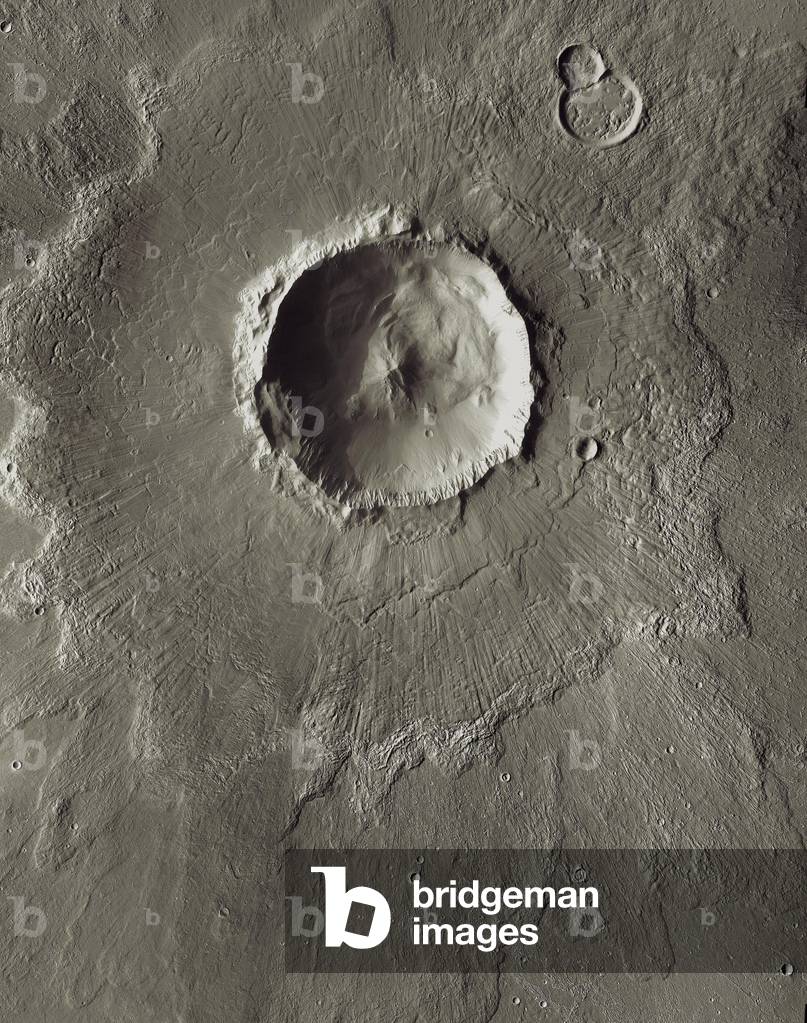
Crater Bacolor on Mars - Bacolor Crater on planet Mars - View of the impact crater Bacolor obtained by the Mars Odyssey probe. It's an impact crater about 20 km in diameter. Bacolor Crater is a magnificent impact feature about 20 kilometers (12 miles) wide. The lines on the ejecta blanket surrounding the crater rim come from a surge of superheated gas and debris flying outward in the wake of the meteorite impact that made the crater. This view combines images taken during the period from September 2002 to October 2005 by the Thermal Emission Imaging System instrument on Nasa's Mars Odyssey orbiter. The pictured location on Mars is 33 degrees north latitude, 118.6 degrees east longitude
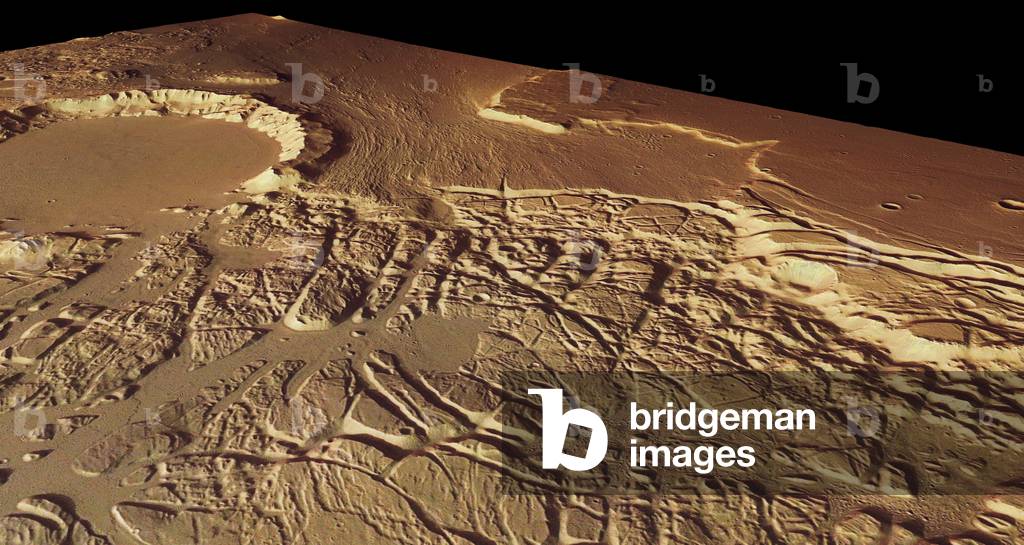
Mars: craters and channels in Hephaestus Fossae - Mars: craters and channels in Hephaestus Fossae - Impact crateres and channel system in Hephaestus Fossae, a region on Mars located on the western flank of Elysium Mons. The large impact crater at the top of the picture is 20 km in diameter. The image covering an area of about 150 square km was obtained by the Mars Express probe on 28 December 2007. This image of Hephaestus Fossae was obtained by Esa's Mars Express orbiter on 28 December 2007. The region is dotted with craters and channel systems and lies at about 21* North and 126* East on the Red Planet. Named after the Greek god of fire, Hephaestus Fossae extends for more than 600 km on the western flank of Elysium Mons in the Utopia Planitia region. The surface is mostly smooth, and is covered by several small impact craters measuring 800 to 2800 m in diameter. Smaller craters are scattered across the entire region. A larger impact crater measuring 20 km in diameter is a prominent feature. Covering an area of approximately 150 sq km, this crater could harbour cities such as Bonn or Kiel. In contrast to the smaller craters, it shows a blanket of ejecta with flow forms surrounding the rim. The large craters were formed when loose, soft material was ejected due to impact, and the smaller ones formed due to secondary impacts, when consolidated material was ejected in a ballistic path and impacted the original crater at varying distances. Most martian water exists in the form of subsurface ice. The presence of a blanket of ejecta and outflow channels around the crater suggest that the primary impact may have penetrated the surface enough to melt a buried frozen water reservoir
Europe - Jupiter Satellite - View of the surface of the Europe satellite obtained from images made by the Galileo probe in 1995 and 1998. Jupiter's icy moon Europa looms large in this newly - reprocessed color view, made from images taken by Nasa's Galileo spacecraft in the late 1990s. This is the color view of Europa from Galileo that shows the largest portion of the moon's surface at the highest resolution. To create this new version, the images were assembled into a realistic color view of the surface that approximates how Europa would appear to the human eye. The scene shows the stunning diversity of Europa's surface geology. Long, linear cracks and ridges crisscross the surface, interrupted by regions of disrupted terrain where the surface ice crust has been broken up and re - frozen into new patterns. Color variations across the surface are associated with differences in geologic feature type and location. For example, areas that appear blue or white contain relatively pure water ice, while reddish and brownish areas include non - ice components in higher concentrations. The polar regions, visible at the left and right of this view, are noticeably bluer than the more equatorial latitudes, which look more white. This color variation is thought to be due to differences in ice grain size in the two locations. Images taken through near - infrared, green and violet filters have been combined to produce this view. The images have been corrected for light scattered outside of the image, to provide a color correction that is calibrated by wavelength. Gaps in the images have been filled with simulated color based on the color of nearby surface areas with similar terrain types. This global color view consists of images acquired by the Galileo Solid - State Imaging (SSI) experiment on the spacecraft's first and fourteenth orbits through the Jupiter system, in 1995 and 1998, respectively. Image scale is 2 miles (1.6 kilometers) per pixel. North on Europa is at righ
Mars: craters and channels in Hephaestus Fossae - Mars: craters and channels in Hephaestus Fossae - Impact crateres and channel system in Hephaestus Fossae, a region on Mars located on the western flank of Elysium Mons. The large impact crater on the left of the image measures 20 km in diameter. The image covering an area of about 150 square km was obtained by the Mars Express probe on 28 December 2007. This image of Hephaestus Fossae was obtained by Esa's Mars Express orbiter on 28 December 2007. The region is dotted with craters and channel systems and lies at about 21* North and 126* East on the Red Planet. Named after the Greek god of fire, Hephaestus Fossae extends for more than 600 km on the western flank of Elysium Mons in the Utopia Planitia region. The surface is mostly smooth, and is covered by several small impact craters measuring 800 to 2800 m in diameter. Smaller craters are scattered across the entire region. The left side of the image shows a large impact crater measuring 20 km in diameter. Covering an area of approximately 150 sq km, a crater of this size on Earth could harbour cities such as Bonn or Kiel. In contrast to the smaller craters, it shows a blanket of ejecta with flow forms surrounding the rim
March: chaotic terrain between Kasei Valles and Sacra Fossae - Mars: Chaotic terrain between Kasei Valles and Sacra Fossae - Region bordering Kasei Valles and Sacra Fossae. The large impact crater is 35 km in diameter. The image covering an area of 225 km by 95 km was obtained by the Mars Express probe. Mars Express flew over the boundary between Kasei Valles and Sacra Fossae and imaged the region, acquiring spectacular views of the chaotic terrain in the area. The images are centred at 12* N/285* E and have a ground resolution of about 21 m/pixel. They cover 225 x 95 km or 21.375 sq km, an area roughly half the size of the Netherlands. The image shows an old 35 km - diameter impact crater in the north. The crater's southwestern rim is eroded strongly, mostly by flowing water. The source of the water was located in Echo Chasma, which lies about 850 km to the southwest
March: chaotic terrain between Kasei Valles and Sacra Fossae - Mars: Chaotic terrain between Kasei Valles and Sacra Fossae - Region bordering Kasei Valles and Sacra Fossae. To the north, the large impact crater is 35 km in diameter. The image covering an area of 225 km by 95 km was obtained by the Mars Express probe. Mars Express flew over the boundary between Kasei Valles and Sacra Fossae and imaged the region, acquiring spectacular views of the chaotic terrain in the area. The images are centred at 12* N/285* E and have a ground resolution of about 21 m/pixel. They cover 225 x 95 km or 21.375 sq km, an area roughly half the size of the Netherlands. The image shows an old 35 km - diameter impact crater in the north. The crater's southwestern rim is eroded strongly, mostly by flowing water. The source of the water was located in Etus Chasma, which lies about 850 km to the southwest. The crater floor and the northwestern part are remarkably flat, formed by sediments and basaltic lava flows from the Tharsis volcanic region
Mars: craters and channels in Hephaestus Fossae - Mars: craters and channels in Hephaestus Fossae - Impact crateres and channel system in Hephaestus Fossae, a region on Mars located on the western flank of Elysium Mons. Close-up of a large impact crater measuring 20 km in diameter. The image was obtained by the Mars Express probe on December 28, 2007. This image of Hephaestus Fossae was obtained by Esa's Mars Express orbiter on 28 December 2007. The region is dotted with craters and channel systems and lies at about 21* North and 126* East on the Red Planet. Named after the Greek god of fire, Hephaestus Fossae extends for more than 600 km on the western flank of Elysium Mons in the Utopia Planitia region. The image shows a large impact crater measuring 20 km in diameter. It shows a blanket of ejecta with flow forms surrounding the rim
Haleakala crater, Hawaii
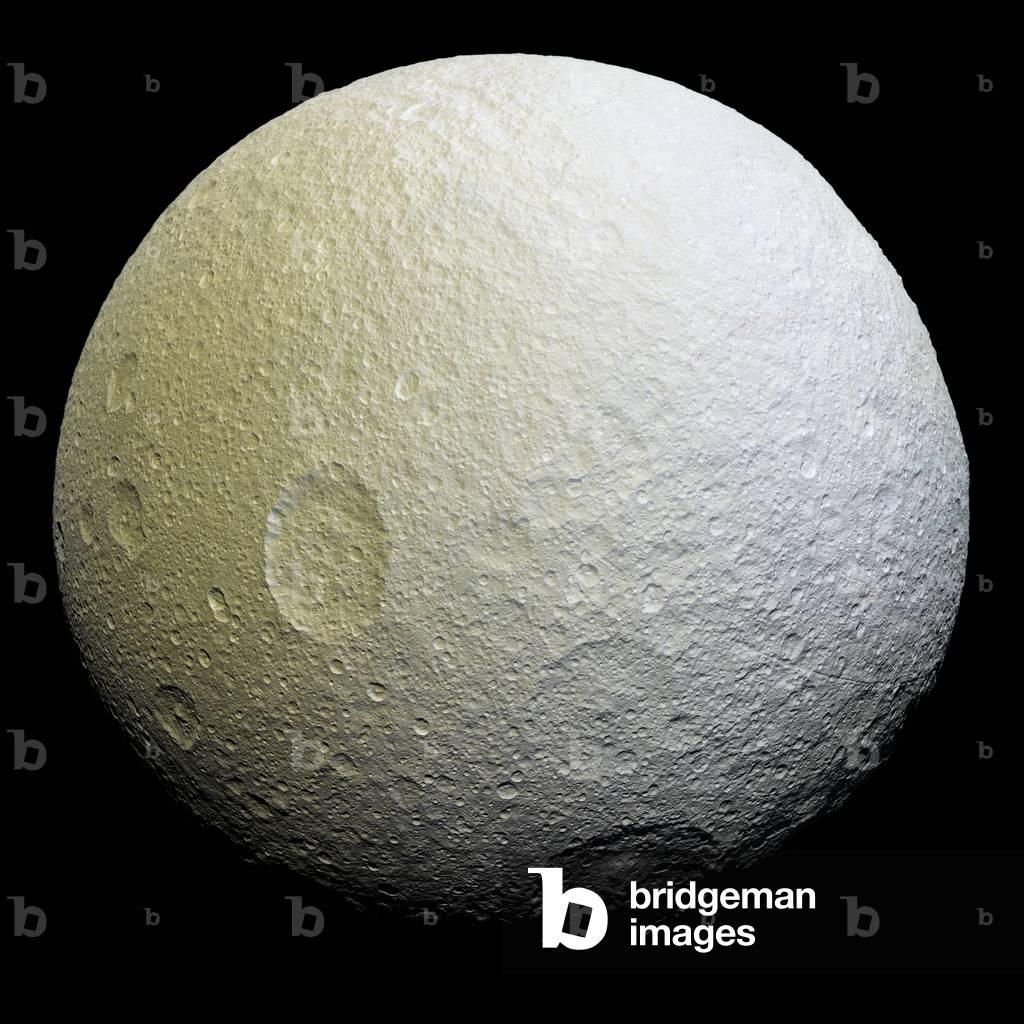
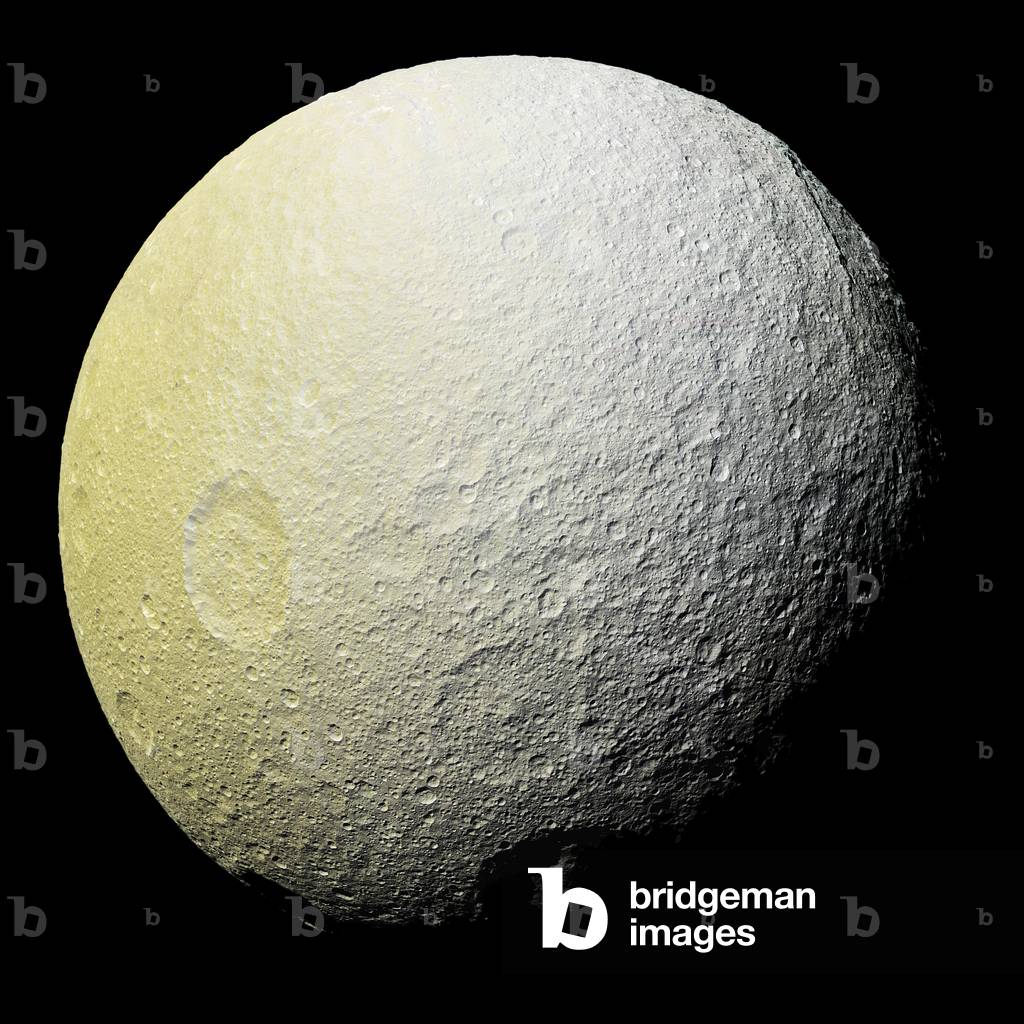
Tethys, Saturn satellite, seen by the Cassini probe - Saturn's moon Tethys seen by Cassini spacecraft: The Tethys satellite photographed by the Cassini probe on 11 April 2015 has a distance of 53,000 km from the satellite. Tethys is about 1070 km in diameter. - This enhancement-color mosaic of Saturn's icy moon Tethys shows a range of features on the moon's trailing hemisphere. Tethys is tidally locked to Saturn, so the trailing hemisphere is the side of the moon that always faces opposite its direction of motion as it orbits the planet - Images taken using clear, green, infrared and ultraviolet spectral filters were combined to create the view, which highlights subtle color differences across Tethys' surface at wavelengths not visible to human eyes. The moon's surface is fairly uniform in natural color - The color of the surface changes conspicuously across the disk, from yellowish hues to nearly white. These broad color changes are affected by a number of external processes. First, Saturn's diffuse E-ring preferentially bombards Tethys' leading hemisphere, towards the right side of this image, with ice bright ice grains. At the same time, charged particles from Saturn's radiation belt bombard the surface on the trailing side, causing color changes due to chemical alteration of the materials there. The albedo - a measure of the surface's reflectivity - drops by 10 to 15 percent from the moon's leading side to the trailing side. Similar global color patterns exist on other Saturnian moons - This mosaic is an orthographic projection constructed from 52 Cassini images obtained on April 11, 2015 with the Cassini spacecraft narrow-angle camera. Resolution is about 1,000 feet (300 meters) per pixel. The images were obtained at a distance of approximately 33,000 miles (53,000 kilometers) from Tethys
Mars - Artist's View - Mars - Artwork - A view from north of Mars' equato
March: Chaotic terrain between Kasei Valles and Sacra Fossae - Mars: Chaotic terrain between Kasei Valles and Sacra Fossae - Region bordering Kasei Valles (top) and Sacra Fossae (bottom). Kasei Valles is one of the largest Martian canal systems. The large impact crater on the right is 35 km in diameter. The image covering an area of 225 km by 95 km was obtained by the Mars Express probe. Mars Express flew over the boundary between Kasei Valles and Sacra Fossae and imaged the region, acquiring spectacular views of the chaotic terrain in the area. The images are centred at 12* N/285* E and have a ground resolution of about 21 m/pixel. They cover 225 x 95 km or 21.375 sq km, an area roughly half the size of the Netherlands. The upper portion of the image swath shows the eastern margin of Kasei Valles and the western margin of the Lunae Planum plateau and the adjoining Sacra Fossae. Kasei Valles is one of the largest outflow channels on Mars, spanning 3000 km, from the Chryse Planitia basin in the north to Etus Chasma to the south. The impact crater at right is 35 km diameter
Moon: Aristarchus crater - Moon: Aristarchus crater - Apollo 15 - The Aristarchus crater and the Schroeter valley. Image obtained from the Apollo 15 control module. An oblique view of Schroeter's Valley and the crater Aristarchus, as photographed by the Apollo 15 Command and Service Module (CSM) in lunar orbit. The large, bright - appearing crater to the left of the head of meandering Schroeter's Valley is Aristarchus, the center of which is located at 48 degrees west longitude and 214 degrees north latitude. The crater Aristarchus approximately 35 kilometers (about 21.75 statute miles) in diameter. The head of Schroeter's Valley, a sinuous rille in the Aristarchus Plateau in the Ocean of Storms, is called Cobra Head. Herodotus the crater just above and to the right of Cobra Head in upper center
Tethys, Saturn satellite, seen by the Cassini probe - Saturn's moon Tethys seen by Cassini spacecraft: The Tethys satellite photographed by the Cassini probe on 11 April 2015 has a distance of 53,000 km from the satellite. Tethys is about 1070 km in diameter. - This enhancement-color mosaic of Saturn's icy moon Tethys shows a range of features on the moon's trailing hemisphere. Tethys is tidally locked to Saturn, so the trailing hemisphere is the side of the moon that always faces opposite its direction of motion as it orbits the planet - Images taken using clear, green, infrared and ultraviolet spectral filters were combined to create the view, which highlights subtle color differences across Tethys' surface at wavelengths not visible to human eyes. The moon's surface is fairly uniform in natural color - The color of the surface changes conspicuously across the disk, from yellowish hues to nearly white. These broad color changes are affected by a number of external processes. First, Saturn's diffuse E-ring preferentially bombards Tethys' leading hemisphere, towards the right side of this image, with ice bright ice grains. At the same time, charged particles from Saturn's radiation belt bombard the surface on the trailing side, causing color changes due to chemical alteration of the materials there. The albedo - a measure of the surface's reflectivity - drops by 10 to 15 percent from the moon's leading side to the trailing side. Similar global color patterns exist on other Saturnian moons - Mountains on the floor of the 280 mile- (450 km-) wide Odysseus impact basin are visible at upper right, around the two o'clock position - This mosaic is an orthographic projection constructed from 52 Cassini images obtained on April 11, 2015 with the Cassini spacecraft narrow-angle camera. Resolution is about 1,000 feet (300 meters) per pixel. The images were obtained at a distance of approximately 33,000 miles (53,000 kilometers) from Tethys
Meteor Crater - Arizona - USA - Impact Crater Meteor Crater, Arizona, USA
Moon: Aristarchus crater - Moon: Aristarchus crater - Apollo 15 - The Aristarchus crater, on the left, the Herodote crater, on the right, and the Schroeter valley. Image obtained from the Apollo 15 control module. An oblique view of Schroeter's Valley and the crater Aristarchus, as photographed by the Apollo 15 Command and Service Module (CSM) in lunar orbit. The large, bright - appearing crater to the left of the head of meandering Schroeter's Valley is Aristarchus, the center of which is located at 48 degrees west longitude and 214 degrees north latitude. The crater Aristarchus approximately 35 kilometers (about 21.75 statute miles) in diameter. The head of Schroeter's Valley, a sinuous rille in the Aristarchus Plateau in the Ocean of Storms, is called Cobra Head. Herodotus the crater just above and to the right of Cobra Head in upper center
Moon: Theophile crater - Moon: Theophilus crater - View of the large impact crater Theophile with the Madler crater and the Nectar Sea on its left. Image obtained in July 1969 from the command module of Apollo 11. An Apollo 11 oblique view of the large crater Theophilus located at the northwest edge of the Sea of Nectar on the lunar nearside. Theophilus is about 60 statute miles in diameter. The smooth area is Mare Nectaris. The smaller crater Madler, about 14 statute miles in diameter, is located to the east of Theophilus. Visible in the background are the large crater Fracastorius and the smaller crater Beaumont. The coordinates of the center of this photograph are 29 degrees east longitude and 11 degrees south latitude
A crater on the southwest rim of Metius B crater.
Cratere Erlanger sur la Lune - Erlanger crater near Moon north pole - Erlanger cratere is located 90 km from the north pole of the Moon. The bottom of this 10 km-diameter crater rarely receives the sun's rays. In this image obtained on August 8, 2009 by the LRO probe (Lunar Reconnaissance Orbiter), only the edges of the crater are illuminated by the Sun. Bed view of Erlanger, crater 10 km (6 miles) across just 90 km (50 miles) from the Moon's north pole. The Sun is perpetually on the horizon as seen from the crater, and only the raised rim is ever lit. In this shot almost the entire circle of the rim can be seen, poking into the sunlight. The crater has steep walls, and the bottom almost never sees sunlight. Image taken by the Lunar Reconnaissance Orbiter's (LRO) instrument on august 8 2009
Mars: crateres and canals in Hephaestus Fossae - Impact crateres and channel system in Hephaestus Fossae, a region on Mars located on the western flank of Elysium Mons. The large impact crater on the left is 20 km in diameter. The image covering an area of about 150 square km was obtained by the Mars Express probe on 28 December 2007. This image of Hephaestus Fossae was obtained by Esa's Mars Express orbiter on 28 December 2007. The region is dotted with craters and channel systems and lies at about 21* North and 126* East on the Red Planet. This image covering an area of approximately 150 km exhibits a large impact crater measuring 20 kilometers in diameter. Named after the Greek god of fire, Hephaestus Fossae extends for more than 600 km on the western flank of Elysium Mons in the Utopia Planitia region
Moon: King crater - Moon: King crater - The King impact crater on the hidden face of the Moon. This crater is about 75 km in diameter and 4 km in depth. Image obtained in April 1972 from the control module of Apollo 16. An oblique view of King Crater on the lunar farside, as photographed from the Apollo 16 spacecraft in lunar orbit. Note the interesting mountainous feature inside the crater. The coordinates of the center of King Crater are 120.5 degrees east longitude and 5.5 degrees north latitude. The two “” fingers”” of the central highlands in King Crater point towards the north - northwest. While astronauts John W. Young, commander; and Charles M. Duke Jr., lunar module pilot; descended in the Apollo 16 Lunar Module (LM) “” Orion””” to explore the Descartes highlands landing site on the moon, astronaut Thomas K. Mattingly II, command module pilot, remained with the Command and Service Modules (CSM) “” Casper””” in lunar orbit. April 1972
Apollo 8: lunar craters - Moon craters seen from Apollo 8 - View of Goclenius crateres (foreground), Colombo A and Magelhaens from the Apollo 8 module in December 1968. This oblique view of the lunar surface was taken from the Apollo 8 spacecraft looking southward toward Goclenius and other large craters near 45 degrees east longitude and 10 degrees south latitude in the Sea of Fertility. Goclenius, the crater in the foreground with a rille - broken flat floor, is about 70 kilometers (45 statute miles) in diameter. One rille, approximately horizontal in this view, crosses both crater rims and the central peak, and, on adjoining Apollo 8 photographs, can be traced several kilometers across the mare surface beyond the high crater wall. In the background, the two large craters with smooth floors are Colombo A (left) and Magelhaens. Magelhaens A, the crater with the irregular floor, is about 35 kilometers (20 statute miles) in diameter
Sunrise on the crater Tycho - Tycho Crater Sunrise - Sunrise on the central peak of the crater Tycho on the Moon. This crater is about 82 km in diameter and its central peak rises at 2 km above sea level. Image obtained on June 10, 2011 by the LRO (Lunar Reconnaissance Orbiter) probe. On 10 June 2011 the LRO spacecraft slewed 65* to the west, allowing the LROC NACs to capture this dramatic sunrise view of Tycho crater. A very popular target with amateur astronomers, Tycho is located at 43.37* S, 348.68* E, and is ~ 82 km (51 miles) in diameter. The summit of the central peak is 2 km (6562 ft) above the crater floor, and the crater floor is about 4700 m (15,420 ft) below the rim. Many “” clasts”” ranging in size from 10 meters to 100s of meters are exposed in the central peak slopes
Moon: Moscow Sea and crateres - Moon: Mare Moscoviense and craters - Part of the hidden face of the Moon with the Moscow Sea on the right. Image obtained during the Apollo 13 mission, April 1970. This oblique view of the lunar farside was photographed from the Apollo 13 spacecraft as it passed around the moon on its hazardous journey home. The large conspicuous mare area is Mare Moscoviense which is located at 146 degrees east longitude and 25 degrees north latitude. The large crater at the horizon is International Astronomical Union Crater No. 221. This view is looking northeast from the spacecraft
Moon: Copernicus crater - Moon: Copernicus crater - Copernic Crateres (in the centre near the limbo) and Reinhold (in the foreground) seen in November 1969 from the control module of Apollo 12. An Apollo 12 high - oblique view of the lunar nearside looking northeast towards the crater Copernicus (in center near horizon), as photographed from lunar orbit. The shaded crater in the foreground is Reinhold. Reinhold B is the crater next to Reinhold which as the small crater in the center of it. November 1969
Tethys, Saturn satellite, seen by the Cassini probe - Saturn's moon Tethys seen by Cassini spacecraft - The Tethys satellite photographed by the Cassini probe on August 30, 2007 at a distance of 97,000 km. Tethys is about 1070 km in diameter. At the top left of the picture is the gigantic impact crater Odysseus, which measures 450 km in diameter. The vast expanse of the crater Odysseus spreads out below Cassini in this mosaic view of Saturn's moon Tethys. The crater (450 kilometers or 280 miles across) is a remarkably well - preserved example of an ancient multi - ringed impact basin: the outer ring is defined by steep, cliff - like walls that descend to generally broad internal terraces. The inner ring is formed by a prominent, crown - shaped, 140 - kilometer (88 - mile) diameter circular band of icy mountains. Multi - ring basins are seen on rocky bodies as well as icy ones. The complex internal structure and multi - ringed nature of these very large basins are believed to arise from the rebound of intense shock waves that penetrated the body at the time of impact. Tethys is 1,071 kilometers (665 miles) across. This mosaic was assembled from four clear filter, narrow - angle camera images. The view is an orthographic projection centered on 3 degrees south latitude, 119 degrees west longitude and has a resolution of 572 meters (0.35 mile) per pixel. An orthographic view is most like the view seen by a distant observer looking through a telescope. North is up. The view was obtained by the Cassini spacecraft on Aug. 30, 2007, from a distance of approximately 97,000 kilometers (60,000 miles) and at a sun - Tethys - spacecraft, or phase, angle of 51 degrees
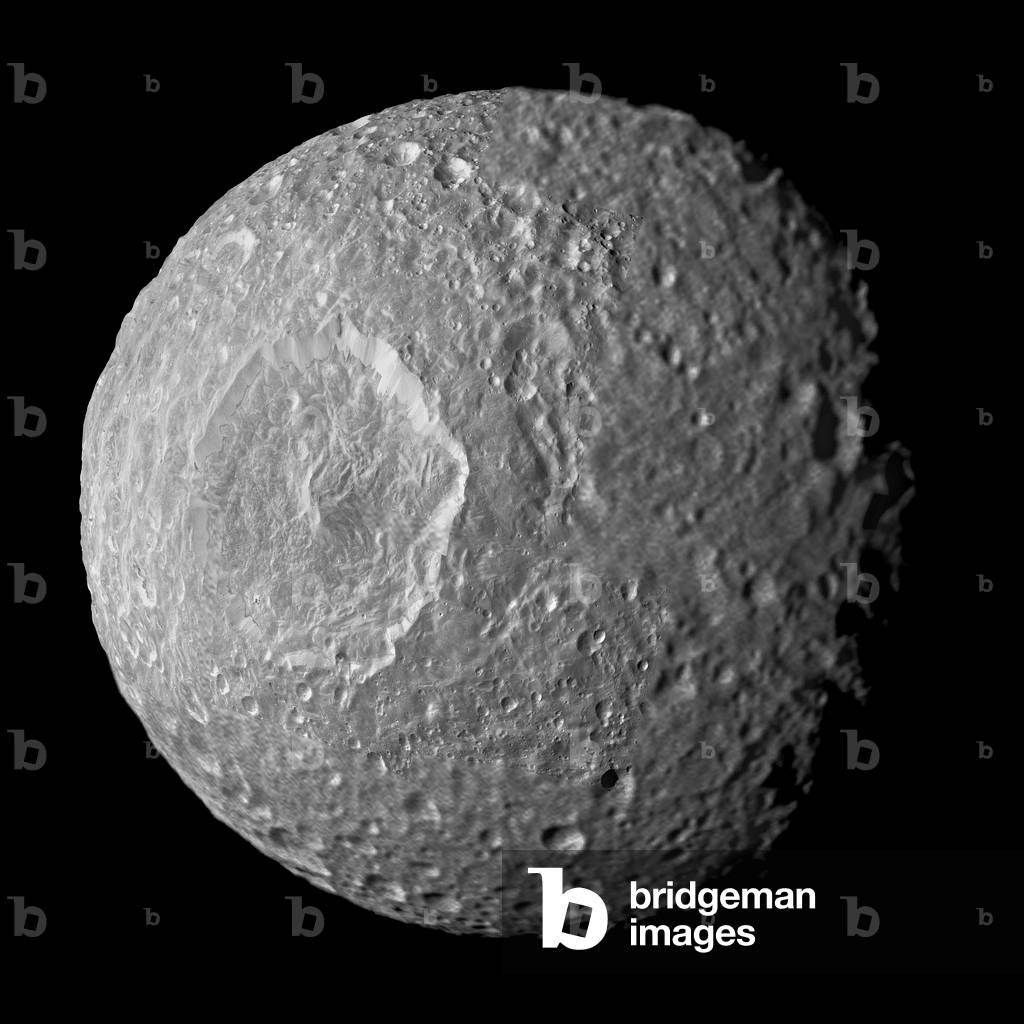
Mimas, satellite of Saturn, seen by the Cassini probe on 13/02/2010 - Saturn's moon Mimas seen by Cassini spacecraft - February 13 2010 - The Mimas satellite seen in false colours by the Cassini probe on 13 February 2010 has a distance of 16,000 km from the satellite. Color differences reveal differences in terrain nature. Mimas is about 400 km in diameter. At the right centre is the large impact crater Herschel, 130 km wide. Subtle color differences on Saturn's moon Mimas are apparent in this false - color view of Herschel Crater captured by Nasa's Cassini spacecraft during its closest - ever flyby of that moon. The image shows terrain - dependent color variations, particularly the contrast between the bluish materials in and around Herschel Crater (130 kilometers, or 80 miles, wide) and the greenish cast on older, more heavily cratered terrain elsewhere. The origin of the color differences is not yet understood, but may be caused by subtle differences in the surface composition between the two terrains. Herschel Crater covers most of the bottom of this image. To create this false - color view, ultraviolet, green and infrared images were combined into a single picture that exaggerates the color differences of terrain on the moon. These data were combined with a high - resolution image taken in visible light to provide the high - resolution information from the clear - filter image and the color information from the ultraviolet, green and infrared filter images. The natural color of Mimas visible to the human eye may be a uniform gray or yellow color, but this mosaic has been contrast - enhanced and shows differences at other wavelengths of light. During its closest - ever flyby on Feb. 13, 2010, Cassini came within about 9,500 kilometers (5,900 miles) of Mimas. This view looks toward the northern part of the hemisphere of Mimas that leads in the moon's orbit around Saturn. Mimas is 396 kilometers (246 miles) across. North on Mimas is up
Mimas, satellite of Saturn, seen by the Cassini probe on 13/02/2010 - Saturn's moon Mimas seen by Cassini spacecraft - February 13 2010 - The Mimas satellite photographed by the Cassini probe on 13 February 2010 has a distance of 16,000 km from the satellite. Mimas is about 400 km in diameter. In the centre left, the large impact crater Herschel, 130 km wide. Relatively dark regions below bright crater walls and streaks on some of the walls are seen in this mosaic of Saturn's moon Mimas, created from images taken by Nasa's Cassini spacecraft during its closest flyby of the moon. The crater floors and surroundings are about 20 percent darker than the steep crater walls in this view. Mimas 'original surface, like the surfaces of most of the other major Saturnian moons without atmospheres, is not pure ice but contains some dark impurities. The relatively dark markings appear along the lower portion of the walls of Herschel Crater (130 kilometers, 80 miles wide) and some of the smaller craters and are marked in green in the annotated version of the image. Cassini scientists interpret this darkening as evidence for the gradual concentration of impurities from evaporating icy materials in areas where the dark impurities slide slowly down the crater wall. There, the bright ice is baked away by the sun and the vacuum of space. At Herschel, the edge where the darker regions contact the crater floor is interrupted by an extensive hummocky area. Scientists believe the hummocky texture came from the flow of melted ice that occurred during the impact that created the crater. That melt filled the bottom of the crater around the central peak. Dark streaks are seen making their way down the sides of some craters and often originated from pockets of dark contaminants embedded just below the rim of the crater wall. The pockets themselves likely represent small, pre - existing, dark - floored craters that were buried by the blanket of material thrown out from the newer im
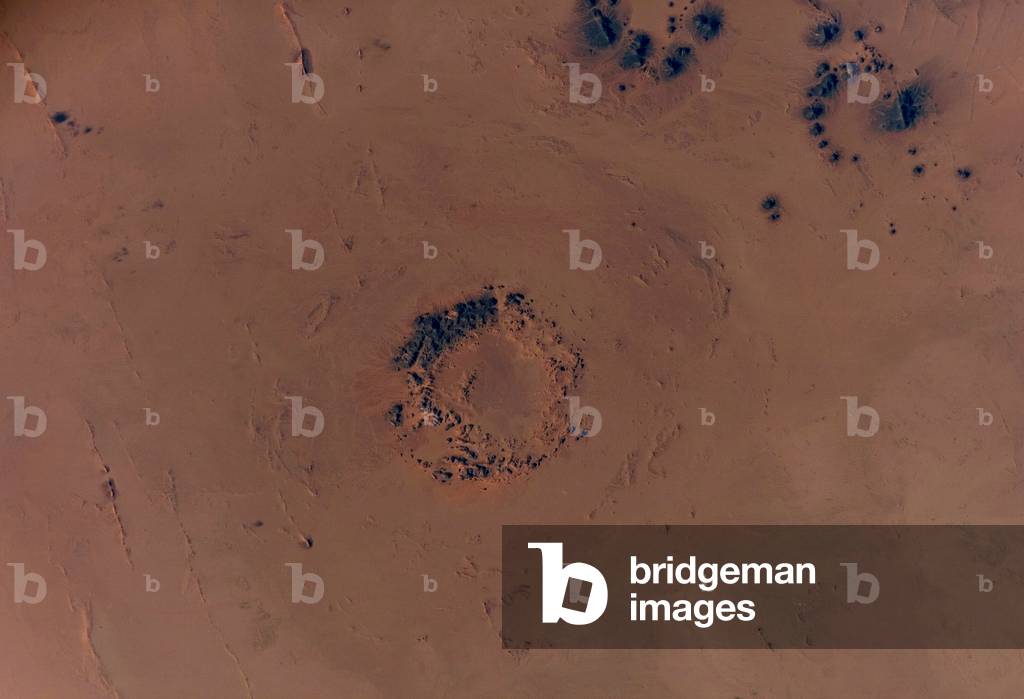
Tenoumer Impact Crater, Mauritania (photo)
Moon: Copernicus crater and Sea of the Islands - Moon: Copernicus crater and Mare Insularum - The Copernic crater, on the top left, is about 90 km in diameter
Moon: Cratere Clavius - Moon: Clavius Crater: Image obtained on August 24, 2016, a day before the last quarter of the moon
Mars - Gale Crater Region - Gale Crater area on planet Mars - View of the region of the impact crater Gale in which the Curiosity rover will be installed in 2012. This crater (in the top center of the picture) is 154 km in diameter. Image recomposed from data obtained by the Mars Global Surveyor probe. This computer - generated view depicts part of Mars at the boundary between darkness and daylight, with an area including Gale Crater beginning to catch morning light. Northward is to the left. Gale is the crater with a mound inside it near the center of the image. NASA has selected Gale as the landing site for the Mars Science Laboratory mission. The mission's rover will be placed on the ground in a northern portion of Gale crater in August 2012. Gale crater is 96 miles (154 kilometers) in diameter and holds a layered mountain rising about 3 miles (5 kilometers) above the crater floor. The intended landing site is at 4.5 degrees south latitude, 137.4 degrees east longitude. This view was created using three - dimensional information from the Mars Orbiter Laser Altimeter, which flew on Nasa's Mars Global Surveyor orbiter. The vertical dimension is not exaggerated. Color information is based on general March color characteristics
Mimas, satellite of Saturn, seen by the Cassini probe on 13/02/2010 - Saturn's moon Mimas seen by Cassini spacecraft - February 13 2010 - The Mimas satellite photographed by the Cassini probe on 13 February 2010 has a distance of 30,000 km from the satellite. Mimas is about 400 km in diameter. In the centre, the large impact crater Herschel, 130 km wide. This mosaic, created from images taken by Nasa's Cassini spacecraft during its closest flyby of Saturn's moon Mimas, looks straight at the moon's huge Herschel Crater and reveals new insights about the moon's surface. Bright - walled craters, with floors and surroundings about 20 percent darker than the steep crater walls, are notable in this view. Mimas 'original surface, like the surfaces of most of the other major Saturnian moons without atmospheres, is not pure ice but contains some dark impurities. Herschel Crater (130 kilometers, 80 miles wide) and some of the smaller craters seen in this mosaic show relatively dark markings along the lower portion of their crater walls (marked in green in the annotated version of the image). Cassini scientists interpret this darkening as evidence for the gradual concentration of impurities from evaporating icy materials in areas where the dark impurities slide slowly down the crater wall. There, bright ice is baked away by the sun and the vacuum of space. At Herschel, the edge where the darker regions contact the crater floor is interrupted by an extensive hummocky area. Scientists believe the hummocky texture came from the flow of melted ice that occurred during the impact that created the crater. That melt filled the bottom of the crater around the central peak. Dark streaks are seen making their way down the sides of some craters, often originating from pockets of dark contaminants embedded just below the rim of the crater wall. The pockets themselves likely represent small, pre - existing, dark - floored craters that were buried by the blanket of material that
Moon: Copernicus crater - Moon: Copernicus crater - Copernic Crateres (in the centre near the limbo) and Reinhold (in the foreground) seen in November 1969 from the control module of Apollo 12. An Apollo 12 high - oblique view of the lunar nearside looking northeast towards the crater Copernicus (in center near horizon), as photographed from lunar orbit. The shaded crater in the foreground is Reinhold. Reinhold B is the crater next to Reinhold which as the small crater in the center of it. November 1969
Mars - Volcanoes Ceraunius Tholus and Uranius Tholus - Mosaic of images obtained by the Mars Express probe between November 25, 2004 and June 22, 2006 during three different orbits. This image shows the volcanoes Ceraunius Tholus (left) and Uranius Tholus (right). These volcanoes measure 130 and 62 km respectively, and s'elevent is 5500m and 4500m. In the second orbit, a cloud was present near the summit of Ceraunius Tholus volcano; in the final mosaic it appears cut in a straight line because the cloud had disappeared in the last image. Ceraunius Tholus and Uranius Tholus are two volcanoes in the Tharsis region of Mars. Ceraunius Tholus is 130 km across and rises 5.5 km above its surroundings. The flanks of this volcano are etched with many valleys. Its neighbour, Uranius Tholus is a smaller volcano, with a base diameter of 62 km and a height of 4.5 km. This image is derived from data acquired during three separate orbits of Mars Express, which took place between 25 November 2004 and 22 June 2006. During the second orbit, Mars Express's camera captured icy clouds drifting past the summit of Ceraunius Tholus. In the finished mosaic image there is a sharp line because the clouds had long since dispersed by the time Mars Express crossed again and took the final strip of data needed for the image
Tethys, Saturn satellite, seen by the Cassini probe - Saturn's moon Tethys seen by Cassini spacecraft - The southern pole of the Tethys satellite photographed by the Cassini probe on September 24, 2005. Mosaic of nine images. With this full - disk mosaic, Cassini presents the best view yet of the south pole of Saturn's moon Tethys. The giant rift Ithaca Chasma cuts across the disk. Much of the topography seen here, including that of Ithaca Chasma, has a soft, muted appearance. It is clearly very old and has been heavily bombarded by impacts over time. Many of the fresh - appearing craters (ones with crisp relief) exhibit unusually bright crater floors. The origin of the apparent brightness (or “” albedo”) contrast is not known. It is possible that impacts punched through to a brighter layer underneath, or perhaps it is brighter because of different grain sizes or textures of the crater floor material in comparison to material along the crater walls and surrounding surface. The moon's high southern latitudes, seen here at the bottom, were not imaged by Nasa's Voyager spacecraft during their flybys of Tethys 25 years ago. The mosaic is composed of nine images taken during Cassini's close flyby of Tethys (1,071 kilometers, or 665 miles across) on Sept. 24, 2005, during which the spacecraft passed approximately 1,500 kilometers (930 miles) above the Moon's surface. This view is centered on terrain at approximately 1.2 degrees south latitude and 342 degrees west longitude on Tethys. It has been rotated so that north is up. The clear filter images in this mosaic were taken with the Cassini spacecraft narrow - angle camera at distances ranging from 71,600 kilometers (44,500 miles) to 62,400 kilometers (38,800 miles) from Tethys and at a Sun - Tethys - spacecraft, or phase, angle of 21 degrees. The image scale is 370 meters (1,200 feet) per pixel
Moon: King crater - Moon: King crater - The King impact crater on the hidden face of the Moon. This crater is about 75 km in diameter and 4 km in depth. Image obtained in April 1972 from the control module of Apollo 16. This vertical view shows the King Crater on the lunar surface. It was exposed with color positive film in a hand - held 70 mm camera onboard the Command and Service Modules during the Apollo 16 mission's 98th orbit of the moon. Center point coordinates are located at 5.4 degrees north latitude and 120.8 degrees east longitude. April 1972
Mimas, satellite of Saturn, seen by the Cassini probe on 13/02/2010 - Saturn's moon Mimas seen by Cassini spacecraft - February 13 2010 - The Mimas satellite photographed by the Cassini probe on 13 February 2010 has a distance of 50,000 km from the satellite. Mimas is about 400 km in diameter. At the right centre is the large impact crater Herschel, 130 km wide. In this view captured by Nasa's Cassini spacecraft on its closest - ever flyby of Saturn's moon Mimas, large Herschel Crater dominates Mimas, making the moon look like the Death Star in the movie “” Star Wars.”” Herschel Crater is 130 kilometers, or 80 miles, wide and covers most of the right of this image. Cassini came within about 9,500 kilometers (5,900 miles) of Mimas on Feb. 13, 2010.This mosaic was created from six images taken that day in visible light with Cassini's narrow - angle camera on Feb. 13, 2010. The images were re - projected into an orthographic map projection. This view looks toward the area between the region that leads on Mimas 'orbit around Saturn and the region of the moon facing away from Saturn. Mimas is 396 kilometers (246 miles) across. This view is centered on terrain at 11 degrees south latitude, 158 degrees west longitude. North is up. This view was obtained at a distance of approximately 50,000 kilometers (31,000 miles) from Mimas and at a sun - Mimas - spacecraft, or phase, angle of 17 degrees. Image scale is 240 meters (790 feet) per pixel
Volcano Stromboli - Stromboli crater terrace - Eruption mouths in the terrace of the crater. Stromboli crater terrac
Moon: Mare Orientale and Grimaldi - Moon: Mare Orientale and Grimaldi - Taking advantage of a very strong libration, this image reveals Mare Orientale, at the top of the image, a lunar sea of 900 km in diameter. Also visible are Montes Cordillera, the bright Byrgius crater (bottom left) and the dark crater Grimaldi (bottom right of the picture). Panorama of three images obtained on August 12, 2009, one day before the last quarter of the Moon. A remarkable libration helped to catch the elusive mare Orientale at its best. Also visible are Montes Cordillera, the bright crater Byrgius A on the bottom - left corner and the dark Grimaldi basin on the bottom - right corner; in the middle, the neverending Sirsalis rille. Panorama of three images taken on august 12, 2009, one day before last quarter of the moon
Asteroide Vesta and other asteroides - Asteroid Vesta compared to other asteroids - Comparison of the sizes of the nine asteroides visits to date by space probes. The asteroid Vesta, with a diameter of 530 km, is the largest. This composite image shows the comparative sizes of nine asteroids. Up until now, Lutetia, with a diameter of 81 miles (130 kilometers), was the largest asteroid visited by a spacecraft, which occurred during a flyby. Vesta, which is also considered a protoplanet because it's a large body that almost became a planet, dwarfs all other small bodies in this image, with its diameter sizing up at approximately 330 miles (530 kilometers)
Moon: crateres near the south pole - Lunar south pole area - In the middle of the picture, the crater Moretus with a central peak rising to 2700m. To his right is the Curtius crater. Near the blade on the left, the crater Cabeus A where the Centaur floor of the LCROSS probe crashed. Image obtained on August 22, 2008. In the middle of the image is Moretus crater (biggest crater with a central peak). Near the limb, to the left is the crater Cabeus A where the LCROSS spacecraft impacted in october 2009. Image taken on August 22, 2008
Detail of the panorama obtained by Spirit on 12 and 13 March 2004. Bonneville is an impact crater of 200m in diameter. Far right, Columbia Hills. The Rover Spirit landed on Mars in the crater region Gusev, July 4, 2004 - The rim and interior of a 200m diameter impact crater nicknamed “” Bonneville”” dominate this image. The Mars Exploration Rover Spirit acquired this panoramic camera image mosaic on the 68th martian day, or sol, of its mission (March 12, 2004): March: Cratere Bonneville seen by Spirit - March: impact crater Bonneville seen by Spirit
Mahone's Counterattack - Battle of the Crater, 2003 (oil on canvas)
Permissions
  • Permission required for non-editorial use (inc book and magazine covers). Please contact us
Content Partner Restrictions
  • Not to be used for cards, calendars, prints or posters
Copyright
  • Copyright Applies
premium
Impact Crater Vredefort, South Africa (photo)
A bright crater on the flank of a larger dark halo crater.
March - Opportunity - Cratere Endurance. 05/2004 - Martian crater Endurance seen by Opportunity. 05/2004 - Panorama of 360 degres obtained by Opportunity from 22 to 28 May 2004. The Rover Opportunity landed on Mars in the Meridiani Planum region on January 25, 2004. This 360 - degree panorama shows “” Endurance Crater”” and the surrounding plains of Meridiani Planum on Mars. It took seven sols to complete this panorama (sols 117 - 123), using 81 separate camera positions. The composite shown here is an approximate true - color rendering
Dione, satellite of Saturn, seen by Cassini - Dione, moon of Saturn, as seen by Cassini - Mosaic of images obtained by the Cassini probe on 11 October 2005 at a distance of about 25,000 km from the satellite. As it departed its encounter with Saturn's moon Dione, Cassini sailed above an unreal landscape blasted by impacts. The rising Sun throws craters into sharp contrast and reveals steep crater walls. At the far right, a medium - sized crater is bisected by a fracture, revealing a cross section of the impact site. The seven clear - filter images in this mosaic were taken with the Cassini spacecraft narrow - angle camera on Oct. 11, 2005, at distances ranging from 21.650 to 25.580 kilometers (13,450 to 15,890 miles) from Dione and at a Sun - Dione - spacecraft, or phase, angle of 154 degrees. Resolution in the original images ranges from 126 to 154 meters (413 to 505 feet) per pixel. The images have been re - sized to have an image scale of about 100 meters (330 feet) per pixel. North on Dione is 140 degrees to the left
Moon: crateres in the Sea of Rains - Moon: craters in Mare Imbrium - Crateres in the South of the Sea of Rains (Mare Imbrium). The large crater at the bottom of the picture is the Diophantus crater (18 km in diameter), in the upper center is the Brayley crater. On its left is Mount Vinogradov. Image obtained from the Apollo 15 control module. The north is down. Craters located south of Mare Imbrium, as photographed by the metric camera in the Scientific Instrumentation Module (SIM) bay of the Apollo 15 Command and Service Module (CSM) in lunar orbit. Bottom left, the large crater is Diophantus, above it is Mons Vinogradov and to the right of this mountain, near the center of the image is the crater Brayley. North is at bottom
Vredefort impact crater - South Africa - Vredefort impact crater, South Africa - Vredefort impact crater in South Africa is the largest impact crater on Earth and one of the oldest. Its diameter is 300 km; it would have been formed 2 billion years ago. Image obtained from the International Space Station (ISS) on 27 June 2009. Vredefort crater is the largest impact crater on earth and one of the oldest known impact crater. Its diameter is 300 km and its age is estimated to be 2 billion years. Image taken from the international space station (ISS) on June 27, 2009
Crater of Vesuvius, 1864 (Woodburytype)
Permissions
  • Permission required for non-editorial use (inc book and magazine covers). Please contact us
Moon: grooves and mountain, April 1972 (photo)
Crater on Mars
Manicouagan Crater
Crater Vesuvius.
Barringer Crater
Permissions
  • Permission required for non-editorial use (inc book and magazine covers). Please contact us
Image Restrictions
  • Content within this photograph may require additional clearances (eg: trademark and personality rights) depending on Licensee's specific use of material, which may include book and magazine cover use.
Content Partner Restrictions
  • Not available to clients invoiced in Austria, Bosnia and Herzegovina, China, Croatia, Denmark, Former Yugoslav Republic of Macedonia, Germany, Hong Kong, Kosovo, Montenegro, Poland, Serbia, Slovenia, Switzerland and Taiwan
Rhea, satellite of Saturn, seen by Cassini - Saturn's moon Rhea seen by Cassini - Mosaic of images obtained by the Cassini probe in March 2015. Rhea is the second largest satellite in Saturn (1528 km in diameter). After a couple of years in high - inclination orbits that limited its ability to encounter Saturn's moons, Nasa's Cassini spacecraft returned to Saturn's equatorial plane in March 2015.Image taken using clear, green, infrared and ultraviolet spectral filters were combined to create these enhanced color views, which offer an expanded range of the colors visible to human eyes in order to highlight subtle color differences across Rhea's surface. The moon's surface is fairly uniform in natural color.This view at right is centered at 9 degrees north latitude, 254 degrees west longitude. Resolution in this mosaic is 300 meters (984 feet) per pixel. The image was acquired at a distance that ranged from about 36,000 to 32.100 miles (57,900 to 51,700 kilometers) from Rhea
Manicouagan Crater
VESUVIUS CRATER
Permissions
  • Permission required for non-editorial use (inc book and magazine covers). Please contact us
Content Partner Restrictions
  • Only available to clients invoiced in France and North, Central and South America
Copyright
  • Copyright Applies
Apollo 16: the LEM approaching the control module - Apollo 16: LM ascent stage approaching CSM - The LEM (Orion) after leaving the Moon, seen as approaching the control module of Apollo 16 (Casper). The LEM is above the Schubert B crater, west of the Smyth Sea. 23/04/1972. The Apollo 16 Lunar Module (LM) ascent stage, with astronauts John W. Young and Charles M. Duke Jr. aboard, returns from the lunar surface to rejoin the Command and Service Modules (CSM) in lunar orbit. Astronaut Thomas K. (Ken) Mattingly II took this photograph from the Command Module (CM). The LM is above the Crater Schubert B. The lunar surface area visible in this picture is located at the western edge of Smyth's Sea. 23 April 1972
Moon: Apennine Mountains - Moon: Apenninus Mountains - The Apennine Mountains are a chain of mountains between the Rainy Sea (left) and the Serenite Sea (right). Some peaks peak at 5000m. Mosaic of images obtained on September 2, 2007, two days before the last quarter of the Moon. Montes Apenninus are a mountain chain located between Mare Imbrium (left) and Mare Serenitatis (right). Some of these mountains are 5000 m high. Composite of images taken on september 2 2007, two days before last quarter of the moon
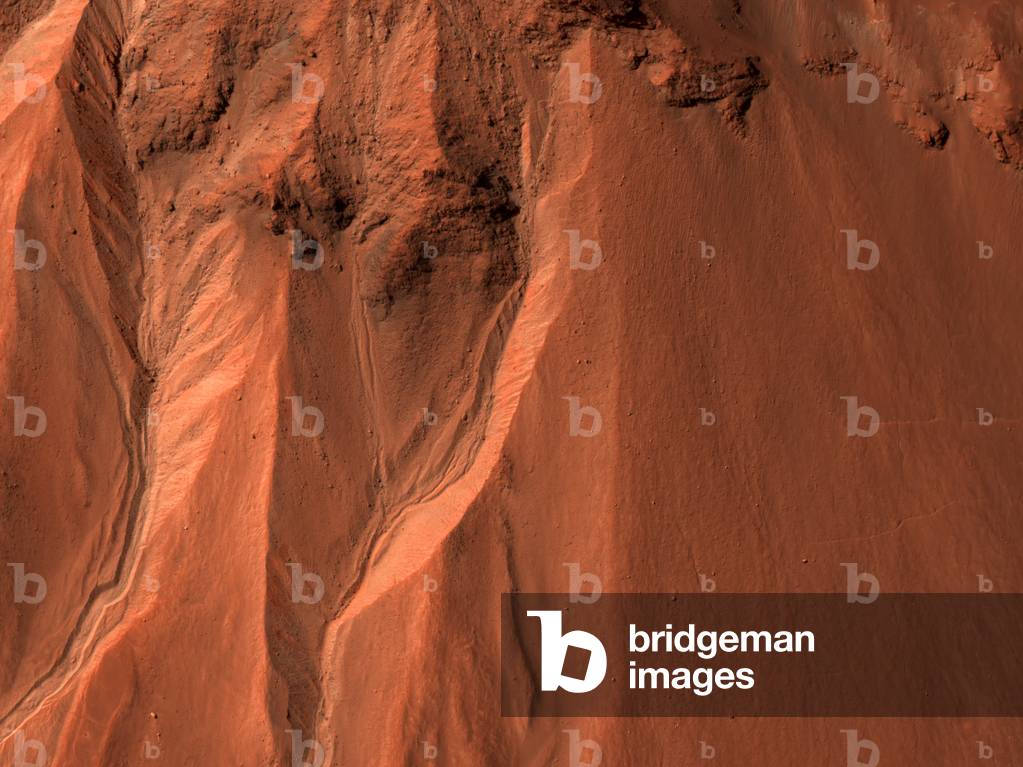
Traces of flow on Mars - Mars: gullies on impact crater wall - Gullies along a wall of an impact crater (Hale crater). These ravines are thought to indicate the presence of liquid water in the Martian basement. Image obtained by the Mars Reconnaissance Orbiter probe on August 3, 2009. Gullies, on Earth, are usually formed through the action of liquid water. Whether gullies form under today's cold dry conditions on Mars is a major question that planetary scientists are trying to answer. The gullies pictured here in Hale crater are great examples of what a typical Martian gully looks like. Wide V - shaped channels running downhill (from top to bottom) where the material that carved the gully flowed. At the bottom of the channel this material empties out onto a fan - shaped mound. Several gullies are visible here and the fans from each gully overlap one other in complicated ways. Image taken on August 3, 2009 by the HIRISE camera on Nasa's Mars Reconnaissance Orbiter
BATTLE OF THE CRATER
Permissions
  • Permission required for non-editorial use (inc book and magazine covers). Please contact us
Content Partner Restrictions
  • Only available to clients invoiced in France and North, Central and South America
Asteroide Ida seen by Galileo probe - Asteroid Ida seen by Galileo spacecraft - Mosaic of five images obtained by the Galileo probe on 28 August 1993 between 3000 and 3800 km from the asteroid. This view of the asteroid 243 Ida is a mosaic of five image frames acquired by the Galileo spacecraft's solid-state imaging system at ranges of 3,057 to 3,821 kilometers (1,900 to 2,375 miles) on August 28, 1993. Ida is the second asteroid ever encountered by a spacecraft. It appears to be about 52 kilometers (32 miles) in length, more than twice as large as Gaspra, the first asteroid observed by Galileo in October 1991