[]
Votre Sélection en cours
média(s) Média(s)
Votre devis 0

Votre sélection

Annuler la sélection
Média ajouté au panier
{"event":"pageview","page_type1":"undetected","page_type2":"_assets_search_override","language":"fr","user_logged":"false","user_type":"ecommerce","nl_subscriber":"false"}
{"event":"ecommerce_event","event_name":"view_item","event_category":"browse_catalog","ecommerce":{"items":[{"item_id":"PIX4572490","item_category":"photo","item_category2":"no_copyright","item_category3":"standard","item_category4":"l_bret","item_category5":"not_balown","item_list_name":"search_results","item_name":"the_smallest_stars_artist_s_view_the_smallest_stars_artwork_comparison_to_the_scale_of_the_smallest_","item_variant":"undefined"},{"item_id":"PIX4608398","item_category":"photo","item_category2":"no_copyright","item_category3":"standard","item_category5":"not_balown","item_list_name":"search_results","item_name":"planetary_system_around_trappist_1_artist_s_impressions_of_the_trappist_1_planetary_system_artist_s_","item_variant":"undefined"},{"item_id":"PIX4572553","item_category":"photo","item_category2":"no_copyright","item_category3":"standard","item_category4":"walter_b_myers","item_category5":"not_balown","item_list_name":"search_results","item_name":"brown_dwarf_star_gliese_229_b_brown_dwarf_gliese_229_b_artist_view_of_the_brown_dwarf_star_gliese_22","item_variant":"undefined"},{"item_id":"PIX4607542","item_category":"photo","item_category2":"no_copyright","item_category3":"standard","item_category4":"miller_ron_b_1947","item_category5":"not_balown","item_list_name":"search_results","item_name":"brown_dwarf_star_gliese_229b_artist_s_view_of_the_brown_dwarf_star_gliese_229_b_seen_from_a_possible","item_variant":"undefined"},{"item_id":"PIX4572483","item_category":"photo","item_category2":"no_copyright","item_category3":"standard","item_category4":"miller_ron_b_1947","item_category5":"not_balown","item_list_name":"search_results","item_name":"artist_s_view_of_a_red_dwarf_star_in_the_sky_of_an_exoplanet_a_red_dwarf_seen_from_an_exoplanet_artw","item_variant":"undefined"},{"item_id":"PIX4573087","item_category":"photo","item_category2":"no_copyright","item_category3":"standard","item_category5":"not_balown","item_list_name":"search_results","item_name":"the_evolution_of_stars_illustration_the_evolution_of_stars_illustration_all_stars_are_born_in_inters","item_variant":"undefined"},{"item_id":"PIX4571864","item_category":"photo","item_category2":"no_copyright","item_category3":"standard","item_category5":"not_balown","item_list_name":"search_results","item_name":"barnard_s_star_movement_the_proper_motion_of_barnard_s_star_barnard_s_star_is_a_red_dwarf_less_than_","item_variant":"undefined"},{"item_id":"PIX4572585","item_category":"photo","item_category2":"no_copyright","item_category3":"standard","item_category4":"p_carril","item_category5":"not_balown","item_list_name":"search_results","item_name":"binary_star_artist_view_binary_star_artist_view_binary_star_mass_exchange_between_a_red_giant_a_blue","item_variant":"undefined"},{"item_id":"PIX4572634","item_category":"photo","item_category2":"no_copyright","item_category3":"standard","item_category4":"p_carril","item_category5":"not_balown","item_list_name":"search_results","item_name":"binary_star_artist_view_binary_star_artist_view_a_white_dwarf_orbiting_very_close_to_her_giant_red_c","item_variant":"undefined"},{"item_id":"PIX4571842","item_category":"photo","item_category2":"no_copyright","item_category3":"standard","item_category5":"not_balown","item_list_name":"search_results","item_name":"motion_of_the_star_proxima_of_centauri_the_proper_motion_of_proxima_centauri_proxima_of_centauri_in_","item_variant":"undefined"},{"item_id":"PIX4608442","item_category":"photo","item_category2":"no_copyright","item_category3":"standard","item_category5":"not_balown","item_list_name":"search_results","item_name":"planetary_system_around_trappist_1_artist_s_impressions_of_the_trappist_1_planetary_system_artist_s_","item_variant":"undefined"},{"item_id":"PIX4572158","item_category":"photo","item_category2":"no_copyright","item_category3":"standard","item_category5":"not_balown","item_list_name":"search_results","item_name":"double_star_gliese_623_double_star_system_gliese_623_in_hercules_gliese_623_is_a_double_star_located","item_variant":"undefined"},{"item_id":"PIX4571821","item_category":"photo","item_category2":"no_copyright","item_category3":"standard","item_category5":"not_balown","item_list_name":"search_results","item_name":"proxima_star_of_centauri_proxima_centauri_proxima_of_centaur_in_the_center_of_the_image_is_the_close","item_variant":"undefined"},{"item_id":"BL3285768","item_category":"illustration","item_category2":"out_of_copyright","item_category3":"standard","item_category5":"not_balown","item_list_name":"search_results","item_name":"red_dwarf_grass_and_white_dwarf_grass_botanical_drawings_and_text_descriptions_of_plants","item_variant":"undefined"},{"item_id":"PIX4571790","item_category":"photo","item_category2":"no_copyright","item_category3":"standard","item_category5":"not_balown","item_list_name":"search_results","item_name":"red_dwarf_star_proxima_of_centauri_proxima_centauri_in_x_ray_proxima_of_centaur_in_the_center_of_the","item_variant":"undefined"},{"item_id":"PIX4572124","item_category":"photo","item_category2":"no_copyright","item_category3":"standard","item_category5":"not_balown","item_list_name":"search_results","item_name":"brown_dwarf_around_the_red_dwarf_star_gliese_229_brown_dwarf_around_red_dwarf_gliese_229_first_false","item_variant":"undefined"},{"item_id":"PIX7223357","item_category":"illustration","item_category2":"no_copyright","item_category3":"standard","item_category4":"miller_ron_b_1947","item_category5":"not_balown","item_list_name":"search_results","item_name":"artist_s_impression_of_a_red_dwarf_star_in_the_sky_of_an_exoplanet","item_variant":"undefined"},{"item_id":"PIX4574280","item_category":"photo","item_category2":"no_copyright","item_category3":"standard","item_category4":"miller_ron_b_1947","item_category5":"not_balown","item_list_name":"search_results","item_name":"u_geminorum_in_the_sky_of_an_exoplanet_u_geminorum_seen_from_an_exoplanet_artwork_u_geminorum_is_a_d","item_variant":"undefined"},{"item_id":"PIX4572752","item_category":"photo","item_category2":"no_copyright","item_category3":"standard","item_category5":"not_balown","item_list_name":"search_results","item_name":"artist_s_view_of_an_eruptive_star_flare_star_artwork_dg_canum_venaticorum_dg_cvn_is_a_binary_star_lo","item_variant":"undefined"},{"item_id":"PIX4572591","item_category":"photo","item_category2":"no_copyright","item_category3":"standard","item_category5":"not_balown","item_list_name":"search_results","item_name":"nova_de_l_eagle_nova_aquilae_artwork_artist_s_view_of_a_nova_a_white_dwarf_star_that_attracts_the_ma","item_variant":"undefined"},{"item_id":"PIX4650930","item_category":"illustration","item_category2":"no_copyright","item_category3":"standard","item_category5":"not_balown","item_list_name":"search_results","item_name":"august_24_2016_the_three_stars_that_make_up_the_centaur_alpha_system_are_the_closest_stars_to_the_su","item_variant":"undefined"},{"item_id":"PIX4608435","item_category":"photo","item_category2":"no_copyright","item_category3":"standard","item_category5":"not_balown","item_list_name":"search_results","item_name":"planetary_system_around_trappist_1_artist_s_impressions_of_the_trappist_1_planetary_system_artist_s_","item_variant":"undefined"},{"item_id":"PIX4571830","item_category":"photo","item_category2":"no_copyright","item_category3":"standard","item_category5":"not_balown","item_list_name":"search_results","item_name":"the_three_stars_that_make_up_the_centaur_alpha_system_are_the_closest_stars_to_the_sun_the_image_on_","item_variant":"undefined"},{"item_id":"PIX4650886","item_category":"photo","item_category2":"no_copyright","item_category3":"standard","item_category5":"not_balown","item_list_name":"search_results","item_name":"august_24_2016_the_three_stars_that_make_up_the_centaur_alpha_system_are_the_closest_stars_to_the_su","item_variant":"undefined"},{"item_id":"PIX4571946","item_category":"photo","item_category2":"no_copyright","item_category3":"standard","item_category5":"not_balown","item_list_name":"search_results","item_name":"nebula_around_the_star_r_aquarii_r_aquarii_and_its_peculiar_nebula_this_star_is_actually_a_binary_sy","item_variant":"undefined"},{"item_id":"PIX4573022","item_category":"photo","item_category2":"no_copyright","item_category3":"standard","item_category4":"p_carril","item_category5":"not_balown","item_list_name":"search_results","item_name":"the_evolution_of_stars_illustration_the_evolution_of_the_stars_illustration_all_stars_are_born_in_in","item_variant":"undefined"},{"item_id":"PIX4574061","item_category":"photo","item_category2":"no_copyright","item_category3":"standard","item_category4":"miller_ron_b_1947","item_category5":"not_balown","item_list_name":"search_results","item_name":"exoplanete_bd_48_738c_illustration_of_an_extrasolar_planet_orbiting_a_red_dwarf_star_in_the_sky_clos","item_variant":"undefined"},{"item_id":"PIX4573338","item_category":"photo","item_category2":"no_copyright","item_category3":"standard","item_category5":"not_balown","item_list_name":"search_results","item_name":"exoplanets_around_a_red_dwarf_star_exoplanets_around_a_red_dwarf_star_artist_s_view_of_extrasolar_pl","item_variant":"undefined"},{"item_id":"PIX4573041","item_category":"photo","item_category2":"no_copyright","item_category3":"standard","item_category4":"p_carril","item_category5":"not_balown","item_list_name":"search_results","item_name":"the_evolution_of_the_sun_illustration_the_evolution_of_the_sun_illustration_artist_s_view_of_the_evo","item_variant":"undefined"},{"item_id":"PIX4573035","item_category":"photo","item_category2":"no_copyright","item_category3":"standard","item_category4":"p_carril","item_category5":"not_balown","item_list_name":"search_results","item_name":"the_evolution_of_the_sun_illustration_the_evolution_of_the_sun_illustration_artist_s_view_of_the_evo","item_variant":"undefined"},{"item_id":"PIX4608376","item_category":"photo","item_category2":"no_copyright","item_category3":"standard","item_category5":"not_balown","item_list_name":"search_results","item_name":"planetary_system_around_trappist_1_artist_s_impression_of_the_trappist_1_planetary_system_artist_s_v","item_variant":"undefined"},{"item_id":"PIX4573028","item_category":"photo","item_category2":"no_copyright","item_category3":"standard","item_category4":"p_carril","item_category5":"not_balown","item_list_name":"search_results","item_name":"the_evolution_of_stars_illustration_the_evolution_of_the_stars_illustration_all_stars_are_born_in_in","item_variant":"undefined"},{"item_id":"PIX4573031","item_category":"photo","item_category2":"no_copyright","item_category3":"standard","item_category4":"p_carril","item_category5":"not_balown","item_list_name":"search_results","item_name":"the_evolution_of_stars_illustration_the_evolution_of_the_stars_illustration_all_stars_are_born_in_in","item_variant":"undefined"},{"item_id":"PIX4608001","item_category":"photo","item_category2":"no_copyright","item_category3":"standard","item_category4":"miller_ron_b_1947","item_category5":"not_balown","item_list_name":"search_results","item_name":"exoplanete_gliese_581_e_artist_s_view_of_the_extrasolar_planet_gliese_581_e_artist_s_impression_of_t","item_variant":"undefined"},{"item_id":"PIX4607776","item_category":"photo","item_category2":"no_copyright","item_category3":"standard","item_category4":"miller_ron_b_1947","item_category5":"not_balown","item_list_name":"search_results","item_name":"life_on_an_exoplanet_life_on_a_red_dwarf_exoplanet_traces_of_vegetation_on_the_surface_of_an_exoplan","item_variant":"undefined"},{"item_id":"PIX4607886","item_category":"photo","item_category2":"no_copyright","item_category3":"standard","item_category4":"miller_ron_b_1947","item_category5":"not_balown","item_list_name":"search_results","item_name":"exoplanete_gliese_876_d_artist_s_view_of_the_extrasolar_planet_gliese_876_d_a_super_earth_in_orbit_a","item_variant":"undefined"},{"item_id":"PIX4608507","item_category":"photo","item_category2":"no_copyright","item_category3":"standard","item_category5":"not_balown","item_list_name":"search_results","item_name":"exoplanete_ross_128_b_ross_128_b_is_an_extrasolar_planet_probably_of_an_earth_type_located_only_11_l","item_variant":"undefined"},{"item_id":"PIX4608431","item_category":"photo","item_category2":"no_copyright","item_category3":"standard","item_category4":"miller_ron_b_1947","item_category5":"not_balown","item_list_name":"search_results","item_name":"exoplanete_ross_128_b_ross_128_b_is_an_extrasolar_planet_probably_of_an_earth_type_located_only_11_l","item_variant":"undefined"},{"item_id":"PIX4573016","item_category":"photo","item_category2":"no_copyright","item_category3":"standard","item_category4":"p_carril","item_category5":"not_balown","item_list_name":"search_results","item_name":"the_evolution_of_stars_illustration_the_evolution_of_the_stars_illustration_all_stars_are_born_in_in","item_variant":"undefined"},{"item_id":"PIX4573892","item_category":"photo","item_category2":"no_copyright","item_category3":"standard","item_category5":"not_balown","item_list_name":"search_results","item_name":"exoplanete_gj_1214_b_exoplanet_gj_1214_b_illustration_showing_the_transit_of_the_extrasolar_planet_g","item_variant":"undefined"},{"item_id":"PIX4608073","item_category":"photo","item_category2":"no_copyright","item_category3":"standard","item_category4":"miller_ron_b_1947","item_category5":"not_balown","item_list_name":"search_results","item_name":"earth_type_exoplanete_around_centauri_proxima_artist_s_impression_of_the_planet_orbiting_proxima_cen","item_variant":"undefined"},{"item_id":"DGC1064999","item_category":"photo","item_category2":"no_copyright","item_category3":"standard","item_category5":"not_balown","item_list_name":"search_results","item_name":"dwarf_jamaican_heliconia_kew_gardens_london_photo","item_variant":"undefined"},{"item_id":"PIX4607995","item_category":"photo","item_category2":"no_copyright","item_category3":"standard","item_category4":"miller_ron_b_1947","item_category5":"not_balown","item_list_name":"search_results","item_name":"artist_s_view_of_the_exoplanet_gliese_581_b_artist_s_view_of_gliese_581b_an_extrasolar_planet_orbiti","item_variant":"undefined"},{"item_id":"PIX4650935","item_category":"illustration","item_category2":"no_copyright","item_category3":"standard","item_category5":"not_balown","item_list_name":"search_results","item_name":"august_24_2016_artist_s_view_of_the_surface_of_planet_proxima_b_orbiting_the_red_dwarf_star_proxima_","item_variant":"undefined"},{"item_id":"PIX4572996","item_category":"photo","item_category2":"no_copyright","item_category3":"standard","item_category4":"p_carril","item_category5":"not_balown","item_list_name":"search_results","item_name":"hertzsprung_russell_the_hertzsprung_russell_diagram_hr_diagram_hertzsprung_russell_displaying_stars_","item_variant":"undefined"},{"item_id":"PIX4573012","item_category":"photo","item_category2":"no_copyright","item_category3":"standard","item_category4":"p_carril","item_category5":"not_balown","item_list_name":"search_results","item_name":"hertzsprung_russell_the_hertzsprung_russell_diagram_hertzsprung_russell_hr_diagram_displaying_stars_","item_variant":"undefined"},{"item_id":"PIX4607535","item_category":"photo","item_category2":"no_copyright","item_category3":"standard","item_category4":"miller_ron_b_1947","item_category5":"not_balown","item_list_name":"search_results","item_name":"exoplanete_around_mira_ceti_artist_view_mira_ceti_seen_from_an_exoplanet_the_star_mira_ceti_seen_fro","item_variant":"undefined"},{"item_id":"PIX4650952","item_category":"illustration","item_category2":"no_copyright","item_category3":"standard","item_category5":"not_balown","item_list_name":"search_results","item_name":"august_24_2016_artist_s_view_of_planet_proxima_b_orbiting_the_red_dwarf_star_proxima_of_centaur_the_","item_variant":"undefined"},{"item_id":"PIX4573006","item_category":"photo","item_category2":"no_copyright","item_category3":"standard","item_category4":"p_carril","item_category5":"not_balown","item_list_name":"search_results","item_name":"hertzsprung_russell_the_hertzsprung_russell_diagram_hr_diagram_hertzsprung_russell_displaying_stars_","item_variant":"undefined"},{"item_id":"PIX4574170","item_category":"photo","item_category2":"no_copyright","item_category3":"standard","item_category4":"miller_ron_b_1947","item_category5":"not_balown","item_list_name":"search_results","item_name":"artist_s_view_of_a_planetary_system_around_au_microscopii_planetary_system_around_au_microscopii_art","item_variant":"undefined"},{"item_id":"PIX4572723","item_category":"photo","item_category2":"no_copyright","item_category3":"standard","item_category4":"miller_ron_b_1947","item_category5":"not_balown","item_list_name":"search_results","item_name":"artist_s_view_of_the_star_zeta_piscium_the_star_zeta_piscium_seen_in_the_sky_of_an_exoplanet_this_st","item_variant":"undefined"},{"item_id":"PIX4572721","item_category":"photo","item_category2":"no_copyright","item_category3":"standard","item_category4":"miller_ron_b_1947","item_category5":"not_balown","item_list_name":"search_results","item_name":"artist_s_view_of_the_star_zeta_piscium_the_star_zeta_piscium_seen_in_the_sky_of_an_exoplanet_this_st","item_variant":"undefined"},{"item_id":"PRX11860983","item_category":"illustration","item_category2":"out_of_copyright","item_category3":"standard","item_category5":"not_balown","item_list_name":"search_results","item_name":"little_tern_print","item_variant":"undefined"},{"item_id":"PIX4608079","item_category":"photo","item_category2":"no_copyright","item_category3":"standard","item_category4":"miller_ron_b_1947","item_category5":"not_balown","item_list_name":"search_results","item_name":"earth_type_exoplanete_around_centauri_proxima_artist_s_impression_of_the_planet_orbiting_proxima_cen","item_variant":"undefined"},{"item_id":"PIX4607991","item_category":"photo","item_category2":"no_copyright","item_category3":"standard","item_category4":"miller_ron_b_1947","item_category5":"not_balown","item_list_name":"search_results","item_name":"exoplanete_gliese_581_d_exoplanet_gliese_581_d_artist_s_view_of_the_star_gliese_581_in_the_sky_of_th","item_variant":"undefined"},{"item_id":"PIX4608101","item_category":"photo","item_category2":"no_copyright","item_category3":"standard","item_category4":"miller_ron_b_1947","item_category5":"not_balown","item_list_name":"search_results","item_name":"earth_type_exoplanete_around_centauri_proxima_artist_s_impression_of_the_planet_orbiting_proxima_cen","item_variant":"undefined"},{"item_id":"PIX4589059","item_category":"photo","item_category2":"no_copyright","item_category3":"standard","item_category5":"not_balown","item_list_name":"search_results","item_name":"position_of_the_exoplanet_gliese_581b_position_of_the_exoplanet_gliese_581b_trace_of_the_constellati","item_variant":"undefined"},{"item_id":"PIX4574024","item_category":"photo","item_category2":"no_copyright","item_category3":"standard","item_category4":"miller_ron_b_1947","item_category5":"not_balown","item_list_name":"search_results","item_name":"exoplanete_gliese_581d_illustration_artist_s_view_of_the_star_gliese_581_in_the_sky_of_the_extrasola","item_variant":"undefined"},{"item_id":"PIX4573711","item_category":"photo","item_category2":"no_copyright","item_category3":"standard","item_category5":"not_balown","item_list_name":"search_results","item_name":"artist_view_of_the_planetary_system_around_gliese_581_planetary_system_around_the_red_dwarf_gliese_5","item_variant":"undefined"},{"item_id":"PIX4573851","item_category":"photo","item_category2":"no_copyright","item_category3":"standard","item_category4":"walter_b_myers","item_category5":"not_balown","item_list_name":"search_results","item_name":"life_forms_on_the_surface_of_gliese_581_c_flying_fauna_over_gliese_581_c_artist_s_view_of_the_exopla","item_variant":"undefined"},{"item_id":"PIX4573770","item_category":"photo","item_category2":"no_copyright","item_category3":"standard","item_category4":"walter_b_myers","item_category5":"not_balown","item_list_name":"search_results","item_name":"gl_581c_discovery_of_a_habitable_planet_gl_581c_discovery_of_an_habitable_planet_artist_s_view_of_th","item_variant":"undefined"},{"item_id":"HOL449842","item_category":"object","item_category2":"out_of_copyright","item_category3":"standard","item_category4":"english_school_18th_century","item_category5":"not_balown","item_list_name":"search_results","item_name":"wine_glasses_dwarf_ale_glass_english_school_18th_19th_century_glass","item_variant":"undefined"},{"item_id":"FLO5324698","item_category":"illustration","item_category2":"no_copyright","item_category3":"standard","item_category5":"not_balown","item_list_name":"search_results","item_name":"poinciana_caesalpinia_pulcherrima_poinciana_pulcherrima","item_variant":"undefined"},{"item_id":"PIX4583213","item_category":"photo","item_category2":"no_copyright","item_category3":"standard","item_category5":"not_balown","item_list_name":"search_results","item_name":"remains_of_supernova_sn_1006_supernova_remnant_sn_1006_remains_of_supernova_sn_1006_located_7000_yea","item_variant":"undefined"},{"item_id":"PIX7223360","item_category":"illustration","item_category2":"no_copyright","item_category3":"standard","item_category4":"miller_ron_b_1947","item_category5":"not_balown","item_list_name":"search_results","item_name":"exoplanet_and_red_giant_artist_view","item_variant":"undefined"},{"item_id":"PIX4573836","item_category":"photo","item_category2":"no_copyright","item_category3":"standard","item_category4":"h_piraud","item_category5":"not_balown","item_list_name":"search_results","item_name":"artist_s_view_of_the_exoplanet_ogle_05_390l_b_artist_s_view_of_the_exoplanet_ogle_05_390l_b_the_firs","item_variant":"undefined"},{"item_id":"UIG5307068","item_category":"photo","item_category2":"no_copyright","item_category3":"standard","item_category5":"not_balown","item_list_name":"search_results","item_name":"kepler_186f_also_known_by_its_kepler_object_of_interest_designation_koi_571","item_variant":"undefined"},{"item_id":"PIX4607920","item_category":"photo","item_category2":"no_copyright","item_category3":"standard","item_category4":"miller_ron_b_1947","item_category5":"not_balown","item_list_name":"search_results","item_name":"artist_s_view_of_the_exoplanet_ogle_2005_blg_390l_b_artist_s_view_of_the_exoplanet_ogle_05_390l_b_th","item_variant":"undefined"},{"item_id":"PIX4573841","item_category":"photo","item_category2":"no_copyright","item_category3":"standard","item_category4":"h_piraud","item_category5":"not_balown","item_list_name":"search_results","item_name":"artist_s_view_of_an_exoplanet_near_a_giant_red_star_artist_s_view_of_an_exoplanet_close_to_a_giant_r","item_variant":"undefined"},{"item_id":"PIX4607909","item_category":"photo","item_category2":"no_copyright","item_category3":"standard","item_category4":"miller_ron_b_1947","item_category5":"not_balown","item_list_name":"search_results","item_name":"artist_s_view_of_the_exoplanet_ogle_2005_blg_390l_b_artist_s_view_of_the_exoplanet_ogle_05_390l_b_th","item_variant":"undefined"},{"item_id":"PIX4573888","item_category":"photo","item_category2":"no_copyright","item_category3":"standard","item_category4":"walter_b_myers","item_category5":"not_balown","item_list_name":"search_results","item_name":"exoplanete_near_a_star_at_the_end_of_life_a_dying_star_sheds_its_outer_layers_an_artist_s_view_of_a_","item_variant":"undefined"},{"item_id":"PIX6426006","item_category":"photo","item_category2":"no_copyright","item_category3":"standard","item_category4":"miller_ron_b_1947","item_category5":"not_balown","item_list_name":"search_results","item_name":"artist_s_impression_of_the_exoplanete_proxima_centauri","item_variant":"undefined"},{"item_id":"PIX6426003","item_category":"photo","item_category2":"no_copyright","item_category3":"standard","item_category4":"miller_ron_b_1947","item_category5":"not_balown","item_list_name":"search_results","item_name":"exoplanets_gliese_876_e_and_b","item_variant":"undefined"},{"item_id":"PIX4623563","item_category":"photo","item_category2":"no_copyright","item_category3":"standard","item_category5":"not_balown","item_list_name":"search_results","item_name":"helix_planetary_nebula_ngc_7293_in_aquarius_by_hst_helice_s_planetary_nebula_located_in_aquarius_is_","item_variant":"undefined"},{"item_id":"PIX4608038","item_category":"photo","item_category2":"no_copyright","item_category3":"standard","item_category4":"miller_ron_b_1947","item_category5":"not_balown","item_list_name":"search_results","item_name":"exoplanete_ogle_2013_blg_0341l_bb_artist_s_view_ogle_2013_blg_0341l_bb_is_an_exoplanet_about_twice_t","item_variant":"undefined"},{"item_id":"PIX6426011","item_category":"photo","item_category2":"no_copyright","item_category3":"standard","item_category4":"miller_ron_b_1947","item_category5":"not_balown","item_list_name":"search_results","item_name":"artist_s_impression_of_the_teegarden_b","item_variant":"undefined"},{"item_id":"PIX4608509","item_category":"photo","item_category2":"no_copyright","item_category3":"standard","item_category5":"not_balown","item_list_name":"search_results","item_name":"futuristic_advertising_poster_for_tourism_on_trappist_1e_illustration_futuristic_advert_for_tourism_","item_variant":"undefined"},{"item_id":"UIS5104162","item_category":"photo","item_category2":"no_copyright","item_category3":"standard","item_category5":"not_balown","item_list_name":"search_results","item_name":"white_dwarf_star_sirius_b_c_2000","item_variant":"undefined"},{"item_id":"PIX9005756","item_category":"photo","item_category2":"no_copyright","item_category3":"standard","item_category5":"not_balown","item_list_name":"search_results","item_name":"artist_s_impression_of_extrasolar_planet_lp_791_18_d_photo","item_variant":"undefined"},{"item_id":"PIX6425989","item_category":"photo","item_category2":"no_copyright","item_category3":"standard","item_category4":"miller_ron_b_1947","item_category5":"not_balown","item_list_name":"search_results","item_name":"artist_impression_of_oumuamua","item_variant":"undefined"},{"item_id":"UIS5090767","item_category":"illustration","item_category2":"no_copyright","item_category3":"standard","item_category5":"not_balown","item_list_name":"search_results","item_name":"the_constellation_centaurus_featuring_alpha_centauri_1603","item_variant":"undefined"},{"item_id":"PIX4573998","item_category":"photo","item_category2":"no_copyright","item_category3":"standard","item_category5":"not_balown","item_list_name":"search_results","item_name":"artist_s_impression_of_sunset_on_the_super_earth_world_gliese_667_cc_this_artist_s_view_represents_a","item_variant":"undefined"},{"item_id":"PIX4608153","item_category":"photo","item_category2":"no_copyright","item_category3":"standard","item_category4":"miller_ron_b_1947","item_category5":"not_balown","item_list_name":"search_results","item_name":"exoplanete_kepler_186f_kepler_186f_the_first_earth_size_planet_in_the_habitable_zone_kepler_186f_is_","item_variant":"undefined"},{"item_id":"PIX6425987","item_category":"photo","item_category2":"no_copyright","item_category3":"standard","item_category4":"miller_ron_b_1947","item_category5":"not_balown","item_list_name":"search_results","item_name":"artist_impression_of_oumuamua","item_variant":"undefined"},{"item_id":"PRX11861246","item_category":"illustration","item_category2":"out_of_copyright","item_category3":"standard","item_category5":"not_balown","item_list_name":"search_results","item_name":"small_lark_from_buenos_aires_and_black_lark_from_ensenada_print","item_variant":"undefined"},{"item_id":"PIX4608105","item_category":"photo","item_category2":"no_copyright","item_category3":"standard","item_category4":"miller_ron_b_1947","item_category5":"not_balown","item_list_name":"search_results","item_name":"exoplanete_kepler_186f_kepler_186f_the_first_earth_size_planet_in_the_habitable_zone_kepler_186f_is_","item_variant":"undefined"},{"item_id":"PIX4574126","item_category":"photo","item_category2":"no_copyright","item_category3":"standard","item_category5":"not_balown","item_list_name":"search_results","item_name":"kepler_186f_the_first_earth_size_planet_in_the_habitable_zone_kepler_186f_is_the_first_earth_sized_p","item_variant":"undefined"},{"item_id":"PRX11858805","item_category":"illustration","item_category2":"out_of_copyright","item_category3":"standard","item_category5":"not_balown","item_list_name":"search_results","item_name":"royal_antelope_print","item_variant":"undefined"}]}}
{"event":"custom_event","event_name":"view_search_result","event_category":"browse_catalog","keyword":"naine rouge","search_type":"standard","search_bridgeman_artists":"false","search_mode":"automatic","search_zero_result":"false","search_results":88,"search_results_page_number":1}

'Naine Rouge' images et/ou videos résultats page 1 of 1

Filtres Principaux
Option pour "Acheter un tirage"
Option Libre de Droits
Ecommerce option
Résultats pour Reuters
Type de média
Orientation
Couleur
Catégorie
Droits
Filtres supplémentaires
Artistes Bridgeman
Photographes Bridgeman
Siècle
Filtres vidéo
Video Original Format
Video Resolution
Video Category
Filter group
Filter colors
Classer par:
par page
Filter group
Catégorie
Type de média
No copyright
Filter colors

Options d'affichage

View
Image Size

88 médias trouvés pour 'Naine Rouge'

Planetary system around Trappist-1 - Artist's impressions of the TRAPPIST-1 planetary system: Artist's view of extrasolar planets around the red dwarf star TRAPPIST-1. At least seven exoplanets the size of the Earth are orbiting this star 40 light years ago in the constellation Aquarius. All could contain water. This artist's impression shows several of the planets orbiting the ultra-cool red dwarf star TRAPPIST-1. New observations, when combined with very sophisticated analysis, have now yielded good estimates of the densities of all seven of the Earth-sized planets and suggest that they are rich in volatile materials, probably water
Brown dwarf star Gliese 229 b - Brown dwarf Gliese 229 b - Artist view of the brown dwarf star Gliese 229B. Discovered in 1995 in the constellation Lievre at 18 years - light from Earth, this brown dwarf is 30 to 40 times more massive than Jupiter and is estimated to be 2 to 4 billion years old. Top left is the red dwarf star Gliese 229A. This is how the brown dwarf Gliese 229b might appear from a distance of about a half million miles. Glowing like a charcoal ember, Gliese 229 b was discovered in 1995 and is 19 light years from the Earth. This brown dwarf orbits the red dwarf Gliese 229A in the constellation Lepus. Gliese A can be seen shining dimly on the upper left. These two dwarfs are about four billion miles apart, about the same distance between Pluto and our sun. Gliese 229 b is believed to be 30 to 40 times more massive than the planet Jupiter, which is massive enough for Gliese 229 b to sustain deuterium fusion, but not enough mass to initiate hydrogen fusion like our Sun. As a result, Gliese 229 b radiates a temperature of only 1,300o F. It is believed to be two to four billion years old. Despite being so much more massive than the planet Jupiter, the diameter of this brown dwarf is believed to be actually slightly less than Jupiter's; Gliese 229 b's greater mass results in its overcoming the internal pressures that sustain Jupiter's greater volume
Brown dwarf star Gliese 229b: Artist's view of the brown dwarf star Gliese 229 B seen from a possible satellite. Discovered in 1995 in the constellation Lievre at 18 light years from Earth, this brown dwarf is 30 to 40 times more massive than Jupiter and would be 2 to 4 billion years old. Top left is the red dwarf star Gliese 229A. This is how the brown dwarf Gliese 229b might appear from a satellite. Gliese 229 b was discovered in 1995 and is 19 light years from the Earth. This brown dwarf orbits the red dwarf Gliese 229A in the constellation Lepus. Gliese A can be seen shining dimly on the upper left. These two dwarfs are about four billion miles apart, about the same distance between Pluto and our sun
The evolution of stars - Illustration - The evolution of stars - Illustration - All stars are born in interstellar clouds but according to their masses they will follow different destinies. From top to bottom: - The brown dwarf - The red dwarf, a small star that will become a white dwarf and then a black dwarf. - A star of the same type as the Sun, which will evolve into a red giant then planetary nebula to become a white dwarf and end up as a black dwarf. - A blue giant star that becomes supergeant red to explode in supernova and finish either black hole or neutron star. Every stars come to life in interstellar clouds, but their evolution will depend on their mass; from top to bottom: - A brown dwarf - A red dwarf, a small star which will slowly collapse to become a white dwarf then a black dwarf. - A Sun - like star will become a red giant then a planetary nebula, a white dwarf and will end as a black dwarf. - A blue star will become a red supergiant, then will explode in a supernova to end as a black hole or a neutron star
Barnard's Star Movement - The proper motion of Barnard's star - Barnard's Star is a red dwarf less than six years from Earth in the constellation Ophiuchus. Its proximity makes it move quickly ahead of the other stars. Barnard's star is known for having the most important clean movement. This composite image made from three images taken in 1988 (blue), 1991 (red) and 1993 (green) shows the shift of the star in 15 years. Barnard's Star is red dwarf star approximately 6 light - years away from Earth in the constellation of Ophiuchus Its proper motion is 10.3 arcseconds per year, which remains the largest known proper motion of any star relative to the Sun. The monochrome plates from which this 3 - colour picture were made were taken in 1988 (blue), 1991 (red) and 1993 (green) showing its movement over 15 years
Motion of the Star Proxima of Centauri - The proper motion of Proxima Centauri - Proxima of Centauri (in the center of the image) is the closest star to the Sun, located at a distance of 4.2 years - light. This star is a red dwarf, 10,000 times less luminous than our Sun, and is invisible to the naked eye. Its proximity makes it move quickly ahead of the other stars. This composite image made from three images taken in 1976 (blue), 1982 (red) and 1993 (green) shows the shift of the star in 17 years. Image obtained from the 1.2m Schmidt UK telescope of Siding Spring. Proxima Centauri is the nearest known star to the sun, at a distance of about 4.2 light years. It is an intrinsically faint red star, more than ten magnitudes (ten thousand times) fainter than the Sun. It is also much cooler, with a surface temperature of about 3100 C. Its visual (apparent) magnitude is eleven, so it is only visible with a good telescope, and only then from southern latitudes. Proxima is about one - tenth the mass of the sun, which accounts for its low surface temperature. It is possibly an outlying member of the triple alpha Centauri system just a few light days closer to us than the other, much brighter stars in the group. Because it is so close Proxima has a large 'proper motion', moving against the multitudes of background stars by 3.85 arc seconds a year, enough to carry it the width of the full Moon in about 500 years. The monochrome plates from which this 3 - colour picture were made were taken in 1976 (blue), 1982 (red) and 1993 (green) showing its movement over 17 years. The faint reddish halo around the star is an artifact of the infrared plate
Planetary system around Trappist-1 - Artist's impressions of the TRAPPIST-1 planetary system: Artist's view of extrasolar planets around the red dwarf star TRAPPIST-1. At least seven exoplanets the size of the Earth are orbiting this star 40 light years ago in the constellation Aquarius. All could contain water. This artist's impression shows several of the planets orbiting the ultra-cool red dwarf star TRAPPIST-1. New observations, when combined with very sophisticated analysis, have now yielded good estimates of the densities of all seven of the Earth-sized planets and suggest that they are rich in volatile materials, probably water
Double star Gliese 623 - Double star system Gliese 623 in Hercules - Gliese 623 is a double star located about 25 years ago - light in the constellation Hercules. The Hubble space telescope was able for the first time to obtain an image of the two stars that make up this system, in June 1994. The two stars are separated by about twice the distance from Earth to Sun. On the right, 623b, a star 60,000 times less bright than the Sun, and 10 times less massive. Its nature is misidentified, it's a red dwarf or a brown dwarf. A dim double star system cataloged as Gliese 623 lies 25 light - years from Earth, in the constellation of Hercules. The individual stars of this binary system were distinguished for the first time when the Hubble Space Telescope's Faint Object Camera recorded this image in June 1994. They are separated by 200 million miles - about twice the Earth/Sun distance. On the right, the fainter Gliese 623b is 60,000 times less luminous than the Sun and approximately 10 times less massive. The fuzzy rings around its brighter companion, Gliese 623a, are image artifacts. The lowest mass stars are classified as red dwarf stars, but even red dwarfs are massive enough to trigger hydrogen fusion in their cores to sustain their feeble starlight. Slightly less massive objects, known as brown dwarfs, can shine only briefly as their central temperatures are too low to utilize hydrogen as nuclear fuel. The present estimates of the mass of Gliese 623b are right at this red dwarf/brown dwarf border but future observations should help clarify the nature of one of our Galaxy's small stars. Dim and difficult to detect, an abundance of objects like GL623b has been proposed as a possible solution to the mystery of “” Dark Matter”” in the Universe
Proxima Star of Centauri - Proxima Centauri - Proxima of Centaur (in the center of the image) is the closest star to the Sun, at a distance of 4.2 years - light. Image obtained from the 1.2m Schmidt UK telescope of Siding Spring. Proxima Centauri is the nearest known star to the sun, at a distance of about 4.2 light years. It is an intrinsically faint red star, more than ten magnitudes (ten thousand times) fainter than the Sun. It is also much cooler, with a surface temperature of about 3100 C. Its visual (apparent) magnitude is eleven, so it is only visible with a good telescope, and only then from southern latitudes. Proxima is about one - tenth the mass of the sun, which accounts for its low surface temperature. It is possibly an outlying member of the triple alpha Centauri system just a few light days closer to us than the other, much brighter stars in the group
Red dwarf grass and white dwarf grass. Botanical drawings and text descriptions of plants.
Permissions
  • Permission required for non-editorial use (inc book and magazine covers). Please contact us
Red Dwarf Star Proxima of Centauri - Proxima Centauri in X - Ray - Proxima of Centaur (in the center of the image) is the closest star to the Sun, at a distance of 4.2 years - light. It belongs to the triple Alpha star system of the Centaurus being the least bright star of this system; it is a red dwarf star. X-ray image obtained by the Chandra space telescope. Chandra and XMM - Newton observations of the red dwarf star Proxima Centauri have shown that its surface is in a state of turmoil. Flares, or explosive outbursts, occur almost continually. This behavior can be traced to Proxima Centauri's low mass, about a tenth that of the Sun. In the cores of low mass stars, nuclear fusion reactions that convert hydrogen to helium proceed very slowly, and create a turbulent, convective motion throughout their interiors. This motion stores up magnetic energy which is often released explosively in the star's upper atmosphere where it produces flares in X - rays and other forms of light. The same process produces X - rays on the Sun, but the magnetic energy is released in a less explosive manner through heating loops of gas, with occasional flares. The difference is due to the size of the convection zone, which in a more massive star such as the Sun, is smaller and closer to its surface. Red dwarfs are the most common type of star. They have masses between about 8% and 50% of the mass of the Sun. Though they are much dimmer than the Sun, they will shine for much longer - trillions of years in the case of Proxima Centauri, compared to the estimated 10 billion - year lifetime of the Sun. X - rays from Proxima Centauri are consistent with a point - like source. The extended X - ray glow is an instrumental effect. The nature of the two dots above the image is unknown - they could be background sources
Brown dwarf around the red dwarf star Gliese 229 - Brown dwarf around red dwarf Gliese 229 - First false-colored image of a brown dwarf. With a mass of 20 to 50 times that of Jupiter, but of a diameter equivalent to the gas planet, GL229B, is orbiting around the red dwarf star Gliese 229, about 18 years - light from Earth in the constellation Lievre. On the left, the observation made from the ground in adaptive optics at Mount Palomar, October 27, 1994. On the right, the image obtained by the Hubble space telescope on November 17, 1995. These two false - color telescope images reveal the faintest object ever seen around a star beyond our Sun, and the first unambiguous detection of a brown dwarf. The brown dwarf, called GL229B, orbits the red dwarf star Gliese 229, located approximately 18 light - years away in the constellation Lepus. The brown dwarf is about 20 - 50 times the mass of Jupiter, but is so dense it is about the same diameter as Jupiter (80,000 miles). Brown dwarfs are a mysterious class of long - sought objects that form the same way stars do, by condensing out of a cloud of hydrogen gas. However, they do not accumulate enough mass to sustain nuclear fusion at their core, which make stars shine. [left] - The brown dwarf (center) was first observed in far red light October 27, 1994 using the adaptive optics device and a 60 - inch reflecting telescope on Palomar Mountain in California. Another year was required to confirm that the object was actually gravitationally bound to the companion star. GL229B is at least four billion miles from its companion star, roughly the separation between the planet Pluto and our Sun. Even though a cornograph on the detector masked most of the light from the star, which is off the left edge of the image, it is so bright relative to the brown dwarf the glare floods the detector. [right] - This image of the GL229B (center) was taken with Hubble Space Telescope's Wide Field Planetary Camera -
Artist's impression of a red dwarf star in the sky of an exoplanet
Instructions spéciales
  • No additional copyright fee required
U Geminorum in the sky of an exoplanet - U Geminorum seen from an exoplanet. Artwork - U Geminorum is a dwarf nova, a variable star composed of a white dwarf orbiting around a red dwarf. This binary greenhouse system is represented here in the sky of an extrasolar planet. Artwork showing U Geminorum in the sky of an exoplanet. U Geminorum, in the constellation Gemini, is an archetypal example of a dwarf nova. The binary star system consists of a white dwarf closely orbiting a red dwarf
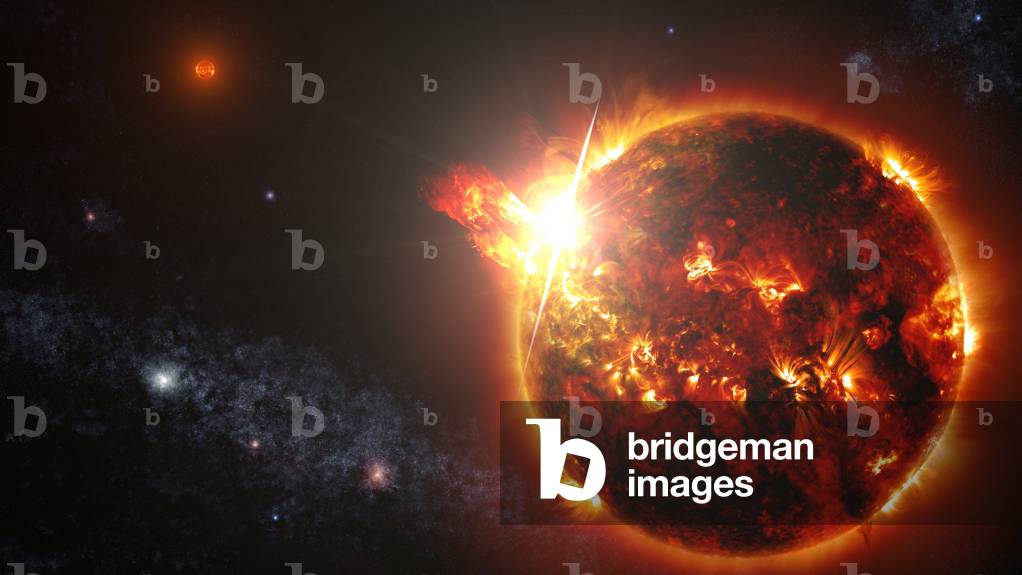
Artist's view of an eruptive star - Flare star - Artwork: DG Canum Venaticorum (DG CVN) is a binary star located in the constellation Hunting Dogs. On 23 April 2014, a powerful gamma eruption from this system was recorded by the Swift satellite. DG Canum Venaticorum (DG CVN) is a binary star system in the northern constellation of Canes Venatici. On 2014 April 23, 2014, a gamma-ray superflare event was observed by the Swift satellite coming from the position of this system. It may have been perhaps the most luminous such events ever observed coming from a red dwarf star
Nova de l'Eagle - Nova Aquilae. Artwork - Artist's view of a nova, a white dwarf star that attracts the material of a companion star at the end of life, a red giant, and compresses these gases and then unleash a nuclear fusion reaction releasing a huge amount of energy in the form of a brief, extremely bright light. Here the artist showed the binary system just before the explosion of the nova. The artist's illustration depicts a classical nova binary system just before an explosion on the surface of the white dwarf. Classical novas occur in a system where a white dwarf closely orbits a normal, companion star. In this illustration, gas is flowing from the large red, companion star into a disk and then onto the white dwarf that is hidden inside the white area. As the gas flows ever closer to the white dwarf, it gets increasingly hotter, as indicated by the change in colors from yellow to white. When the explosion occurs, it engulfs the disk of gas and the red companion star
August 24, 2016: The three stars that make up the Centaur Alpha system are the closest stars to the Sun. Proxima du Centaur is located at a distance of 4.22 light years from the Sun but is invisible to the naked eye. Alpha Centauri A and B are a little further away, 4.36 light years from the Sun. These two stars are relatively similar to the Sun. Although Proxima of Centauri is distant from the Alpha couple of Centauri, its movement seems to link it to this system and is sometimes called Alpha Centauri C - This image of the sky around the bright star Alpha Centauri AB also shows the much fainter red dwarf star, Proxima Centauri, the closest star to the Solar System. The picture was created from pictures forming part of the Digitized Sky Survey 2. The blue halo around Alpha Centauri AB is an artifact of the photographic process, the star is really pale yellow in colour like the Sun
Planetary system around Trappist-1 - Artist's impressions of the TRAPPIST-1 planetary system: Artist's view of extrasolar planets around the red dwarf star TRAPPIST-1. At least seven exoplanets the size of the Earth are orbiting this star 40 light years ago in the constellation Aquarius. All could contain water. This artist's impression shows several of the planets orbiting the ultra-cool red dwarf star TRAPPIST-1. New observations, when combined with very sophisticated analysis, have now yielded good estimates of the densities of all seven of the Earth-sized planets and suggest that they are rich in volatile materials, probably water
The three stars that make up the Centaur Alpha System are the closest stars to the Sun. The image on the left shows the double alpha star of the Centauri (Alpha Centauri A and B) overexposed to the red dwarf star Proxima of the Centaurus (indicated by the arrow). Proxima du Centaur is located at a distance of 4.22 years - light from the Sun but is invisible to the naked eye. Alpha Centauri A and B are a little further away, 4.36 years from the Sun. These two stars are relatively similar to the Sun. Although Proxima of Centauri is distant from the Alpha couple of Centauri, its movement seems to link it to this system and is sometimes called Alpha Centauri C. Location of the Alpha Centauri triple stellar system in the sky. The brighter stars (Alpha Centauri A and B) are strongly overexposed, with the outlying member, Proxima lying approx. 2.2* to the south - west (arrow). Smaller areas around the stars are shown in the inserts to the right. The photo has been reproduced from a blue - sensitive photographic plate obtained by the ESO 1 - m Schmidt Telescope, a wide - angle telescope at the La Silla observatory in Chile that has now been decommissioned. The Alpha Centauri triple stellar system is our closest neighbour in space. It is located at a distance of 4.36 light - years, or 41 million km, in the direction of the southern constellation Centaurus (The Centaur). The two main stars in the system, Alpha Centauri A and Alpha Centauri B, are rather similar to the Sun; their stellar spectral types are “” G2V”” and “” K1V””, respectively. The third star is a “” red dwarf”” known as Proxima. It is much cooler and smaller than the other two. Alpha Centauri A and B orbit each other at a distance of about 3600 million km, or somewhat more than the distance of planet Uranus from the Sun. The orbital period is almost exactly 80 years. Their smaller companion, Proxima, is about
August 24, 2016: The three stars that make up the Centaur Alpha system are the closest stars to the Sun. Proxima du Centaur is located at a distance of 4.22 light years from the Sun but is invisible to the naked eye. Alpha Centauri A and B are a little further away, 4.36 light years from the Sun. These two stars are relatively similar to the Sun. Although Proxima of Centauri is distant from the Alpha couple of Centauri, its movement seems to link it to this system and is sometimes called Alpha Centauri C - This image of the sky around the bright star Alpha Centauri AB also shows the much fainter red dwarf star, Proxima Centauri, the closest star to the Solar System. The picture was created from pictures forming part of the Digitized Sky Survey 2. The blue halo around Alpha Centauri AB is an artifact of the photographic process, the star is really pale yellow in colour like the Sun. Proxima Centauri appears as a faint red star towards the lower-right of the picture
Nebula around the star R Aquarii - R Aquarii and its peculiar nebula - This star is actually a binary system composed of a giant red star (in the center) and a white dwarf (invisible in this photo). Image obtained by Siding Spring's 3.9m telescope. The star at the centre of this unique nebula has been known to be variable since 1810. It has a period of a little over a year, but the brightness shifts are erratic, ranging from the threshold of naked eye visibility to about 200 times fainter. At the centre of the nebula is a symbiotic star, an interacting pair consisting of a red giant and white dwarf. The dwarf draws in material from the giant, occasionally ejecting the surplus as the strange loops seen in the colour picture. The white dwarf itself is invisible and the light from the red dwarf is truly red, perhaps because the whole system is embedded in very dusty nebula which absorbs what blue light there is
Exoplanete BD+48 738c - Illustration of an extrasolar planet orbiting a red dwarf star. In the sky, close to the dwarf star, the giant red star BD+48 738. It's a large planet, which may be a small brown dwarf, that orbits a red dwarf star. According to one reference: “”... one of the massive, dying stars - - BD+48 738 - - is accompanied not only by an enormous, Jupiter - like planet, but also by a second, mystery object. According to the team, this object could be another planet, a low - mass star, or - - most interestingly - - a brown dwarf, which is a star - like body that is intermediate in mass between the coolest stars and giant planets.
The evolution of the Sun - Illustration - The evolution of the Sun - Illustration - Artist's view of the evolution of a yellow star, such as the Sun
The evolution of the Sun - Illustration - The evolution of the Sun - Illustration - Artist's view of the evolution of a yellow star like the Solei
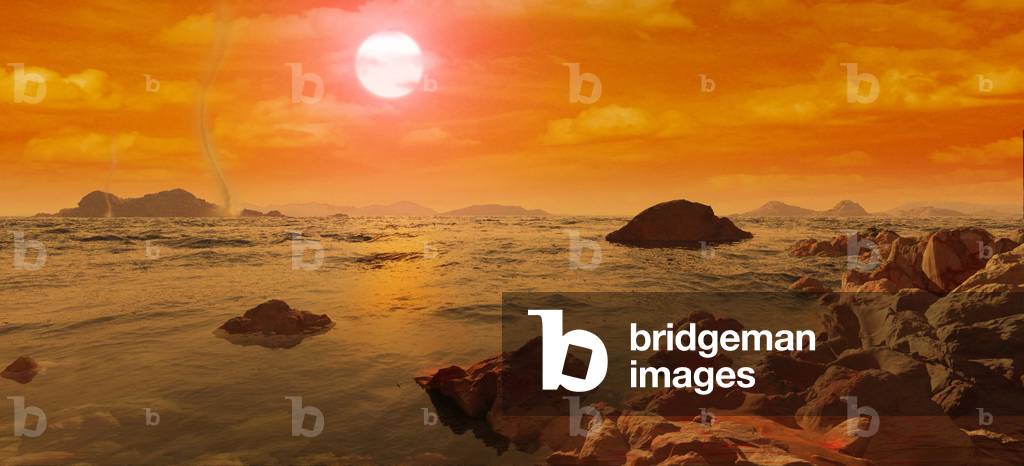
Planetary system around Trappist-1 - Artist's impression of the TRAPPIST-1 planetary system: Artist's view of extrasolar planets around the red dwarf star TRAPPIST-1. At least seven exoplanets the size of the Earth are orbiting this star 40 light years ago in the constellation Aquarius. This artist's impression shows the view from the surface of one of the planets in the TRAPPIST-1 system. At least seven planets orbit this ultra cool dwarf star 40 light-years from Earth in Aquarius constellation and they are all roughly the same size as the Earth. They are at the right distances from their star for liquid water to exist on the surfaces of several of them.
Exoplanete Gliese 581 e: Artist's view of the extrasolar planet Gliese 581 e. Artist's impression of the star red dwarf Gliese 581 shining with the extrasolar planet Gliese 581 e foreground
Life on an exoplanet - Life on a red dwarf exoplanet: Traces of vegetation on the surface of an exoplanet orbiting around a red dwarf. Struggle for life in the twilight zone of a red dwarf planet
Exoplanete Ross 128 b: Ross 128 b is an extrasolar planet probably of an Earth type, located only 11 light years from Earth in the constellation of the Virgin. Planet Ross 128 b, with its red dwarf parent star in the background. This planet, which lies only 11 light-years from Earth, was found by a team using Eso's unique planet-hunting HARPS instrument. The new world is now the second-closest temperate planet to be detected after Proxima b. It is also the closest planet to be discovered orbiting an inactive red dwarf star, which may increase the likelihood that this planet could potentially sustain life. Ross 128 b will be a prime target for Eso's Extremely Large Telescope, which will be able to search for biomarkers in the planet's atmosphere
Exoplanete Ross 128 b: Ross 128 b is an extrasolar planet probably of an Earth type, located only 11 light years from Earth in the constellation of the Virgin. Planet Ross 128 b, with its red dwarf parent star in the background. This planet, which lies only 11 light-years from Earth, was found by a team using Eso's unique planet-hunting HARPS instrument. The new world is now the second-closest temperate planet to be detected after Proxima b. It is also the closest planet to be discovered orbiting an inactive red dwarf star, which may increase the likelihood that this planet could potentially sustain life.
Exoplanete GJ 1214 b - Exoplanet GJ 1214 b - Illustration showing the transit of the extrasolar planet GJ 1214 b in front of its star, the red dwarf GJ 1214, in the constellation Ophiuchus. GJ 1214 b is a super Earth, six times the mass of the Earth, which has an atmosphere but is too inhospitable to shelter life as we know it. This artist's impression shows how the super - Earth surrounding the nearby star GJ1214 may look. Discovered by the Mearth project and investigated further by the HARPS spectrograph on ESO's 3.6 - metre telescope at La Silla, GJ1214b is the second super - Earth exoplanet for which astronomers have determined the mass and radius, giving vital clues about its structure. It is also the first super - Earth around which an atmosphere has been found. The exoplanet, orbiting a small star only 40 light - years away from us, thus opens dramatic new perspectives in the quest for habitable worlds. The planet, GJ1214b, has a mass about six times that of Earth and its interior is likely mostly made of water ice. It appears to be rather hot and surrounded by a thick atmosphere, which makes it inhospitable for life as we know it on Earth
Earth-type exoplanete around Centauri Proxima - Artist's impression of the planet orbiting Proxima Centauri: Artist's view of Planet Proxima b orbiting around the red dwarf star Proxima of Centauri, the closest star to the solar system. The double star Alpha Centauri AB is visible at the top right of the image. Proxima b is slightly more massive than the Earth, orbit in habitable areas where the temperature would allow the presence of liquid water on its surface. This artist's impression shows a view of the planet Proxima b orbiting the red dwarf star Proxima Centauri, the closest star to the Solar System. The double star Alpha Centauri AB also appears in the image to the upper-right. Proxima b is a little more massive than the Earth and orbits in the habitable zone around Proxima Centauri, where the temperature is suitable for liquid water to exist on its surface
Dwarf Jamaican Heliconia, Kew Gardens, London. (photo)
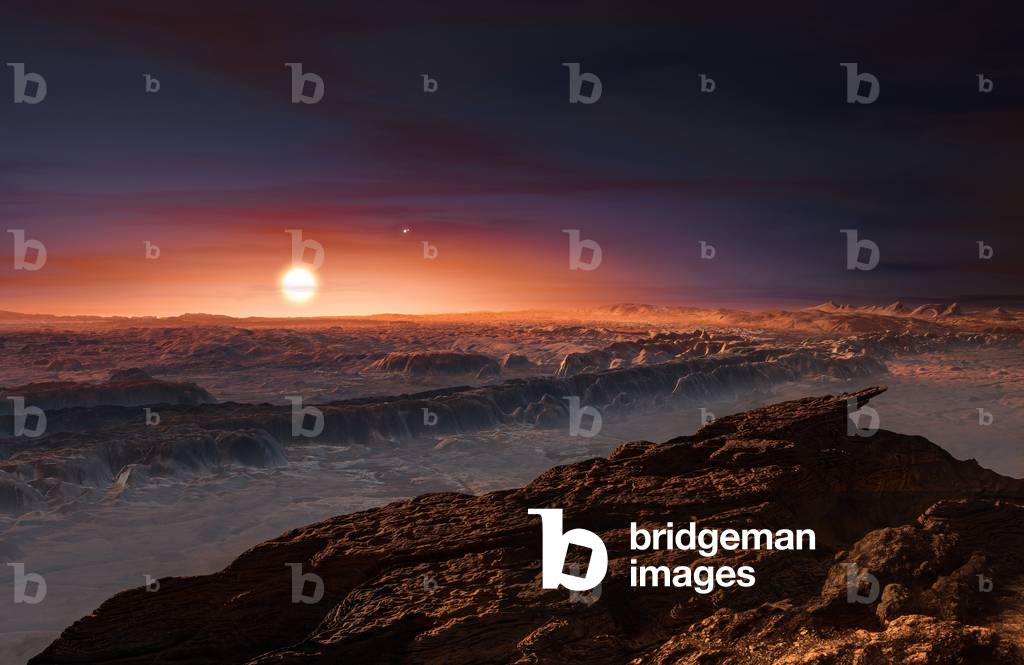
August 24, 2016: Artist's view of the surface of Planet Proxima b orbiting the red dwarf star Proxima of Centaur, the closest star to the solar system. The double star Alpha Centauri AB is visible at the top right of the star Proxima. Proxima b is a little more massive than the Earth, orbit in habitable area where the temperature would allow the presence of liquid water on its surface - This artist's impression shows a view of the surface of the planet Proxima b orbiting the red dwarf star Proxima Centauri, the closest star to the Solar System. The double star Alpha Centauri AB also appears in the image to the upper-right of Proxima itself. Proxima b is a little more massive than the Earth and orbits in the habitable zone around Proxima Centauri, where the temperature is suitable for liquid water to exist on its surface
Hertzsprung - Russell - The Hertzsprung - Russell diagram - HR diagram (Hertzsprung - Russell) displaying stars according to their surface temperature and luminosite. The Hertzsprung - Russell diagram is named after the Danish astronomer Einar Hertzsprung (1873 - 1967) and the American astronomer Henry Norris Russell (1877 - 1957). At the beginning of the 20th century they independently noticed that red stars come in very different sizes, pioneering subsequent studies of stellar parameters (e.g., temperature, size and mass). In its basic version, this diagram plots stellar temperature (or colour) against brightness (or magnitude) and is therefore also referred to as the “” colour - magnitude diagram””. The position of a particular star in the diagram also provides information about its evolutionary stage (and age)
Hertzsprung - Russell - The Hertzsprung - Russell diagram - Hertzsprung - Russell (HR) diagram displaying stars according to their surface temperature and luminosite. The Hertzsprung - Russell diagram is named after the Danish astronomer Einar Hertzsprung (1873 - 1967) and the American astronomer Henry Norris Russell (1877 - 1957). At the beginning of the 20th century they independently noticed that red stars come in very different sizes, pioneering subsequent studies of stellar parameters (e.g., temperature, size and mass). In its basic version, this diagram plots stellar temperature (or colour) against brightness (or magnitude) and is therefore also referred to as the “” colour - magnitude diagram””. The position of a particular star in the diagram also provides information about its evolutionary stage (and age)
August 24, 2016: Artist's view of Planet Proxima b orbiting the red dwarf star Proxima of Centaur, the closest star to the solar system. The double star Alpha Centauri AB is visible between the planet and the star Proxima. Proxima b is a little more massive than Earth, orbit in habitable area or temperature would allow the presence of liquid water on its surface - This artist's impression shows the planet Proxima b orbiting the red dwarf star Proxima Centauri, the closest star to the Solar System. The double star Alpha Centauri AB also appears in the image between the planet and Proxima itself. Proxima b is a little more massive than the Earth and orbits in the habitable zone around Proxima Centauri, where the temperature is suitable for liquid water to exist on its surface
Hertzsprung - Russell - The Hertzsprung - Russell diagram - HR diagram (Hertzsprung - Russell) displaying stars according to their surface temperature and luminosite. The Hertzsprung - Russell diagram is named after the Danish astronomer Einar Hertzsprung (1873 - 1967) and the American astronomer Henry Norris Russell (1877 - 1957). At the beginning of the 20th century they independently noticed that red stars come in very different sizes, pioneering subsequent studies of stellar parameters (e.g., temperature, size and mass). In its basic version, this diagram plots stellar temperature (or colour) against brightness (or magnitude) and is therefore also referred to as the “” colour - magnitude diagram””. The position of a particular star in the diagram also provides information about its evolutionary stage (and age)
Little Tern (print)
Earth-type exoplanete around Centauri Proxima - Artist's impression of the planet orbiting Proxima Centauri: Artist's view of the surface of the planet Proxima b orbiting around the red dwarf star Proxima of Centauri, the closest star to the solar system. Proxima b is slightly more massive than the Earth, orbit in habitable areas where the temperature would allow the presence of liquid water on its surface. This artist's impression shows a view of the surface of the planet Proxima b orbiting the red dwarf star Proxima Centauri, the closest star to the Solar System. Proxima b is a little more massive than the Earth and orbits in the habitable zone around Proxima Centauri, where the temperature is suitable for liquid water to exist on its surface
Exoplanete Gliese 581d - Illustration - Artist's view of the star Gliese 581 in the sky of the extrasolar planet Gliese 581 d. Discovered in 20074, this exoplanet in the constellation Libra is considered to be potentially habitable. The atmosphere is dense and its thick cloud layer would plunge the surface into a reddish shade. Artist's impression of the star red dwarf Gliese 581 shining in the sky of the extrasolar planet Gliese 581 d. This exoplanet located in the habitable zone of its star could harbor extraterrestrial life
Artist view of the planetary system around Gliese 581 - Planetary system around the red dwarf Gliese 581 - Artist view of the planetary system around the star Gliese 581. In the foreground, the exoplanet Gliese 581st. In the background, Gliese 581d (blueberry), in the center Gliese 581c and near the star, Gliese 581b. Gliese 581e (foreground) is only about twice the mass of our Earth. The Gliese 581 planetary system now has four known planets, with masses of about 1.9 (planet e, left in the foreground), 16 (planet b, nearest to the star), 5 (planet c, centre), and 7 Earth - masses (planet d, with the bluish colour). The planet furthest out, Gliese 581d, orbits its host star in 66.8 days, while Gliese 581 e completes its orbit in 3.15 days
Life forms on the surface of Gliese 581 c - Flying fauna over Gliese 581 c - Artist's view of the exoplanet Gliese 581c housing an alien life form. Gliese 581c, with a radius of 1.5 times that of the Earth, is the first exoplanet gathering the necessary elements to imagine the existence of a possible extra-terrestrial life. From its surface, its star, about 100 times less bright than our Sun, must be large in the sky because of its proximity to the planet. Gliese 581 b, another planet in this system, passes past this star. Flying life forms grace the crimson skies of the potentially earth - like extrasolar planet Gliese 581 v. The red dwarf star Gliese 581 rests on the horizon, presiding over a liquid water sea. Eclipsing the red dwarf is Gliese 581 b, a sister planet in the same system with a mass 17 times that of the Earth. While the existence of all three bodies has been confirmed, it is not known if Gliese 581 c has all the necessary ingredients to support life as we know it
Gl 581c: discovery of a habitable planet - Gl 581c: discovery of an habitable planet - Artist's view of the exoplanet Gliese 581c. Gliese 581c, with a radius of 1.5 times that of the Earth, is the first exoplanet gathering the necessary elements to imagine the existence of a possible extra-terrestrial life. From its surface, its star, about 100 times less bright than our Sun, must be large in the sky because of its proximity to the planet. In April 2007 the Geneva Observatory in Switzerland announced the discovery of a “super - earth”” extrasolar planet orbiting the red dwarf star Gliese 581. Dubbed Gliese 581 c, it's been called a super - earth because it is one of the few known extrasolar planets that has a mass near Earth's, and the only one to occupy its sun's “” habitable zone.”” Gliese 581 c is believed to be about five times more massive than the Earth with a diameter about half - again as large as Earth's. Depending upon the planet's composition, whether mostly rock or a combination of rock a water, a visitor would experience a surface gravity between 1.25 to 2.2 times the Earth's. Gliese 581 c is about 20 light years away, a “” next door neighbor”” in stellar terms, but far beyond the reach of human visitors with today's technology. There is special interest in Gliese 581 c because it is the only known extrasolar planet where liquid water - - a necessary ingredient for life as we know it - - could exist. Surface temperatures are believed to range between the freezing point of water to about 100* F. However, there are other factors that could affect these values, including the possibility that Gliese 581 c always keeps the same side facing its host star, with the result that one side would become extremely hot while the other extremely cold. In this image from the surface of Gliese 581 c, its red dwarf host hangs low in the sky over a rocky and watery terrain. This sun has a diameter and radius about a third that of the earth
Poinciana, Caesalpinia pulcherrima (Poinciana pulcherrima)
Restrictions relatives au partenaire de contenu
  • Not available to clients invoiced in Japan
Remains of supernova SN 1006 - Supernova remnant SN 1006 - Remains of supernova SN 1006 located 7000 years ago - light in the constellation Wolf. This supernova that appeared in 1006 is the result of a white dwarf star that absorbs the matter of a companion star became unstable and eventually exploded. This image is a composite of X-ray images obtained by the Chandra telescope (blue), by Cerro Tololo's 90 cm telescope (yellow) and by the Digitized Sky Survey (orange and light blue), and by the VLA and the Green Bank's telescope radio (red). Just over a thousand years ago, the stellar explosion known as supernova SN 1006 was observed. It was brighter than Venus, and visible during the day for weeks. The brightest supernova ever recorded on Earth, this spectacular light show was documented in China, Japan, Europe, and the Arab world. Astronomers now understand that SN 1006 was caused by a white dwarf star that captured mass from a companion star until the white dwarf became unstable and exploded. Recent observations of the remnant of SN 1006 reveal the liberation of elements such as iron that were previously locked up inside the star. Because no material falls back into a neutron star or black hole after this type of supernova explosion, the liberation of this star's contents is complete. This is a composite image of the SN 1006 supernova remnant, which is located about 7000 light years from Earth. Shown here are X - ray data from Nasa's Chandra X - ray Observatory (blue), optical data from the University of Michigan's 0.9 meter Curtis Schmidt telescope at the NSF's Cerro Tololo Inter - American Observatory (CTIO; yellow) and the Digitized Sky Survey (orange and light blue), plus radio data from the NRAO's Very Large Array and Green Bank Telescope (VLA/GB/GBV T ; red)
Exoplanet and Red Giant - Artist view
Instructions spéciales
  • No additional copyright fee required
Kepler-186f (also known by its Kepler Object of Interest designation KOI-571
Exoplanete near a star at the end of life - A dying star sheds its outer layers - An artist's view of a star that, like the Sun at the end of life, turns into a red giant, and expels its upper layers into concentric circles, before becoming a white dwarf. In the foreground, an exoplanet distant from its star that sees its surface reheat. When a star like our sun nears the end of its life, it expands to more than 50 times its original diameter, becoming a red giant. Then over the next several tens of thousands of years the star episodically ejects its outer layers into space, sometimes producing concentric shells. These ejected layers eventually form a planetary nebula. What will subsequently remain of the star is a small, extremely hot core which cools off to become a white dwarf. In this image a red giant star expels its first of many shells of gas into space. In the years to come this spherical shell will grow outward, its circumference eventually expanding far beyond the orbit of this planet. As for this planet, being so far from its parent sun for most of its life has kept it in a deep, dark freeze for the past ten billion years (think Pluto). It has been during only the past 100 million years, when its sun first blossomed into a red giant, that this planet has experienced such light and warmth. This effluence is short - lived, however; in about another million years darkness and cold will again be the norm for this world
Artist's impression of the Exoplanète Proxima Centauri
Instructions spéciales
  • No additional copyright fee required
Exoplanets Gliese 876 e and b
Instructions spéciales
  • No additional copyright fee required
Helix planetary nebula (NGC 7293) in Aquarius by HST - Helice's planetary nebula, located in Aquarius, is one of the closest to Earth (650 years - light) and is also one of the most extended. Its apparent diameter is about half of the full moon. It was obtained from two clicks taken by the ACS panoramic camera of the Hubble Space Telescope and from the 90 cm telescope of Kitt Peak in Arizona. It reveals unseen details of the filamentary structure of the blue and red gas ring that surrounds the starred star (in the centre of the nebula). In the center of the image, the star that expelled its material became a white dwarf
Exoplanete OGLE-2013-BLG-0341L Bb - Artist's view: OGLE-2013-BLG-0341L Bb is an exoplanet about twice the mass of the Earth gravitating around the red dwarf OGLE-2013-BLG-0341L B, a secondary component of the binary star OGLE-2013-BLG-0341L located in the constellation. OGLE-2013-BLG-0341LBB, is located in the constellation Sagittarius, about 3,000 light-years away. It is twice the mass of Earth, and orbits one of the stars in the binary system at almost exactly the same distance from which Earth orbits the Sun. But its star is 400 times dimmer than our Sun, so the exoplanet is very cold - around minus 213 degrees Celsius
Artist's impression of the Teegarden b
Instructions spéciales
  • No additional copyright fee required
Futuristic advertising poster for tourism on Trappist-1e - Illustration - Futuristic Advert for tourism on Trappist-1e - Illustration: Advertising promoting tourism on Trappist-1e. This exoplanet is orbiting in the habitable zone of the star system TRAPPIST-1, a red dwarf star located at a distance of about 40 light years from the Sun in the constellation Aquarius. At least seven exoplanets the size of the Earth orbit this star. Some 40 light-years from Earth, a planet called Trappist-1e offers a heart-stopping view: brilliant objects in a red sky, looming like larger and smaller versions of our own moon. But these are no moons. They are Earth-sized planets in a spectacular planetary system outside our own. These seven rocky worlds huddle around their small, dim, red star, like a family around a campfire. Any of them could harbor liquid water, but the planet shown here, fourth from the TRAPPIST-1 star, is in the habitable zone, the area around the star where liquid water is most likely to be detected. This system was revealed by the Transiting Planets and PlaneteSimals Small Telescope (TRAPPIST) and Nasa's Spitzer Space Telescope. Take a planet-hopping excursion through the TRAPPIST-1 system.
White Dwarf star Sirius B, c 2000
Restrictions relatives au partenaire de contenu
  • Not available to clients invoiced in the UK
Artist's impression of extrasolar planet LP 791-18 d (photo)
Artist impression of Oumuamua
Instructions spéciales
  • No additional copyright fee required
The constellation Centaurus, featuring Alpha Centauri, 1603
Restrictions relatives au partenaire de contenu
  • Not available to clients invoiced in the UK
Artist's impression of sunset on the super - Earth world Gliese 667 Cc - This artist's view represents a sunset seen from Super Earth Gliese 667Cc. The brightest star in the sky is the red dwarf Gliese 667 C, which is part of a triple star system. The other two more distant stars, Gliese 667 A and B also appear right in the sky. Gliese 667 Cc is an exoplanet orbiting the star Gliese 667 C, located about 23 years from Earth in the constellation of the scorpion. This super Earth was detected using the HARPS program at the La Silla Observatory in Chile in October 2009. This artist's impression shows a sunset seen from the super - Earth Gliese 667 Cc. The brightest star in the sky is the red dwarf Gliese 667 C, which is part of a triple star system. The other two more distant stars, Gliese 667 A and B appear in the sky also to the right. On 19 October 2009, the team who built the High Accuracy Radial Velocity Planet Searcher, better known as HARPS, the spectrograph for ESO's 3.6 - metre telescope, reported on the incredible discovery of some 32 new exoplanets, cementing Harps's position as the world's foremost exoplanet hunter. One of these is surrounding the star Gliese 667 C, which belongs to a triple system. The 6 Earth - mass exoplanet circulates around its low - mass host star at a distance equal to only 1/20th of the Earth - Sun distance
Exoplanete Kepler-186f - Kepler-186f, the first Earth-size Planet in the Habitable Zone: Kepler-186f is the first Earth-size planet in the habitable zone of its star to be discovered. It orbits Kepler-186, a red dwarf located in the constellation of Swan, between 490 and 500 light years of the Earth. Kepler-186f, the first Earth-size Planet in the Habitable Zone. The artist's concept depicts Kepler-186f, the first validated Earth-size planet to orbit a distant star in the habitable zone - a range of distance from a star where liquid water might pool on the planet's surface. The discovery of Kepler-186f confirms that Earth-size planets exist in the habitable zones of other stars and signals a significant step closer to finding a world similar to Earth. The size of Kepler-186f is known to be less than ten percent larger than Earth, but its mass, composition and density are not known. Previous research suggests that a planet the size of Kepler-186f is likely to be rocky. Prior to this discovery, the “” record holder”” for the most “” Earth-like”” planet went to Kepler-62F, which is 40 percent larger than the size of Earth and orbits in its star's habitable zone. Kepler-186f orbits its star once every 130 days and receives one-third the energy that Earth does from the sun, placing it near the outer edge of the habitable zone. If you could stand on the surface of Kepler-186f, the brightness of its star at high noon would appear as bright as our sun is about an hour before sunset on Earth. Kepler-186f resides in the Kepler-186 system about 500 light-years from Earth in the constellation Cygnus. The system is also home to four inner planets, seen lined up in orbit around a host star that is half the size and mass of the sun
Artist impression of Oumuamua
Instructions spéciales
  • No additional copyright fee required
Small Lark from Buenos Aires and Black Lark from Ensenada (print)
Exoplanete Kepler-186f - Kepler-186f, the first Earth-size Planet in the Habitable Zone: Kepler-186f is the first Earth-size planet in the habitable zone of its star to be discovered. It orbits Kepler-186, a red dwarf located in the constellation of Swan, between 490 and 500 light years of the Earth. Kepler-186f, the first Earth-size Planet in the Habitable Zone. The artist's concept depicts Kepler-186f, the first validated Earth-size planet to orbit a distant star in the habitable zone - a range of distance from a star where liquid water might pool on the planet's surface. The discovery of Kepler-186f confirms that Earth-size planets exist in the habitable zones of other stars and signals a significant step closer to finding a world similar to Earth. The size of Kepler-186f is known to be less than ten percent larger than Earth, but its mass, composition and density are not known. Previous research suggests that a planet the size of Kepler-186f is likely to be rocky. Prior to this discovery, the “” record holder”” for the most “” Earth-like”” planet went to Kepler-62F, which is 40 percent larger than the size of Earth and orbits in its star's habitable zone. Kepler-186f orbits its star once every 130 days and receives one-third the energy that Earth does from the sun, placing it near the outer edge of the habitable zone. If you could stand on the surface of Kepler-186f, the brightness of its star at high noon would appear as bright as our sun is about an hour before sunset on Earth. Kepler-186f resides in the Kepler-186 system about 500 light-years from Earth in the constellation Cygnus. The system is also home to four inner planets, seen lined up in orbit around a host star that is half the size and mass of the sun
Kepler - 186f, the first Earth - size Planet in the Habitable Zone - Kepler - 186f is the first Earth-sized planet in the habitable zone of its star to be discovered. It orbits Kepler - 186, a red dwarf located in the constellation of Swan, between 490 and 500 years of light from the Earth. The artist's concept depicts Kepler - 186f, the first validated Earth - size planet to orbit a distant star in the habitable zone - - a range of distance from a star where liquid water might pool on the planet's surface. The discovery of Kepler - 186f confirms that Earth - size planets exist in the habitable zones of other stars and signals a significant step closer to finding a world similar to Earth. The size of Kepler - 186f is known to be less than ten percent larger than Earth, but its mass, composition and density are not known. Previous research suggests that a planet the size of Kepler - 186f is likely to be rocky. Prior to this discovery, the “” record holder”” for the most “” Earth - like”” planet went to Kepler - 62f, which is 40 percent larger than the size of Earth and orbits in its star's habitable zone. Kepler - 186f orbits its star once every 130 days and receives one - third the energy that Earth does from the sun, placing it near the outer edge of the habitable zone. If you could stand on the surface of Kepler - 186f, the brightness of its star at high noon would appear as bright as our sun is about an hour before sunset on Earth. Kepler - 186f resides in the Kepler - 186 system about 500 light - years from Earth in the constellation Cygnus. The system is also home to four inner planets, seen lined up in orbit around a host star that is half the size and mass of the sun. The artistic concept of Kepler - 186f is the result of scientists and artists collaborating to imagine the appearance of these distant worlds
Royal Antelope (print)