[]
您当前的选择
资产 资产
您的报价 0

您的选择

清除选择
商品已加入购物车
{"event":"pageview","page_type1":"undetected","page_type2":"_assets_search_override","language":"cn","user_logged":"false","user_type":"ecommerce","nl_subscriber":"false"}
{"event":"ecommerce_event","event_name":"view_item","event_category":"browse_catalog","ecommerce":{"items":[{"item_id":"PIX4608398","item_category":"photo","item_category2":"no_copyright","item_category3":"standard","item_category5":"not_balown","item_list_name":"search_results","item_name":"planetary_system_around_trappist_1_artist_s_impressions_of_the_trappist_1_planetary_system_artist_s_","item_variant":"undefined"},{"item_id":"PIX4608442","item_category":"photo","item_category2":"no_copyright","item_category3":"standard","item_category5":"not_balown","item_list_name":"search_results","item_name":"planetary_system_around_trappist_1_artist_s_impressions_of_the_trappist_1_planetary_system_artist_s_","item_variant":"undefined"},{"item_id":"PIX4608435","item_category":"photo","item_category2":"no_copyright","item_category3":"standard","item_category5":"not_balown","item_list_name":"search_results","item_name":"planetary_system_around_trappist_1_artist_s_impressions_of_the_trappist_1_planetary_system_artist_s_","item_variant":"undefined"},{"item_id":"PIX4607298","item_category":"photo","item_category2":"no_copyright","item_category3":"standard","item_category4":"walter_b_myers","item_category5":"not_balown","item_list_name":"search_results","item_name":"the_dawn_probe_near_ceres_artist_s_view_dawn_approaches_ceres_artist_view_of_the_dawn_probe_near_the","item_variant":"undefined"},{"item_id":"PIX4574228","item_category":"photo","item_category2":"no_copyright","item_category3":"standard","item_category4":"miller_ron_b_1947","item_category5":"not_balown","item_list_name":"search_results","item_name":"exoplanets_around_a_white_dwarf_illustration_white_dwarf_system_artwork","item_variant":"undefined"},{"item_id":"PIX4630011","item_category":"photo","item_category2":"no_copyright","item_category3":"standard","item_category4":"walter_b_myers","item_category5":"not_balown","item_list_name":"search_results","item_name":"comparison_between_the_earth_ceres_and_the_moon_ceres_earth_earth_s_moon_compared_comparison_at_the_","item_variant":"undefined"},{"item_id":"PIX4607656","item_category":"photo","item_category2":"no_copyright","item_category3":"standard","item_category4":"miller_ron_b_1947","item_category5":"not_balown","item_list_name":"search_results","item_name":"exoplanets_around_a_brown_dwarf_artist_view_brown_dwarf_exoplanets_artist_rendering","item_variant":"undefined"},{"item_id":"PIX4607680","item_category":"photo","item_category2":"no_copyright","item_category3":"standard","item_category4":"miller_ron_b_1947","item_category5":"not_balown","item_list_name":"search_results","item_name":"exoplanets_around_a_brown_dwarf_artist_view_brown_dwarf_exoplanets_artist_rendering","item_variant":"undefined"},{"item_id":"PIX4607669","item_category":"photo","item_category2":"no_copyright","item_category3":"standard","item_category4":"miller_ron_b_1947","item_category5":"not_balown","item_list_name":"search_results","item_name":"exoplanets_around_a_brown_dwarf_artist_view_brown_dwarf_exoplanets_artist_rendering","item_variant":"undefined"},{"item_id":"PIX4607660","item_category":"photo","item_category2":"no_copyright","item_category3":"standard","item_category4":"miller_ron_b_1947","item_category5":"not_balown","item_list_name":"search_results","item_name":"exoplanets_around_a_brown_dwarf_artist_view_brown_dwarf_exoplanets_artist_rendering","item_variant":"undefined"},{"item_id":"PIX4572490","item_category":"photo","item_category2":"no_copyright","item_category3":"standard","item_category4":"l_bret","item_category5":"not_balown","item_list_name":"search_results","item_name":"the_smallest_stars_artist_s_view_the_smallest_stars_artwork_comparison_to_the_scale_of_the_smallest_","item_variant":"undefined"},{"item_id":"PIX4573338","item_category":"photo","item_category2":"no_copyright","item_category3":"standard","item_category5":"not_balown","item_list_name":"search_results","item_name":"exoplanets_around_a_red_dwarf_star_exoplanets_around_a_red_dwarf_star_artist_s_view_of_extrasolar_pl","item_variant":"undefined"},{"item_id":"UIG2628619","item_category2":"no_copyright","item_category3":"standard","item_category5":"not_balown","item_list_name":"search_results","item_name":"the_dwarf_planet_pluto","item_variant":"undefined"},{"item_id":"PIX4608349","item_category":"photo","item_category2":"no_copyright","item_category3":"standard","item_category4":"miller_ron_b_1947","item_category5":"not_balown","item_list_name":"search_results","item_name":"exoplanete_moa_2007_blg_192l_b_moa_2007_blg_192l_b_is_a_confirmed_extrasolar_planet_exoplanet_orbiti","item_variant":"undefined"},{"item_id":"PIX4607329","item_category":"photo","item_category2":"no_copyright","item_category3":"standard","item_category4":"walter_b_myers","item_category5":"not_balown","item_list_name":"search_results","item_name":"artist_s_view_of_the_new_horizons_probe_near_pluto_new_horizons_over_pluto_and_charon_artist_s_view_","item_variant":"undefined"},{"item_id":"PIX4573892","item_category":"photo","item_category2":"no_copyright","item_category3":"standard","item_category5":"not_balown","item_list_name":"search_results","item_name":"exoplanete_gj_1214_b_exoplanet_gj_1214_b_illustration_showing_the_transit_of_the_extrasolar_planet_g","item_variant":"undefined"},{"item_id":"PIX4572535","item_category":"photo","item_category2":"no_copyright","item_category3":"standard","item_category4":"h_piraud","item_category5":"not_balown","item_list_name":"search_results","item_name":"brown_dwarves_oph_1622_artist_s_view_brown_dwarves_oph_1622_these_two_stars_orbit_each_other_in_the_","item_variant":"undefined"},{"item_id":"PIX4573104","item_category":"photo","item_category2":"no_copyright","item_category3":"standard","item_category4":"miller_ron_b_1947","item_category5":"not_balown","item_list_name":"search_results","item_name":"l_exoplanete_2m1207b_vue_d_artiste_exoplanet_2m1207b_artist_rendering_illustration_of_the_extrasolar","item_variant":"undefined"},{"item_id":"PIX4608376","item_category":"photo","item_category2":"no_copyright","item_category3":"standard","item_category5":"not_balown","item_list_name":"search_results","item_name":"planetary_system_around_trappist_1_artist_s_impression_of_the_trappist_1_planetary_system_artist_s_v","item_variant":"undefined"},{"item_id":"PIX4608073","item_category":"photo","item_category2":"no_copyright","item_category3":"standard","item_category4":"miller_ron_b_1947","item_category5":"not_balown","item_list_name":"search_results","item_name":"earth_type_exoplanete_around_centauri_proxima_artist_s_impression_of_the_planet_orbiting_proxima_cen","item_variant":"undefined"},{"item_id":"PIX4574061","item_category":"photo","item_category2":"no_copyright","item_category3":"standard","item_category4":"miller_ron_b_1947","item_category5":"not_balown","item_list_name":"search_results","item_name":"exoplanete_bd_48_738c_illustration_of_an_extrasolar_planet_orbiting_a_red_dwarf_star_in_the_sky_clos","item_variant":"undefined"},{"item_id":"PIX4624547","item_category":"photo","item_category2":"no_copyright","item_category3":"standard","item_category4":"walter_b_myers","item_category5":"not_balown","item_list_name":"search_results","item_name":"pluto_s_atmosphere_artist_s_view_pluto_s_atmosphere_pluto_s_artist_s_view_surrounded_by_its_thin_atm","item_variant":"undefined"},{"item_id":"PIX4589059","item_category":"photo","item_category2":"no_copyright","item_category3":"standard","item_category5":"not_balown","item_list_name":"search_results","item_name":"position_of_the_exoplanet_gliese_581b_position_of_the_exoplanet_gliese_581b_trace_of_the_constellati","item_variant":"undefined"},{"item_id":"PIX4607648","item_category":"photo","item_category2":"no_copyright","item_category3":"standard","item_category4":"miller_ron_b_1947","item_category5":"not_balown","item_list_name":"search_results","item_name":"l_exoplanete_2m1207b_vue_d_artiste_exoplanet_2m1207b_artist_rendering_illustration_of_the_extrasolar","item_variant":"undefined"},{"item_id":"PIX4608001","item_category":"photo","item_category2":"no_copyright","item_category3":"standard","item_category4":"miller_ron_b_1947","item_category5":"not_balown","item_list_name":"search_results","item_name":"exoplanete_gliese_581_e_artist_s_view_of_the_extrasolar_planet_gliese_581_e_artist_s_impression_of_t","item_variant":"undefined"},{"item_id":"PIX4608431","item_category":"photo","item_category2":"no_copyright","item_category3":"standard","item_category4":"miller_ron_b_1947","item_category5":"not_balown","item_list_name":"search_results","item_name":"exoplanete_ross_128_b_ross_128_b_is_an_extrasolar_planet_probably_of_an_earth_type_located_only_11_l","item_variant":"undefined"},{"item_id":"PIX4607776","item_category":"photo","item_category2":"no_copyright","item_category3":"standard","item_category4":"miller_ron_b_1947","item_category5":"not_balown","item_list_name":"search_results","item_name":"life_on_an_exoplanet_life_on_a_red_dwarf_exoplanet_traces_of_vegetation_on_the_surface_of_an_exoplan","item_variant":"undefined"},{"item_id":"PIX4607886","item_category":"photo","item_category2":"no_copyright","item_category3":"standard","item_category4":"miller_ron_b_1947","item_category5":"not_balown","item_list_name":"search_results","item_name":"exoplanete_gliese_876_d_artist_s_view_of_the_extrasolar_planet_gliese_876_d_a_super_earth_in_orbit_a","item_variant":"undefined"},{"item_id":"PIX4607995","item_category":"photo","item_category2":"no_copyright","item_category3":"standard","item_category4":"miller_ron_b_1947","item_category5":"not_balown","item_list_name":"search_results","item_name":"artist_s_view_of_the_exoplanet_gliese_581_b_artist_s_view_of_gliese_581b_an_extrasolar_planet_orbiti","item_variant":"undefined"},{"item_id":"PIX4650952","item_category":"illustration","item_category2":"no_copyright","item_category3":"standard","item_category5":"not_balown","item_list_name":"search_results","item_name":"august_24_2016_artist_s_view_of_planet_proxima_b_orbiting_the_red_dwarf_star_proxima_of_centaur_the_","item_variant":"undefined"},{"item_id":"PIX4650935","item_category":"illustration","item_category2":"no_copyright","item_category3":"standard","item_category5":"not_balown","item_list_name":"search_results","item_name":"august_24_2016_artist_s_view_of_the_surface_of_planet_proxima_b_orbiting_the_red_dwarf_star_proxima_","item_variant":"undefined"},{"item_id":"PIX4607635","item_category":"photo","item_category2":"no_copyright","item_category3":"standard","item_category4":"miller_ron_b_1947","item_category5":"not_balown","item_list_name":"search_results","item_name":"exploration_of_the_exoplanet_2m1207b_artist_view_exoplanet_2m1207b_artist_rendering_a_probe_studies_","item_variant":"undefined"},{"item_id":"PIX4572495","item_category":"photo","item_category2":"no_copyright","item_category3":"standard","item_category4":"l_bret","item_category5":"not_balown","item_list_name":"search_results","item_name":"different_types_of_brown_dwarves_artist_s_view_different_types_of_brown_dwarves_artwork_from_left_to","item_variant":"undefined"},{"item_id":"PIX4608507","item_category":"photo","item_category2":"no_copyright","item_category3":"standard","item_category5":"not_balown","item_list_name":"search_results","item_name":"exoplanete_ross_128_b_ross_128_b_is_an_extrasolar_planet_probably_of_an_earth_type_located_only_11_l","item_variant":"undefined"},{"item_id":"PIX4574280","item_category":"photo","item_category2":"no_copyright","item_category3":"standard","item_category4":"miller_ron_b_1947","item_category5":"not_balown","item_list_name":"search_results","item_name":"u_geminorum_in_the_sky_of_an_exoplanet_u_geminorum_seen_from_an_exoplanet_artwork_u_geminorum_is_a_d","item_variant":"undefined"},{"item_id":"PIX4572483","item_category":"photo","item_category2":"no_copyright","item_category3":"standard","item_category4":"miller_ron_b_1947","item_category5":"not_balown","item_list_name":"search_results","item_name":"artist_s_view_of_a_red_dwarf_star_in_the_sky_of_an_exoplanet_a_red_dwarf_seen_from_an_exoplanet_artw","item_variant":"undefined"},{"item_id":"PIX4624351","item_category":"photo","item_category2":"no_copyright","item_category3":"standard","item_category5":"not_balown","item_list_name":"search_results","item_name":"pluto_seen_by_the_new_horizons_probe_pluto_seen_by_new_horizons_pluto_seen_by_the_new_horizons_probe","item_variant":"undefined"},{"item_id":"PIX4574170","item_category":"photo","item_category2":"no_copyright","item_category3":"standard","item_category4":"miller_ron_b_1947","item_category5":"not_balown","item_list_name":"search_results","item_name":"artist_s_view_of_a_planetary_system_around_au_microscopii_planetary_system_around_au_microscopii_art","item_variant":"undefined"},{"item_id":"PIX4574024","item_category":"photo","item_category2":"no_copyright","item_category3":"standard","item_category4":"miller_ron_b_1947","item_category5":"not_balown","item_list_name":"search_results","item_name":"exoplanete_gliese_581d_illustration_artist_s_view_of_the_star_gliese_581_in_the_sky_of_the_extrasola","item_variant":"undefined"},{"item_id":"PIX4582251","item_category":"photo","item_category2":"no_copyright","item_category3":"standard","item_category5":"not_balown","item_list_name":"search_results","item_name":"pluto_seen_by_the_new_horizons_probe_pluto_seen_by_new_horizons_pluto_s_atmosphere_seen_by_the_new_h","item_variant":"undefined"},{"item_id":"PIX4572545","item_category":"photo","item_category2":"no_copyright","item_category3":"standard","item_category4":"walter_b_myers","item_category5":"not_balown","item_list_name":"search_results","item_name":"brown_dwarf_star_teide_1_brown_dwarf_teide_1_artist_view_of_the_brown_dwarf_star_teide_1_discovered_","item_variant":"undefined"},{"item_id":"PIX4607275","item_category":"photo","item_category2":"no_copyright","item_category3":"standard","item_category4":"walter_b_myers","item_category5":"not_balown","item_list_name":"search_results","item_name":"the_dawn_probe_orbiting_around_ceres_artist_s_view_dawn_in_orbit_around_ceres_artist_s_view_of_the_d","item_variant":"undefined"},{"item_id":"PIX4607362","item_category":"photo","item_category2":"no_copyright","item_category3":"standard","item_category4":"walter_b_myers","item_category5":"not_balown","item_list_name":"search_results","item_name":"new_horizons_closest_approach_to_pluto_artist_s_view_of_the_new_horizons_probe_near_pluto_and_its_la","item_variant":"undefined"},{"item_id":"PIX4669622","item_category2":"no_copyright","item_category3":"standard","item_category4":"miller_ron_b_1947","item_category5":"not_balown","item_list_name":"search_results","item_name":"the_end_of_the_earth_the_sun_become_white_dwarf_earth_s_end_sun_as_a_white_dwarf_the_sun_became_whit","item_variant":"undefined"},{"item_id":"PIX4630042","item_category":"photo","item_category2":"no_copyright","item_category3":"standard","item_category4":"walter_b_myers","item_category5":"not_balown","item_list_name":"search_results","item_name":"dwarf_planets_dwarf_planets_ceres_pluto_and_eris_compared_comparison_at_the_scale_of_dwarf_planets_f","item_variant":"undefined"},{"item_id":"PIX4607277","item_category":"photo","item_category2":"no_copyright","item_category3":"standard","item_category5":"not_balown","item_list_name":"search_results","item_name":"artist_s_view_of_the_new_horizons_probe_near_pluto_the_new_horizons_spacecraft_near_pluto_artist_s_v","item_variant":"undefined"},{"item_id":"PIX4630008","item_category":"photo","item_category2":"no_copyright","item_category3":"standard","item_category4":"walter_b_myers","item_category5":"not_balown","item_list_name":"search_results","item_name":"comparison_between_the_earth_ceres_and_the_moon_ceres_earth_earth_s_moon_compared_comparison_at_the_","item_variant":"undefined"},{"item_id":"PIX4607287","item_category":"photo","item_category2":"no_copyright","item_category3":"standard","item_category5":"not_balown","item_list_name":"search_results","item_name":"dawn_and_vesta_and_ceres_artist_s_concept_of_the_dawn_spacecraft_with_vesta_and_ceres_artist_s_view_","item_variant":"undefined"},{"item_id":"PIX4607330","item_category":"photo","item_category2":"no_copyright","item_category3":"standard","item_category5":"not_balown","item_list_name":"search_results","item_name":"artist_s_view_of_the_new_horizons_probe_near_pluto_the_new_horizons_spacecraft_near_pluto_artist_s_v","item_variant":"undefined"},{"item_id":"PIX7223443","item_category":"illustration","item_category2":"no_copyright","item_category3":"standard","item_category4":"miller_ron_b_1947","item_category5":"not_balown","item_list_name":"search_results","item_name":"the_dwarf_planet_haumea_illustration","item_variant":"undefined"},{"item_id":"PIX4607366","item_category":"photo","item_category2":"no_copyright","item_category3":"standard","item_category4":"walter_b_myers","item_category5":"not_balown","item_list_name":"search_results","item_name":"new_horizons_near_pluto_and_charon_artist_s_view_of_the_new_horizons_probe_near_pluto_and_its_larges","item_variant":"undefined"},{"item_id":"PIX4629992","item_category":"photo","item_category2":"no_copyright","item_category3":"standard","item_category4":"walter_b_myers","item_category5":"not_balown","item_list_name":"search_results","item_name":"comparison_between_the_sizes_of_earth_pluto_charon_and_the_moon","item_variant":"undefined"},{"item_id":"PIX4608079","item_category":"photo","item_category2":"no_copyright","item_category3":"standard","item_category4":"miller_ron_b_1947","item_category5":"not_balown","item_list_name":"search_results","item_name":"earth_type_exoplanete_around_centauri_proxima_artist_s_impression_of_the_planet_orbiting_proxima_cen","item_variant":"undefined"},{"item_id":"PIX4607314","item_category":"photo","item_category2":"no_copyright","item_category3":"standard","item_category5":"not_balown","item_list_name":"search_results","item_name":"artist_s_view_of_the_new_horizons_probe_near_pluto_the_new_horizons_spacecraft_near_pluto_artist_s_v","item_variant":"undefined"},{"item_id":"PIX4607323","item_category":"photo","item_category2":"no_copyright","item_category3":"standard","item_category4":"walter_b_myers","item_category5":"not_balown","item_list_name":"search_results","item_name":"artist_s_view_of_the_new_horizons_probe_near_pluto_new_horizons_over_pluto_and_charon_artist_s_view_","item_variant":"undefined"},{"item_id":"PIX4607991","item_category":"photo","item_category2":"no_copyright","item_category3":"standard","item_category4":"miller_ron_b_1947","item_category5":"not_balown","item_list_name":"search_results","item_name":"exoplanete_gliese_581_d_exoplanet_gliese_581_d_artist_s_view_of_the_star_gliese_581_in_the_sky_of_th","item_variant":"undefined"},{"item_id":"PIX4608101","item_category":"photo","item_category2":"no_copyright","item_category3":"standard","item_category4":"miller_ron_b_1947","item_category5":"not_balown","item_list_name":"search_results","item_name":"earth_type_exoplanete_around_centauri_proxima_artist_s_impression_of_the_planet_orbiting_proxima_cen","item_variant":"undefined"},{"item_id":"PIX4624474","item_category":"photo","item_category2":"no_copyright","item_category3":"standard","item_category5":"not_balown","item_list_name":"search_results","item_name":"pluto_seen_by_the_new_horizons_probe_pluto_seen_in_false_colors_by_the_new_horizons_probe_composite_","item_variant":"undefined"},{"item_id":"PIX4607290","item_category":"photo","item_category2":"no_copyright","item_category3":"standard","item_category5":"not_balown","item_list_name":"search_results","item_name":"artist_s_view_of_the_new_horizons_probe_near_pluto_the_new_horizons_spacecraft_near_pluto_artist_s_v","item_variant":"undefined"},{"item_id":"PIX4629642","item_category":"photo","item_category2":"no_copyright","item_category3":"standard","item_category5":"not_balown","item_list_name":"search_results","item_name":"the_dwarf_planet_eris_illustration_dwarf_planet_eris_artwork_artist_s_view_of_the_dwarf_planet_eris_","item_variant":"undefined"},{"item_id":"PIX4573770","item_category":"photo","item_category2":"no_copyright","item_category3":"standard","item_category4":"walter_b_myers","item_category5":"not_balown","item_list_name":"search_results","item_name":"gl_581c_discovery_of_a_habitable_planet_gl_581c_discovery_of_an_habitable_planet_artist_s_view_of_th","item_variant":"undefined"},{"item_id":"PIX4624533","item_category":"photo","item_category2":"no_copyright","item_category3":"standard","item_category5":"not_balown","item_list_name":"search_results","item_name":"pluto_artist_s_view_artist_s_view_of_pluto_surrounded_by_its_thin_atmosphere_an_artist_s_concept_of_","item_variant":"undefined"},{"item_id":"PIX4572527","item_category":"photo","item_category2":"no_copyright","item_category3":"standard","item_category4":"walter_b_myers","item_category5":"not_balown","item_list_name":"search_results","item_name":"brown_dwarf_with_asteroid_ring_artist_s_view_of_a_brown_dwarf_star_surrounded_by_an_asteroid_belt_in","item_variant":"undefined"},{"item_id":"PIX4573711","item_category":"photo","item_category2":"no_copyright","item_category3":"standard","item_category5":"not_balown","item_list_name":"search_results","item_name":"artist_view_of_the_planetary_system_around_gliese_581_planetary_system_around_the_red_dwarf_gliese_5","item_variant":"undefined"},{"item_id":"PIX4572539","item_category":"photo","item_category2":"no_copyright","item_category3":"standard","item_category4":"walter_b_myers","item_category5":"not_balown","item_list_name":"search_results","item_name":"brown_dwarf_with_a_large_debris_ring_artist_s_view_of_a_brown_dwarf_star_surrounded_by_a_disc_of_dus","item_variant":"undefined"},{"item_id":"PIX4624339","item_category":"photo","item_category2":"no_copyright","item_category3":"standard","item_category5":"not_balown","item_list_name":"search_results","item_name":"pluto_seen_by_the_new_horizons_probe_pluto_seen_by_new_horizons_pluto_seen_by_the_new_horizons_probe","item_variant":"undefined"},{"item_id":"PIX4573851","item_category":"photo","item_category2":"no_copyright","item_category3":"standard","item_category4":"walter_b_myers","item_category5":"not_balown","item_list_name":"search_results","item_name":"life_forms_on_the_surface_of_gliese_581_c_flying_fauna_over_gliese_581_c_artist_s_view_of_the_exopla","item_variant":"undefined"},{"item_id":"PIX4624516","item_category":"photo","item_category2":"no_copyright","item_category3":"standard","item_category4":"miller_ron_b_1947","item_category5":"not_balown","item_list_name":"search_results","item_name":"surface_of_pluto_artist_view_pluto_surface_artist_view_the_icy_surface_of_pluto_icy_surface_of_pluto","item_variant":"undefined"},{"item_id":"PIX4624570","item_category":"photo","item_category2":"no_copyright","item_category3":"standard","item_category4":"miller_ron_b_1947","item_category5":"not_balown","item_list_name":"search_results","item_name":"pluto_surface_artist_view_pluto_surface_artist_view_from_liquid_neon_could_circulate_to_the_surface_","item_variant":"undefined"},{"item_id":"PIX4624719","item_category":"photo","item_category2":"no_copyright","item_category3":"standard","item_category4":"miller_ron_b_1947","item_category5":"not_balown","item_list_name":"search_results","item_name":"pluto_mountains_artist_s_view_norgay_montes_are_mountains_of_ice_that_peak_3400m_above_the_surface_o","item_variant":"undefined"},{"item_id":"PIX4573031","item_category":"photo","item_category2":"no_copyright","item_category3":"standard","item_category4":"p_carril","item_category5":"not_balown","item_list_name":"search_results","item_name":"the_evolution_of_stars_illustration_the_evolution_of_the_stars_illustration_all_stars_are_born_in_in","item_variant":"undefined"},{"item_id":"PIX4572541","item_category":"photo","item_category2":"no_copyright","item_category3":"standard","item_category4":"walter_b_myers","item_category5":"not_balown","item_list_name":"search_results","item_name":"brown_dwarf_debris_ring_from_an_oblique_perspective_artist_s_view_of_a_brown_dwarf_star_about_60_tim","item_variant":"undefined"},{"item_id":"PIX4624378","item_category":"photo","item_category2":"no_copyright","item_category3":"standard","item_category5":"not_balown","item_list_name":"search_results","item_name":"pluto_and_charon_satellite_seen_by_the_new_horizons_probe_on_july_14_2015_at_250_000_km_from_the_dwa","item_variant":"undefined"},{"item_id":"PIX4624582","item_category":"photo","item_category2":"no_copyright","item_category3":"standard","item_category4":"miller_ron_b_1947","item_category5":"not_balown","item_list_name":"search_results","item_name":"cryovolcan_sur_pluto_artist_view_ice_volcano_on_pluto_artist_view_ice_volcano_on_pluto","item_variant":"undefined"},{"item_id":"PIX4624552","item_category":"photo","item_category2":"no_copyright","item_category3":"standard","item_category4":"miller_ron_b_1947","item_category5":"not_balown","item_list_name":"search_results","item_name":"pluto_and_charon_view_d_artiste_pluto_seen_from_above_charon_artist_view_pluto_seen_above_his_satell","item_variant":"undefined"},{"item_id":"PIX4624494","item_category":"photo","item_category2":"no_copyright","item_category3":"standard","item_category4":"miller_ron_b_1947","item_category5":"not_balown","item_list_name":"search_results","item_name":"pluto_and_charon_artist_view_pluto_and_charon_artist_view_pluto_s_icy_surface_with_its_charon_satell","item_variant":"undefined"},{"item_id":"PIX4624553","item_category":"photo","item_category2":"no_copyright","item_category3":"standard","item_category4":"miller_ron_b_1947","item_category5":"not_balown","item_list_name":"search_results","item_name":"pluto_and_charon_artist_view_pluto_in_the_foreground_and_its_satellite_charon_foreground_is_pluto","item_variant":"undefined"},{"item_id":"PIX4624653","item_category":"photo","item_category2":"no_copyright","item_category3":"standard","item_category4":"miller_ron_b_1947","item_category5":"not_balown","item_list_name":"search_results","item_name":"in_the_foothills_of_pluto_s_mountains_norgay_montes_are_icy_mountains_near_the_hillary_montes_that_r","item_variant":"undefined"},{"item_id":"PIX4624600","item_category":"photo","item_category2":"no_copyright","item_category3":"standard","item_category4":"miller_ron_b_1947","item_category5":"not_balown","item_list_name":"search_results","item_name":"ring_around_pluto_view_d_artiste_pluto_s_ring_artist_view_view_of_hypothetical_rings_around_pluto_in","item_variant":"undefined"},{"item_id":"PIX4584153","item_category":"photo","item_category2":"no_copyright","item_category3":"standard","item_category4":"miller_ron_b_1947","item_category5":"not_balown","item_list_name":"search_results","item_name":"artist_s_view_of_ceres_degazages_outgassing_on_ceres_artist_s_view_of_the_dwarf_planet_ceres_with_pa","item_variant":"undefined"},{"item_id":"PIX4624539","item_category":"photo","item_category2":"no_copyright","item_category3":"standard","item_category4":"bergeron_joe","item_category5":"not_balown","item_list_name":"search_results","item_name":"pluto_view_from_charon_view_of_artist_pluto_seen_from_charon_artist_view_pluto_view_in_the_sky_of_hi","item_variant":"undefined"},{"item_id":"PIX4629955","item_category":"photo","item_category2":"no_copyright","item_category3":"standard","item_category4":"m_carroll","item_category5":"not_balown","item_list_name":"search_results","item_name":"comparison_of_sizes_objects_by_kuiper_and_france_planetary_size_comparison_kuiper_objects_with_franc","item_variant":"undefined"},{"item_id":"PIX4624510","item_category":"photo","item_category2":"no_copyright","item_category3":"standard","item_category4":"miller_ron_b_1947","item_category5":"not_balown","item_list_name":"search_results","item_name":"pluto_and_charon_artist_view_pluto_and_charon_artist_view_pluto_s_icy_surface_with_its_charon_satell","item_variant":"undefined"},{"item_id":"PIX4624313","item_category":"photo","item_category2":"no_copyright","item_category3":"standard","item_category5":"not_balown","item_list_name":"search_results","item_name":"pluto_hubble_s_full_photomap_of_pluto_the_dwarf_planet_pluto_seen_by_the_hubble_space_telescope_thes","item_variant":"undefined"},{"item_id":"PIX4624513","item_category":"photo","item_category2":"no_copyright","item_category3":"standard","item_category4":"miller_ron_b_1947","item_category5":"not_balown","item_list_name":"search_results","item_name":"geysers_sur_pluto_artist_view_hot_springs_and_geysers_on_pluto_artist_view","item_variant":"undefined"},{"item_id":"PIX4624317","item_category":"photo","item_category2":"no_copyright","item_category3":"standard","item_category5":"not_balown","item_list_name":"search_results","item_name":"pluto_pluto_the_dwarf_planet_pluto_seen_by_the_hubble_space_telescope_these_images_recomposed_by_com","item_variant":"undefined"},{"item_id":"PIX4582252","item_category":"photo","item_category2":"no_copyright","item_category3":"standard","item_category5":"not_balown","item_list_name":"search_results","item_name":"pluto_seen_by_the_probe_new_horizons_pluto_seen_by_new_horizons_view_of_the_norgay_montes_and_hillar","item_variant":"undefined"},{"item_id":"PIX4584200","item_category":"photo","item_category2":"no_copyright","item_category3":"standard","item_category4":"miller_ron_b_1947","item_category5":"not_balown","item_list_name":"search_results","item_name":"surface_de_ceres_ceres_ice_field_ice_surface_of_the_dwarf_planet_ceres_artist_view","item_variant":"undefined"},{"item_id":"PIX4624656","item_category":"photo","item_category2":"no_copyright","item_category3":"standard","item_category4":"miller_ron_b_1947","item_category5":"not_balown","item_list_name":"search_results","item_name":"pluto_tombaugh_regio_ice_plains_of_pluto_s_artist_view_artist_view_of_the_ice_plains_of_tombaugh_reg","item_variant":"undefined"},{"item_id":"PIX4624643","item_category":"photo","item_category2":"no_copyright","item_category3":"standard","item_category4":"miller_ron_b_1947","item_category5":"not_balown","item_list_name":"search_results","item_name":"surface_of_pluto_artist_view_pluto_surface_artist_view_in_the_sky_of_pluto_the_sun_and_the_satellite","item_variant":"undefined"}]}}
{"event":"custom_event","event_name":"view_search_result","event_category":"browse_catalog","keyword":"planet dwarf","search_type":"standard","search_bridgeman_artists":"false","search_mode":"automatic","search_zero_result":"false","search_results":195,"search_results_page_number":1}

Planet Dwarf' 图片和/或视频结果 page 1 of 3

主要过滤器
购买印刷品选项
免版税选项
电子商务选项
路透社业绩
媒体类型
方向
颜色
权利类型
权利
更多过滤器
布里奇曼艺术家
布里奇曼摄影师
世纪
镜头滤镜
视频原始格式
视频分辨率
视频分类
Filter group
Filter colors
按以下排序:
每页
Filter group
权利类型
媒体类型
无版权
Filter colors

显示选项

View
Image Size

[2, 无限[找到'Planet Dwarf'的图片,195

Planetary system around Trappist-1 - Artist's impressions of the TRAPPIST-1 planetary system: Artist's view of extrasolar planets around the red dwarf star TRAPPIST-1. At least seven exoplanets the size of the Earth are orbiting this star 40 light years ago in the constellation Aquarius. All could contain water. This artist's impression shows several of the planets orbiting the ultra-cool red dwarf star TRAPPIST-1. New observations, when combined with very sophisticated analysis, have now yielded good estimates of the densities of all seven of the Earth-sized planets and suggest that they are rich in volatile materials, probably water
The Dawn probe near Ceres - Artist's view - Dawn approaches Ceres - Artist view of the Dawn probe near the dwarf planet Ceres. In February 2015 the unmanned Dawn spacecraft is scheduled to arrive at the dwarf planet Ceres. The 65 foot long, 2.5 ton probe was launched from the Earth in 2007, passed March in 2009, and went into orbit around the protoplanet Vesta in July 2011 where it stayed until September 2012. Once in orbit around Ceres, Dawn is expected to operate for about a year making observations of this largest object in the asteroid belt. In this image Dawn's three xenon electrostatic ion thrusters can be seen emitting ionized xenon's characteristic blue/magenta glow, gently propelling the probe toward Ceres. While the ion engines have relatively low specific thrust (about equal to the weight of a few sheets of paper), they can operate continuously for long periods making efficient use of the approximately 1,000 pounds of xenon propellant onboard. The wing - like solar arrays produce about 1,300 watts for probe's propulsion and other electrical systems. While no close - up observations of yet been made of Ceres itself, here it is rendered as appearing similar to a much smaller version of the Earth's Moon, heavily cratered with the addition of surface water ice and hypothesized plumes of ice crystals from water geysers on its surface
Exoplanets around a white dwarf - Illustration - White dwarf system - Artwork
特殊说明
  • No additional copyright fee required
Exoplanets around a brown dwarf - Artist view - Brown dwarf Exoplanets - Artist rendering
The dwarf planet Pluto.
Exoplanete MOA-2007-BLG-192L b: MOA-2007-BLG-192L b is a confirmed extrasolar planet (exoplanet) orbiting the brown dwarf star MOA-2007-BLG-192L. Its temperature is freezing (< -200* C). MOA-2007-BLG-192LB, occasionally shortened to MOA-192 b, is an extrasolar planet approximately 3,000 light-years away in the constellation of Sagittarius. The planet was discovered orbiting the brown dwarf or low-mass star MOA-2007-BLG-192L. At a mass of approximately 3.3 times Earth, it is one of the lowest-mass extrasolar planets at the time of discovery
Artist's view of the New Horizons probe near Pluto - New Horizons over Pluto and Charon - Artist's view of the New Horizons probe near Pluto and its largest satellite Charon. The New Horizons probe was launched on 19 January 2006 to Jupiter, then Pluto and Charon, which it will reach in 2015 and Kuiper's objects in 2020. Nasa's New Horizons unmanned spacecraft over dwarf planet Pluto and its moon Charon. New Horizons has been en route to Pluto since its launch from Earth in 2006 and is scheduled to make its closest approach on 14 July 2015. New Horizons is about the size and shape of a grand piano and weighed 1,054 pounds at launch. The high - gain dish antenna is about 7 feet in diameter and is employed for communication with the Earth. In this image the New Horizons spacecraft is about 10,000 miles from Pluto (upper right), 22,000 miles from its largest moon Charon (upper left) and 2.97 billion miles from the Earth. Dominating this side of the spacecraft with an 8 inch aperture is the Long - Range Reconnaissance Imager (LORRI), a digital camera with a large telephoto telescope fortified to operate in the cold, hostile environs of deep space. At 90 days before closest approach to Pluto, Lorri's images will surpass the quality of the best Hubble Space Telescope images of Pluto. While little is known about Pluto's appearance, here this Kuiper belt dwarf planet is realized as a frozen world covered with various ices, hosting a thin atmosphere of nitrogen, methane and other hydrocarbons too possibly, with a significantly weathered surface as Pluto's 248 - year orbit alternately brings it closer then further from the warmth of the sun
Exoplanete GJ 1214 b - Exoplanet GJ 1214 b - Illustration showing the transit of the extrasolar planet GJ 1214 b in front of its star, the red dwarf GJ 1214, in the constellation Ophiuchus. GJ 1214 b is a super Earth, six times the mass of the Earth, which has an atmosphere but is too inhospitable to shelter life as we know it. This artist's impression shows how the super - Earth surrounding the nearby star GJ1214 may look. Discovered by the Mearth project and investigated further by the HARPS spectrograph on ESO's 3.6 - metre telescope at La Silla, GJ1214b is the second super - Earth exoplanet for which astronomers have determined the mass and radius, giving vital clues about its structure. It is also the first super - Earth around which an atmosphere has been found. The exoplanet, orbiting a small star only 40 light - years away from us, thus opens dramatic new perspectives in the quest for habitable worlds. The planet, GJ1214b, has a mass about six times that of Earth and its interior is likely mostly made of water ice. It appears to be rather hot and surrounded by a thick atmosphere, which makes it inhospitable for life as we know it on Earth
L'exoplanete 2M1207B - Vue d'artiste - Exoplanet 2M1207B - Artist rendering - Illustration of the extrasolar planet 2M1207B seen from one of its satellites. 2M1207B is 5 times more massive than Jupiter and is located about 200 years ago - light in the constellation of Hydra. It is orbiting a brown dwarf star, visible at the top left of the image. Artwork of the extrasolar planet 2M1207b seen from one of its moons. This exoplanet is five times the Jupiter mass and is located at about 200 light years in the constellation of Hydra. It orbits around a brown dwarf
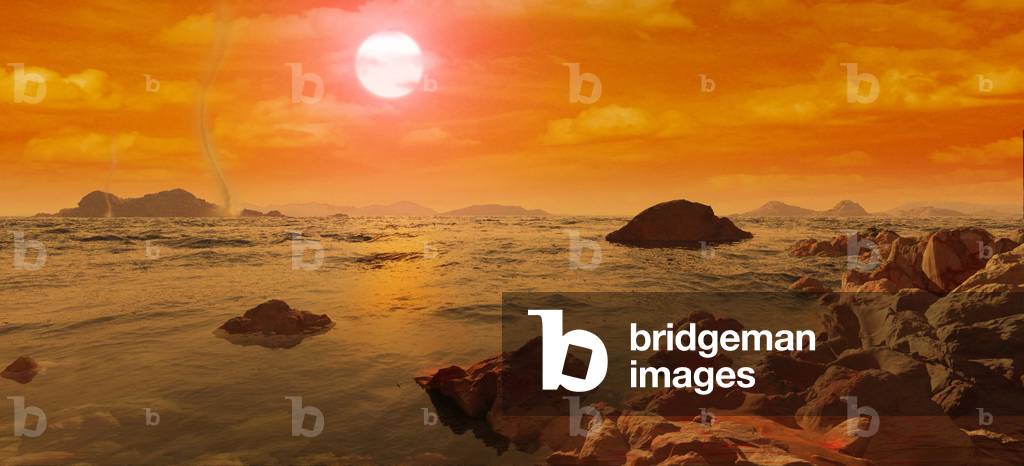
Planetary system around Trappist-1 - Artist's impression of the TRAPPIST-1 planetary system: Artist's view of extrasolar planets around the red dwarf star TRAPPIST-1. At least seven exoplanets the size of the Earth are orbiting this star 40 light years ago in the constellation Aquarius. This artist's impression shows the view from the surface of one of the planets in the TRAPPIST-1 system. At least seven planets orbit this ultra cool dwarf star 40 light-years from Earth in Aquarius constellation and they are all roughly the same size as the Earth. They are at the right distances from their star for liquid water to exist on the surfaces of several of them.
Earth-type exoplanete around Centauri Proxima - Artist's impression of the planet orbiting Proxima Centauri: Artist's view of Planet Proxima b orbiting around the red dwarf star Proxima of Centauri, the closest star to the solar system. The double star Alpha Centauri AB is visible at the top right of the image. Proxima b is slightly more massive than the Earth, orbit in habitable areas where the temperature would allow the presence of liquid water on its surface. This artist's impression shows a view of the planet Proxima b orbiting the red dwarf star Proxima Centauri, the closest star to the Solar System. The double star Alpha Centauri AB also appears in the image to the upper-right. Proxima b is a little more massive than the Earth and orbits in the habitable zone around Proxima Centauri, where the temperature is suitable for liquid water to exist on its surface
Exoplanete BD+48 738c - Illustration of an extrasolar planet orbiting a red dwarf star. In the sky, close to the dwarf star, the giant red star BD+48 738. It's a large planet, which may be a small brown dwarf, that orbits a red dwarf star. According to one reference: “”... one of the massive, dying stars - - BD+48 738 - - is accompanied not only by an enormous, Jupiter - like planet, but also by a second, mystery object. According to the team, this object could be another planet, a low - mass star, or - - most interestingly - - a brown dwarf, which is a star - like body that is intermediate in mass between the coolest stars and giant planets.
Pluto's Atmosphere - Artist's View - Pluto's Atmosphere - Pluto's Artist's View surrounded by its thin atmosphere. In 1985 it was discovered that Pluto has an atmosphere, albeit a very tenuous one. Pluto's atmosphere arises only when it approaches closer to the Sun during its highly eccentric, 248 earth years long orbit. The atmosphere likely consists of nitrogen, methane, and carbon monoxide, which sublimate directly from Pluto's frozen surface. As Pluto's orbit moves it away from the Sun, these gases are believed to slowly precipitate back to Pluto's surface
L'exoplanete 2M1207B - Vue d'artiste - Exoplanet 2M1207B - Artist rendering: Illustration of the extrasolar planet 2M1207B seen from one of its satellites. 2M1207B is 5 times more massive than Jupiter and is located about 200 light years away in the constellation of Hydra. It is orbiting a brown dwarf star, visible at the top left of the image. Artwork of the extrasolar planet 2M1207b seen from one of its moons. This exoplanet is five times the Jupiter mass and is located at about 200 light years in the constellation of Hydra. It orbits around a brown dwarf
Exoplanete Ross 128 b: Ross 128 b is an extrasolar planet probably of an Earth type, located only 11 light years from Earth in the constellation of the Virgin. Planet Ross 128 b, with its red dwarf parent star in the background. This planet, which lies only 11 light-years from Earth, was found by a team using Eso's unique planet-hunting HARPS instrument. The new world is now the second-closest temperate planet to be detected after Proxima b. It is also the closest planet to be discovered orbiting an inactive red dwarf star, which may increase the likelihood that this planet could potentially sustain life.
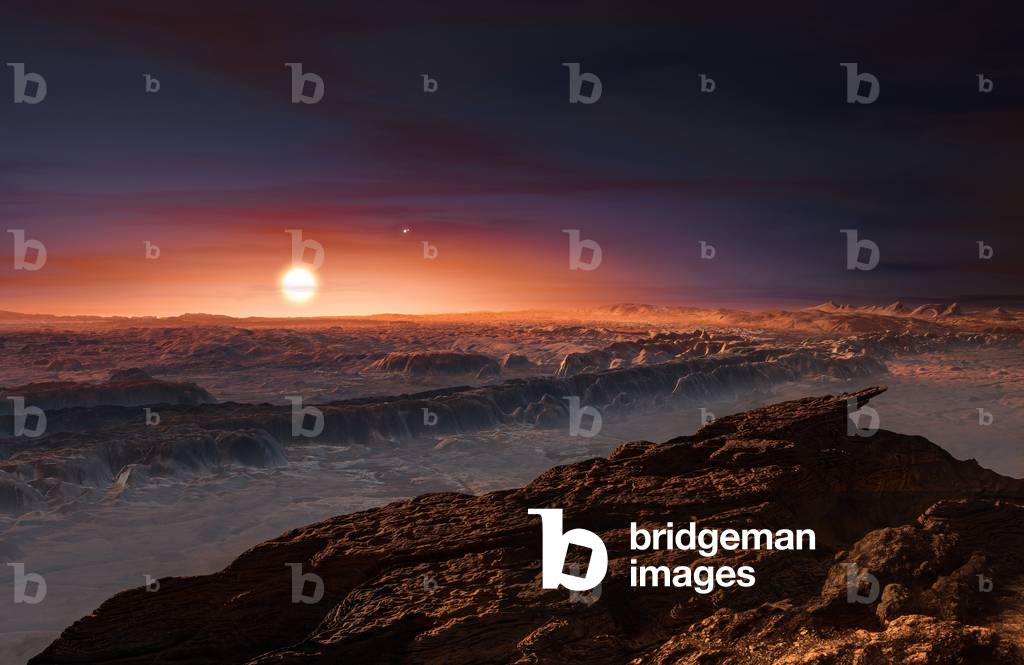
August 24, 2016: Artist's view of Planet Proxima b orbiting the red dwarf star Proxima of Centaur, the closest star to the solar system. The double star Alpha Centauri AB is visible between the planet and the star Proxima. Proxima b is a little more massive than Earth, orbit in habitable area or temperature would allow the presence of liquid water on its surface - This artist's impression shows the planet Proxima b orbiting the red dwarf star Proxima Centauri, the closest star to the Solar System. The double star Alpha Centauri AB also appears in the image between the planet and Proxima itself. Proxima b is a little more massive than the Earth and orbits in the habitable zone around Proxima Centauri, where the temperature is suitable for liquid water to exist on its surface
August 24, 2016: Artist's view of the surface of Planet Proxima b orbiting the red dwarf star Proxima of Centaur, the closest star to the solar system. The double star Alpha Centauri AB is visible at the top right of the star Proxima. Proxima b is a little more massive than the Earth, orbit in habitable area where the temperature would allow the presence of liquid water on its surface - This artist's impression shows a view of the surface of the planet Proxima b orbiting the red dwarf star Proxima Centauri, the closest star to the Solar System. The double star Alpha Centauri AB also appears in the image to the upper-right of Proxima itself. Proxima b is a little more massive than the Earth and orbits in the habitable zone around Proxima Centauri, where the temperature is suitable for liquid water to exist on its surface
Exploration of the exoplanet 2M1207B - Artist view - Exoplanet 2M1207B - Artist rendering: A probe studies the atmosphere of the extrasolar planet 2M1207B. 2M1207B is 5 times more massive than Jupiter and is located about 200 light years away in the constellation of Hydra. It is orbiting a brown dwarf star, visible in the sky. Artwork of the extrasolar planet 2M1207B atmosphere studied by a spaceprobe. This exoplanet is five times the Jupiter mass and is located at about 200 light years in the constellation of Hydra. It orbits around a brown dwarf
Different types of brown dwarves - Artist's view - Different types of brown dwarves. Artwork - From left to right: brown dwarf type M, the youngest and most massive, temperature between 200 and 3000 degres Kelvin; brown dwarf type L, between 1500 and 2000 degres Kelvin; brown dwarf type T, between 1200 and 1500 degres Kelvin; brown dwarf type T but colder, from 1200 to 600 degres Kelvin; brown dwarf type still indefinite, less than 600 degres Kelvin; finally, on the right, Jupiter for size comparison. From left to right: a brown dwarf of type M (the youngest and most massive brown dwarves), a brown dwarf of type L, then a type T, another type T but colder, then another brown dwarf with a type unidentified yet which is colder, at last Jupiter for comparison
Exoplanete Ross 128 b: Ross 128 b is an extrasolar planet probably of an Earth type, located only 11 light years from Earth in the constellation of the Virgin. Planet Ross 128 b, with its red dwarf parent star in the background. This planet, which lies only 11 light-years from Earth, was found by a team using Eso's unique planet-hunting HARPS instrument. The new world is now the second-closest temperate planet to be detected after Proxima b. It is also the closest planet to be discovered orbiting an inactive red dwarf star, which may increase the likelihood that this planet could potentially sustain life. Ross 128 b will be a prime target for Eso's Extremely Large Telescope, which will be able to search for biomarkers in the planet's atmosphere
U Geminorum in the sky of an exoplanet - U Geminorum seen from an exoplanet. Artwork - U Geminorum is a dwarf nova, a variable star composed of a white dwarf orbiting around a red dwarf. This binary greenhouse system is represented here in the sky of an extrasolar planet. Artwork showing U Geminorum in the sky of an exoplanet. U Geminorum, in the constellation Gemini, is an archetypal example of a dwarf nova. The binary star system consists of a white dwarf closely orbiting a red dwarf
Pluto seen by the New Horizons probe - Pluto seen by New Horizons - Pluto seen by the New Horizons probe. Composite image created from four images obtained on 13 July 2015 at a distance of 450,000 km from the dwarf planet. Four images from New Horizons' Long Range Recognition Imager (LORRI) were combined with color data from the Ralph instrument to create this global view of Pluto. (The lower right edge of Pluto in this view currently lacks high - resolution color coverage.) The images, taken when the spacecraft was 280,000 miles (450,000 kilometers) away, show features as small as 1.4 miles (2.2 kilometers), twice the resolution of the single - image view taken on July 13
Exoplanete Gliese 581d - Illustration - Artist's view of the star Gliese 581 in the sky of the extrasolar planet Gliese 581 d. Discovered in 20074, this exoplanet in the constellation Libra is considered to be potentially habitable. The atmosphere is dense and its thick cloud layer would plunge the surface into a reddish shade. Artist's impression of the star red dwarf Gliese 581 shining in the sky of the extrasolar planet Gliese 581 d. This exoplanet located in the habitable zone of its star could harbor extraterrestrial life
Pluto seen by the New Horizons probe - Pluto seen by New Horizons - Pluto's atmosphere seen by the New Horizons probe. Image obtained on July 14, 2015 at a distance of 200,000 km from the dwarf planet. Mosaic of six images. This is the high-resolution color departure shot of Pluto's receding crescent from Nasa's New Horizons spacecraft, taken when the spacecraft was 120,000 miles (200,000 kilometers) away from Pluto. Shown in approximate true color, the picture was constructed from a mosaic of six black-and-white images from the Long Range Reconnaissance Imager (LORRI), with color added from a lower resolution Ralph/Multispectral Visible Imaging Camera (MVIC) color image, all acquired between 15:20 and 15:45 UT - about 3.5 hours after closest approach to Pluto - on July 14, 2015. The resolution of the LORRI images is about 0.6 miles (1 kilometer) per pixel; the sun illuminates the scene from the other side of Pluto and somewhat towards the top of this image. The image is dominated by spectacular layers of blue haze in Pluto's atmosphere. Scientists believe the haze is a photochemical smog resulting from the action of sunlight on methane and other molecules in Pluto's atmosphere, producing a complex mixture of hydrocarbons such as acetylene and ethylene. These hydrocarbons accumulate into small haze particles, a fraction of a micrometer in size, which preferentially scatter blue sunlight - the same process that can make haze appear bluish on Earth. As they settle down through the atmosphere, the haze particles form numerous intricate, horizontal layers, some extending for hundreds of miles around large portions of the limb of Pluto. The haze layers extend to altitudes of over 120 miles (200 kilometers). Pluto's circumference is 4,667 miles (7,466 kilometers). Adding to the beauty of this picture are mountains and other topographic features on Pluto's surface that are silhouetted against the haze near the top of the image. Sunlight casts dramatic and beautiful
Brown dwarf star Teide 1 - Brown dwarf Teide 1 - Artist view of the brown dwarf star Teide 1. Discovered in 1995 in the Pleiades cluster, about 55 times the mass of Jupiter, this brown dwarf is represented here in the sky of a young exoplanet lit by the star. This is how Teide 1 might appear from the surface of a hypothetical, March - like planet. Discovered in 1995, Teide 1 is a type of mysterious object called a brown dwarf (failed star or super planet). Bigger than a planet, but smaller than a star, this brown dwarf is about 400 light years from the Earth in the Pleiades star cluster. It is thought that Teide 1 has the mass equivalent of about 55 Jupiters, which is considered large for a brown dwarf. Teide 1 is massive enough, and hence hot enough, to sustain lithium fusion in its core, but is unable to initiate hydrogen fusion like our sun. Teide 1 is probably only about 120 million years old (compared to our sun's age of 4.5 billion years) and shines at a temperature of 4,000o F, less than half as hot as the surface of our sun. In this image a young planet orbits Teide 1 from distance of about four million miles. The planet has acquired enough atmosphere to host clouds and put a lower limit on size of meteors that reach its surface (the smaller ones burn up before reaching the ground), but it is still very early in its evolution. Teide 1 looms large in this planet's sky, but in fact Teide 1's diameter is only about twice that of Jupiter's. All brown dwarfs are roughly the size of Jupiter - - the more massive brown dwarfs are simply more dense. As for this planet, it is very unlikely that life will ever evolve here due to its host's relatively short life span; in just another billion years Teide 1 will have cooled to a modest 1,700o F
The Dawn probe orbiting around Ceres - Artist's view - Dawn in orbit around Ceres - Artist's view of the Dawn probe orbiting around the dwarf planet Ceres. In march 2015 the unmanned Dawn spacecraft is scheduled to arrive at the dwarf planet Ceres. The 65 foot long, 2.5 ton probe was launched from the Earth in 2007, passed March in 2009, and went into orbit around the protoplanet Vesta in July 2011 where it stayed until September 2012. Once in orbit around Ceres, Dawn is expected to operate for about a year making observations of this largest object in the asteroid belt. In this image Dawn is entering orbit around Ceres. In late November 2015 Dawn will descend to its closest orbit around Ceres at a distance of about 230 miles. While no close - up observations of yet been made of Ceres itself, here it is rendered as appearing similar to a much smaller version of the Earth's Moon, heavily cratered with the addition of surface water ice and hypothesized plumes of ice crystals from water geysers on its surface
New Horizons closest approach to Pluto - Artist's view of the New Horizons probe near Pluto and its largest satellite Charon. The New Horizons probe was launched on 19 January 2006 to Jupiter, then Pluto and Charon, which it will reach in 2015 and Kuiper's objects in 2020. Nasa's New Horizons unmanned spacecraft flies into the shadow of dwarf planet Pluto and its moon Charon. New Horizons has been en route to Pluto since its launch from Earth in 2006 and is scheduled to make its closest approach on 14 July 2015. New Horizons will be traveling at a velocity relative to Pluto of 30,800 mph, far too fast for it to enter orbit around and become a satellite of Pluto. Instead after passing Pluto, New Horizons will continue farther into the Kuiper belt searching for other objects with diameters of 30 to 60 miles. New Horizons is about the size and shape of a grand piano and weighed 1,054 pounds at launch. The high - gain dish antenna is about 7 feet in diameter and is employed for communication with the Earth. In this image the New Horizons spacecraft is about 6,000 miles from Pluto (left), 17,000 miles from its largest moon Charon (far left) and 2.97 billion miles from the Earth While little is known about Pluto's appearance, here this Kuiper belt dwarf planet is realized as a frozen world covered with various ices, hosting a thin atmosphere of nitrogen, methane and other hydrocarbons too possibly, with a significantly weathered surface as Pluto's 248 - year orbit alternately brings it closer then further from the warmth of the sun
Dwarf planets - Dwarf planets Ceres, Pluto, and Eris compared - Comparison at the scale of dwarf planets. From left to right are represented Ceres, Pluto and Eris. Ceres was elevated from asteroid to the status of dwarf planet in 2006 when the International Astronomical Union (IAU) reviewed Pluto's status as the solar system's 9th planet. Pluto was subsequently demoted to dwarf planet. In this image, from left to right are the dwarf planets Ceres, Pluto, and Eris. Eris was discovered in 2003 and is now the largest of the known dwarf planets. It is believed to be slightly more massive than Pluto and follows a highly eccentric orbit that alternately brings it as close as the orbits of Neptune and Pluto and as far as over twice Pluto's furthest distance from the Sun. It was the discovery of Eris that prompted the re-evaluation of Pluto as a planet
Artist's view of the New Horizons probe near Pluto - The New Horizons spacecraft near Pluto - Artist's view of the New Horizons probe near Pluto and its largest satellite Charon. The New Horizons probe was launched on 19 January 2006 to Jupiter, then Pluto and Charon, which it will reach in 2015 and Kuiper's objects in 2020. Artist's concept of the New Horizons spacecraft as it approaches Pluto and its largest moon, Charon, in July 2015. The craft's miniature cameras, radio science experiment, ultraviolet and infrared spectrometers and space plasma experiments will characterize the global geology and geomorphology of Pluto and Charon, map their surface compositions and temperatures, and examine Pluto's atmosphere in detail. The spacecraft's most prominent design feature is a nearly 7 - foot (2.1 - meter) dish antenna, through which it will communicate with Earth from as far as 4.7 billion miles (7.5 billion kilometers) away
Dawn and Vesta and Ceres - Artist's concept of the Dawn spacecraft with Vesta and Ceres - Artist's view of the Dawn probe near the Vesta asteroid and the dwarf planet Ceres Artist's concept of the Dawn spacecraft with Vesta and Ceres. Dawn, part of Nasa's Discovery Program of competitively selected missions, was launched in 2007 to orbit the large asteroid Vesta and the dwarf planet Ceres. The two bodies have very different properties from each other. By observing them both with the same set of instruments, Dawn will probe the early solar system and specify the properties of each body
Artist's view of the New Horizons probe near Pluto - The New Horizons spacecraft near Pluto - Artist's view of the New Horizons probe near Pluto and its largest satellite Charon. The New Horizons probe was launched on 19 January 2006 to Jupiter, then Pluto and Charon, which it reached in 2015 and Kuiper's objects in 2020. Artist's concept of the New Horizons spacecraft as it approaches Pluto and its largest moon, Charon, in July 2015. The craft's miniature cameras, radio science experiment, ultraviolet and infrared spectrometers and space plasma experiments will characterize the global geology and geomorphology of Pluto and Charon, map their surface compositions and temperatures, and examine Pluto's atmosphere in detail. The spacecraft's most prominent design feature is a nearly 7 - foot (2.1 - meter) dish antenna, through which it will communicate with Earth from as far as 4.7 billion miles (7.5 billion kilometers) away
The dwarf planet Hauméa - Illustration
特殊说明
  • No additional copyright fee required
New Horizons near Pluto and Charon - Artist's view of the New Horizons probe near Pluto and its largest satellite Charon. The New Horizons probe was launched on 19 January 2006 to Jupiter, then Pluto and Charon, which it will reach in 2015 and Kuiper's objects in 2020. Nasa's New Horizons unmanned spacecraft flies by dwarf planet Pluto and its moon Charon. New Horizons has been en route to Pluto since its launch from Earth in 2006 and is scheduled to make its closest approach on 14 July 2015. New Horizons is about the size and shape of a grand piano and weighed 1,054 pounds at launch. The high - gain dish antenna is about 7 feet in diameter and is employed for communication with the Earth. In this image the New Horizons spacecraft is about 11,000 miles from Pluto (lower left), 23,000 miles from its largest moon Charon (upper right) and 2.97 billion miles from the Earth. While little is known about Pluto's appearance, here this Kuiper belt dwarf planet is realized as a frozen world covered with various ices, hosting a thin atmosphere of nitrogen, methane and other hydrocarbons too possibly, with a significantly weathered surface as Pluto's 248 - year orbit alternately brings it closer then further from the warmth of the sun
Comparison between the sizes of Earth, Pluto, Charon and the Moon
Earth-type exoplanete around Centauri Proxima - Artist's impression of the planet orbiting Proxima Centauri: Artist's view of the surface of the planet Proxima b orbiting around the red dwarf star Proxima of Centauri, the closest star to the solar system. Proxima b is slightly more massive than the Earth, orbit in habitable areas where the temperature would allow the presence of liquid water on its surface. This artist's impression shows a view of the surface of the planet Proxima b orbiting the red dwarf star Proxima Centauri, the closest star to the Solar System. Proxima b is a little more massive than the Earth and orbits in the habitable zone around Proxima Centauri, where the temperature is suitable for liquid water to exist on its surface
Artist's view of the New Horizons probe near Pluto - The New Horizons spacecraft near Pluto - Artist's view of the New Horizons probe near Pluto and its largest satellite Charon. The New Horizons probe was launched on 19 January 2006 to Jupiter, then Pluto and Charon, which it reached in 2015 and Kuiper's objects in 2020. Artist's concept of the New Horizons spacecraft as it approaches Pluto and its largest moon, Charon, in July 2015. The craft's miniature cameras, radio science experiment, ultraviolet and infrared spectrometers and space plasma experiments will characterize the global geology and geomorphology of Pluto and Charon, map their surface compositions and temperatures, and examine Pluto's atmosphere in detail. The spacecraft's most prominent design feature is a nearly 7 - foot (2.1 - meter) dish antenna, through which it will communicate with Earth from as far as 4.7 billion miles (7.5 billion kilometers) away
Artist's view of the New Horizons probe near Pluto - New Horizons over Pluto and Charon - Artist's view of the New Horizons probe near Pluto and its largest satellite Charon. The New Horizons probe was launched on 19 January 2006 to Jupiter, then Pluto and Charon, which it will reach in 2015 and Kuiper's objects in 2020. Nasa's New Horizons unmanned spacecraft approaches dwarf planet Pluto and its moon Charon. New Horizons has been en route to Pluto since its launch from Earth in 2006 and is scheduled to make its closest approach on 14 July 2015. New Horizons is about the size and shape of a grand piano and weighed 1,054 pounds at launch. The high - gain dish antenna is about 7 feet in diameter and is employed for communication with the Earth. In this image the New Horizons spacecraft is about 15,000 miles from Pluto (upper right), 27,000 miles from its largest moon Charon (lower left) and 2.97 billion miles from the Earth. This side of the spacecraft on the left can be seen the Visible/Near Infrared Multi - Spectral Imager and the Short Wavelength Infrared Spectral Imager (aka “” Ralph”), and the Ultraviolet Imaging Spectrograph (aka “” Alice””). On the right extending about four feet from the main body of the spacecraft is the radioisotope thermoelectric generator (RTG) which provides constant electric power for the 10 year mission from heat produced by 24 pounds of plutonium - 238. While little is known about Pluto's appearance, here this Kuiper belt dwarf planet is realized as a frozen world covered with various ices, hosting a thin atmosphere of nitrogen, methane and other hydrocarbons too possibly, with a significantly weathered surface as Pluto's 248 - year orbit alternately brings it closer then further from the warmth of the sun
Earth-type exoplanete around Centauri Proxima - Artist's impression of the planet orbiting Proxima Centauri: Artist's view of the surface of the planet Proxima b orbiting around the red dwarf star Proxima of Centauri, the closest star to the solar system. Proxima b is slightly more massive than the Earth, orbit in habitable areas where the temperature would allow the presence of liquid water on its surface. This artist's impression shows a view of the surface of the planet Proxima b orbiting the red dwarf star Proxima Centauri, the closest star to the Solar System. Proxima b is a little more massive than the Earth and orbits in the habitable zone around Proxima Centauri, where the temperature is suitable for liquid water to exist on its surface
Pluto seen by the New Horizons probe: Pluto seen in false colors by the New Horizons probe. Composite image created from images obtained on July 14, 2015 - Nasa's New Horizons spacecraft captured this high-resolution enhanced color view of Pluto on July 14, 2015. The image combines blue, red and infrared images taken by the Ralph/Multispectral Visual Imaging Camera (MVIC). Pluto's surface sports a remarkable range of subtle colors, enhanced in this view to a rainbow of pale blues, yellows, oranges, and deep reds. Many landforms have their own distinct colors, telling a complex geological and climatological story that scientists have only just begun to decode. The image resolves details and colors on scales as small as 0.8 miles (1.3 kilometers).
Artist's view of the New Horizons probe near Pluto - The New Horizons spacecraft near Pluto - Artist's view of the New Horizons probe near Pluto and its largest satellite Charon. The New Horizons probe was launched on 19 January 2006 to Jupiter, then Pluto and Charon, which it will reach in 2015 and Kuiper's objects in 2020. Artist's concept of the New Horizons spacecraft as it approaches Pluto and its largest moon, Charon, in July 2015. The craft's miniature cameras, radio science experiment, ultraviolet and infrared spectrometers and space plasma experiments will characterize the global geology and geomorphology of Pluto and Charon, map their surface compositions and temperatures, and examine Pluto's atmosphere in detail. The spacecraft's most prominent design feature is a nearly 7 - foot (2.1 - meter) dish antenna, through which it will communicate with Earth from as far as 4.7 billion miles (7.5 billion kilometers) away
The dwarf planet Eris - Illustration - Dwarf planet Eris - Artwork - Artist's view of the dwarf planet Eris and its satellite Dysnomia. Eris is about three times more distant from the Sun than Pluto. The dwarf planet, formerly known as 2003 UB313 (or Xena), is now called Eris, after the Greek goddess of discord and strife. This artist's concept shows the planet catalogued as 2003 UB313 with its moon Dysnomia. Our Sun can be seen in the distance. The new planet, which is yet to be formally named, is at least as big as Pluto and about three times farther away from the Sun than Pluto. It is very cold and dark. The planet was discovered by the Samuel Oschin Telescope at the Palomar Observatory near San Diego, Calif., on Jan. 8, 2005
Gl 581c: discovery of a habitable planet - Gl 581c: discovery of an habitable planet - Artist's view of the exoplanet Gliese 581c. Gliese 581c, with a radius of 1.5 times that of the Earth, is the first exoplanet gathering the necessary elements to imagine the existence of a possible extra-terrestrial life. From its surface, its star, about 100 times less bright than our Sun, must be large in the sky because of its proximity to the planet. In April 2007 the Geneva Observatory in Switzerland announced the discovery of a “super - earth”” extrasolar planet orbiting the red dwarf star Gliese 581. Dubbed Gliese 581 c, it's been called a super - earth because it is one of the few known extrasolar planets that has a mass near Earth's, and the only one to occupy its sun's “” habitable zone.”” Gliese 581 c is believed to be about five times more massive than the Earth with a diameter about half - again as large as Earth's. Depending upon the planet's composition, whether mostly rock or a combination of rock a water, a visitor would experience a surface gravity between 1.25 to 2.2 times the Earth's. Gliese 581 c is about 20 light years away, a “” next door neighbor”” in stellar terms, but far beyond the reach of human visitors with today's technology. There is special interest in Gliese 581 c because it is the only known extrasolar planet where liquid water - - a necessary ingredient for life as we know it - - could exist. Surface temperatures are believed to range between the freezing point of water to about 100* F. However, there are other factors that could affect these values, including the possibility that Gliese 581 c always keeps the same side facing its host star, with the result that one side would become extremely hot while the other extremely cold. In this image from the surface of Gliese 581 c, its red dwarf host hangs low in the sky over a rocky and watery terrain. This sun has a diameter and radius about a third that of the earth
Brown dwarf with asteroid ring - Artist's view of a brown dwarf star surrounded by an asteroid belt. In the foreground, a primitive exoplanet illuminated by the star. This brown dwarf is host to a disk composed primarily of asteroids and boulders. The light from this dwarf is barely enough to illuminate the surface of this primitive planet. At a distance of about 1.5 million miles, the orbit of this planet is aligned to the plane of the rings with the result that they appear as a fuzzy line occulting the glowing face of this brown dwarf
Artist view of the planetary system around Gliese 581 - Planetary system around the red dwarf Gliese 581 - Artist view of the planetary system around the star Gliese 581. In the foreground, the exoplanet Gliese 581st. In the background, Gliese 581d (blueberry), in the center Gliese 581c and near the star, Gliese 581b. Gliese 581e (foreground) is only about twice the mass of our Earth. The Gliese 581 planetary system now has four known planets, with masses of about 1.9 (planet e, left in the foreground), 16 (planet b, nearest to the star), 5 (planet c, centre), and 7 Earth - masses (planet d, with the bluish colour). The planet furthest out, Gliese 581d, orbits its host star in 66.8 days, while Gliese 581 e completes its orbit in 3.15 days
Brown dwarf with a large debris ring - Artist's view of a brown dwarf star surrounded by a disc of dust and rocks. In the foreground, a primitive exoplanet illuminated by the star. This imaginary high - mass brown dwarf has a larger disk than the previous renderings. The perspective is from the equator of an airless planet, orbiting the brown dwarf at a distance of about 4 million miles. This planet's orbit is very nearly aligned to the plane of the rings, hence the debris appears as a sword - like straight line
Pluto seen by the New Horizons probe - Pluto seen by New Horizons - Pluto seen by the New Horizons probe on July 7, 2015 at a distance of 8 million km from the dwarf planet. In the early morning hours of July 8, 2015, mission scientists received this new view of Pluto - - the most detailed yet returned by the Long Range Reconnaissance Imager (LORRI) aboard New Horizons. The image was taken on July 7, when the NASA spacecraft was just under 5 million miles (8 million kilometers) from Pluto, and is the first to be received since the July 4 anomaly that sent the spacecraft into safe mode. This view is centered roughly on the area that will be seen close - up during New Horizons' July 14 closest approach. This side of Pluto is dominated by three broad regions of varying brightness. Most prominent are an elongated dark feature at the equator, informally known as “” the whale,”” and a large heart - shaped bright area measuring some 1,200 miles (2,000 kilometers) across on the right. Above those features is a polar region that is intermediate in brightness
Life forms on the surface of Gliese 581 c - Flying fauna over Gliese 581 c - Artist's view of the exoplanet Gliese 581c housing an alien life form. Gliese 581c, with a radius of 1.5 times that of the Earth, is the first exoplanet gathering the necessary elements to imagine the existence of a possible extra-terrestrial life. From its surface, its star, about 100 times less bright than our Sun, must be large in the sky because of its proximity to the planet. Gliese 581 b, another planet in this system, passes past this star. Flying life forms grace the crimson skies of the potentially earth - like extrasolar planet Gliese 581 v. The red dwarf star Gliese 581 rests on the horizon, presiding over a liquid water sea. Eclipsing the red dwarf is Gliese 581 b, a sister planet in the same system with a mass 17 times that of the Earth. While the existence of all three bodies has been confirmed, it is not known if Gliese 581 c has all the necessary ingredients to support life as we know it
Surface of Pluto - Artist view - Pluto surface- Artist view: The icy surface of Pluto. Icy surface of Pluto. Lake of liquid neon
Pluto surface - Artist view - Pluto surface- Artist view: From liquid neon could circulate to the surface of Pluto - Pools of liquid neon on Pluto
Brown dwarf & debris ring from an oblique perspective - Artist's view of a brown dwarf star about 60 times the mass of Jupiter, surrounded by a disc of dust and rocks. In the foreground, a primitive exoplanet enlighted by the star. A small, barren planet orbits obliquely to the plane of a massive set of concentric dust rings surrounding a brown dwarf of about 60 Jupiter masses. These rings are evocative of Saturn's famous rings of rock and ice, however there is likely no ice in the rings around this dwarf. Recent observations have revealed that some brown dwarfs may be surrounded by rings of dust. While the origin of these rings, and the brown dwarfs themselves, is unclear, it's thought that material from these rings may even coalesce into planets, providing some brown dwarfs with their own solar systems
Cryovolcan sur Pluto - Artist view - Ice Volcano on Pluto - Artist view: Ice volcano on Pluto
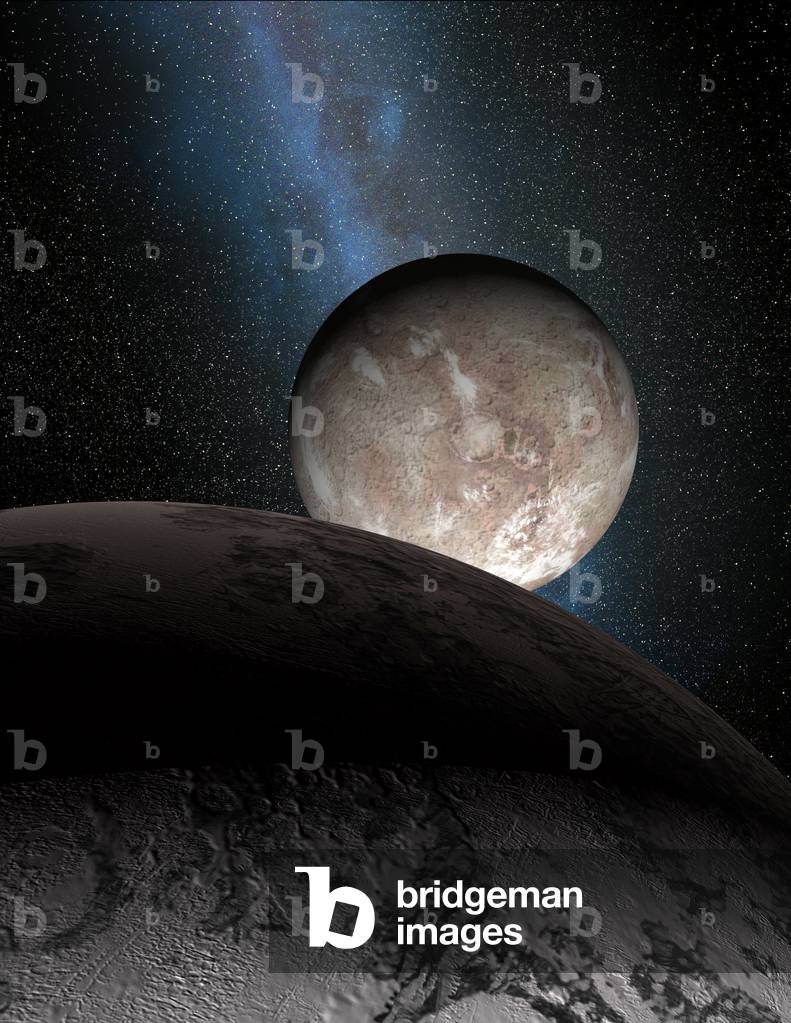
Pluto and Charon - View d'artiste - Pluto seen from above Charon - Artist view: Pluto seen above his satellite Charon
Pluto and Charon - Artist view: Pluto, in the foreground, and its satellite Charon - Foreground is Pluto
Artist's View of Ceres Degazages - Outgassing on Ceres: Artist's View of the Dwarf Planet Ceres with Panaches of Water Vapour
Pluto view from Charon - View of artist - Pluto seen from Charon - Artist view - Pluto view in the sky of his satellite Charon. Pluto seen from its moon Charon
Pluto - Hubble's Full Photomap of Pluto - The dwarf planet Pluto seen by the Hubble space telescope. These images, recomposed by computer from cliches obtained in 2002 and 2003, are not sufficiently precise to show Pluto's surface in detail but reveal color differences. This is the most detailed view to date of the entire surface of the dwarf planet Pluto, as constructed from multiple NASA Hubble Space Telescope photographs taken from 2002 to 2003. Hubble's view isn't sharp enough to see craters or mountains, if they exist on the surface, but Hubble reveals a complex - looking and variegated world with white, dark - orange, and charcoal - black terrain. The overall color is believed to be a result of ultraviolet radiation from the distant Sun breaking up methane that is present on Pluto's surface, leaving behind a dark, molasse - colored, carbon - rich residue. The center disk (180 degrees) has a mysterious bright spot that is unusually rich in carbon monoxide frost. This region will be photographed in the highest possible detail when Nasa's New Horizons probe flies by Pluto in 2015. The Hubble images are a few pixels wide. But through a technique called dithering, multiple, slightly offset pictures can be combined through computer - image processing to synthesize a higher - resolution view than could be seen in a single exposure. This series of pictures took four years and 20 computers operating continuously and simultaneously to accomplish
Geysers sur Pluto - Artist view - Hot springs and Geysers on Pluto - Artist view
特殊说明
  • No additional copyright fee required
Pluto - Pluto - The dwarf planet Pluto seen by the Hubble space telescope. These images, recomposed by computer from cliches obtained in 2002 and 2003, are not sufficiently precise to show Pluto's surface in detail but reveal color differences. This is the most detailed view to date of the entire surface of the dwarf planet Pluto, as constructed from multiple NASA Hubble Space Telescope photographs taken from 2002 to 2003. Hubble's view isn't sharp enough to see craters or mountains, if they exist on the surface, but Hubble reveals a complex - looking and variegated world with white, dark - orange, and charcoal - black terrain. The overall color is believed to be a result of ultraviolet radiation from the distant Sun breaking up methane that is present on Pluto's surface, leaving behind a dark, molasse - colored, carbon - rich residue. The center disk (180 degrees) has a mysterious bright spot that is unusually rich in carbon monoxide frost. This region will be photographed in the highest possible detail when Nasa's New Horizons probe flies by Pluto in 2015. The Hubble images are a few pixels wide. But through a technique called dithering, multiple, slightly offset pictures can be combined through computer - image processing to synthesize a higher - resolution view than could be seen in a single exposure. This series of pictures took four years and 20 computers operating continuously and simultaneously to accomplish
Pluto seen by the probe New Horizons - Pluto seen by New Horizons: View of the Norgay Montes and Hillary Montes mountains, young 3500 metres high; on the right, east of the Sputnik Plannum plain. Image taken by the New Horizons probe on July 14, 2015 at a distance of 18,000 km from the dwarf planet. Just 15 minutes after its closest approach to Pluto on July 14, 2015, Nasa's New Horizons spacecraft looked back towards the sun and captured this near-sunset view of the rugged, icy mountains and flat ice plains extending to Pluto's horizon. The smooth expanse of the informally named icy plain Sputnik Planum (right) is flanked to the west (left) by rugged mountains up to 11,000 feet (3,500 meters) high, including the informally named Norgay Montes in the foreground and Hillary Montes on the skyline. To the right, east of Sputnik, rougher terrain is cut by apparent glaciers. The backlighting highlights more than a dozen layers of haze in Pluto's tenuous but distended atmosphere. The image was taken from a distance of 11,000 miles (18,000 kilometers) to Pluto; the scene is 780 miles (1,250 kilometers) wide
Surface de Ceres - Ceres ice field: Ice surface of the dwarf planet Ceres. Artist view
Surface of Pluto - Artist view - Pluto surface- Artist view: In the sky of Pluto, the Sun and the satellite Charon